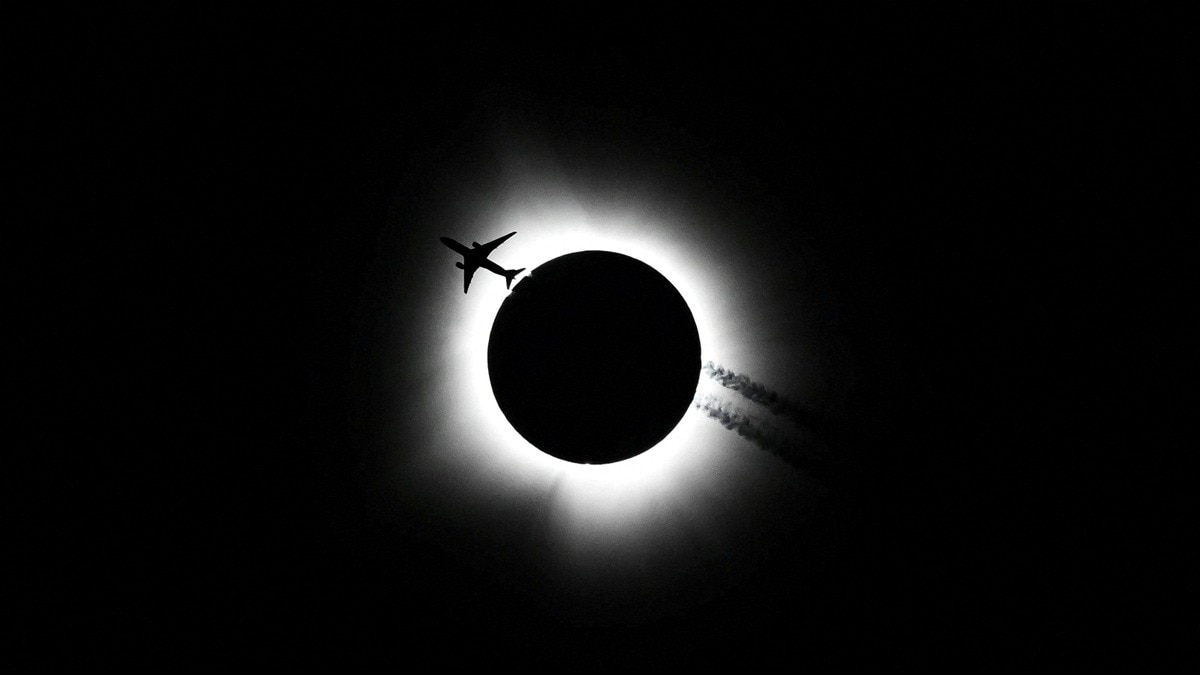
Europe is preparing for a total solar eclipse on August 12, 2026, its first mainland totality since 1999. The event will briefly darken parts of the continent and draw large crowds, especially in Spain.An airplane passes near the total solar eclipse during the Hoosier Cosmic Celebration at Memorial Stadium in Bloomington, Indiana, US. (Photo: Reuters)Millions of skywatchers across Europe are preparing for a rare celestial spectacle on August 12, when the continent will witness its first total solar eclipse over mainland Europe since 1999.A total solar eclipse occurs when the Moon passes directly between Earth and the Sun, completely covering the solar disk.During totality, daylight briefly turns into twilight, bright stars become visible, temperatures can drop, and the Sun's faint outer atmosphere, known as the corona, becomes visible to the naked eye. WILL EUROPE GO DARK DURING DAYTIME?Yes, the eclipse will briefly plunge parts of Europe into darkness as the Moon completely blocks the Sun, creating one of astronomy's most dramatic events.The total solar eclipse marks the first time in nearly three decades that mainland Europe will experience totality. The last such event occurred on August 11, 1999, when the Moon's shadow crossed France, Germany, Austria, Hungary, Romania and Bulgaria after clipping the southwest tip of the United Kingdom.Since then, totality in Europe has been limited to remote regions, including parts of Russia and Georgia in 2006, and the Faroe Islands and Norway's Svalbard archipelago in 2015, leaving much of mainland Europe waiting for another opportunity. The eclipse will briefly plunge parts of Europe into darkness. (Photo: Reuters) WHERE WILL THE TOTAL SOLAR ECLIPSE BEGIN?According to eclipse predictions, the path of totality on August 12, 2026, will begin in the far north of Russia before crossing Greenland and skimming the western edge of Iceland.The Moon's shadow will then sweep across northern and eastern Spain, where millions are expected to gather for the event.A small portion of northeastern Portugal will also experience totality, making it the fifth country touched by the eclipse path, albeit over only a few square kilometres.For observers in India, the eclipse will occur during the afternoon and evening. It is expected to begin around 2:30 pm IST, reach maximum eclipse at approximately 5:15 pm IST, and conclude close to 8:00 pm IST.However, the eclipse will not be visible from India because the event will occur after sunset for most parts of the country.Astronomers say the eclipse is expected to draw thousands of tourists, photographers and researchers to Spain, making it one of the largest astronomical gatherings in Europe in recent decades.The next total solar eclipse visible from mainland Europe will not occur until several years later, making the August 12 event a once-in-a-generation spectacle for many observers.- EndsPublished By: Sibu Kumar TripathiPublished On: Aug 3, 2026 12:18 IST
Europe to go dark in broad daylight: First total solar eclipse totality since 1999
Full Article
Original Source
Read the full article at Indiatoday →KhanList aggregates and links to publicly available news content. We do not host full articles from third-party sources. Always verify important information with original sources.