
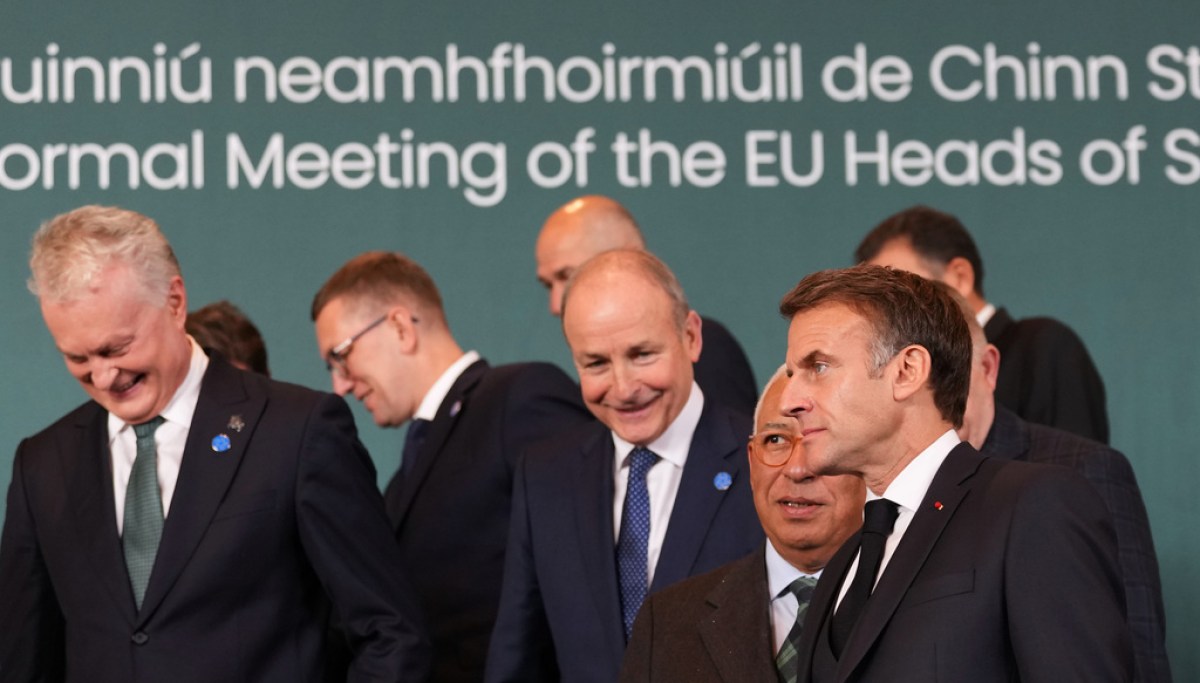
European leaders are in a squabble over who will represent them in peace talks to end the Russian invasion of Ukraine, even though the Kremlin has not yet affirmed that it will allow them to sit in on the negotiations.Presidential envoys Steve Witkoff and Jared Kushner met with Ukrainian President Volodymyr Zelensky on Friday in Dublin, just a day after meeting with Russian President Vladimir Putin in Moscow. The two envoys now claim that “both sides” are open to the Europeans having a seat at future peace talks, but no one is quite sure who will represent the continent.“If Europe could identify one person to speak on their behalf, that would be a bigger achievement than getting the Russians to include them in the negotiation,” Kushner said Thursday. From left, Lithuanian President Gitanas Nauseda, Estonian Prime Minister Kristen Michal, Irish Prime Minister Micheál Martin, European Council President Antonio Costa and French President Emmanuel Macron step off the podium after a group photo during the EU summit on Friday, Nov. 13, 2026, in Dublin. (AP Photo/Virginia Mayo) Diplomats from the European Commission, the European Council, France, Germany, Italy, NATO, and the United Kingdom attended talks in Abu Dhabi, United Arab Emirates, this week. They met with the Americans and Ukrainians on the sidelines but were told by the Russians to “sit there in the hotel” during the main talks.With the potential for direct participation, the question of who will represent the continent becomes more pressing — and divisive.High Representative Kaja Kallas, the foreign policy chief of the European Union, has portrayed herself as the logical option to represent the alliance’s interests. But she admitted Friday that the Russians “don’t want” her due to her “strong” positions.“They don’t want anybody strong on the other side because they want to push through their maximum demands,” she complained.European Council President António Costa is also empowered by EU protocols to represent the alliance, leading to many member states backing him as a special representative.Meanwhile, leaders such as German Chancellor Friedrich Merz are pushing for a coalition of regional powers to represent the continent instead of a special envoy.“These talks will likely involve the group of European nations that were present in Abu Dhabi this week,” the German leader said Friday in Dublin. “Germany will certainly be part of this; that is absolutely clear.”The unanswered question of representation has been frustrating national leaders for weeks. Italian Prime Minister Giorgia Meloni filed a letter to Costa on Nov. 5 lambasting the continent’s disorganization on the Russia-Ukraine conflict.“I’m convinced that we all realize how, by projecting the image of a Europe that’s all over the place, we’re doing nothing but serving the interests of those who want this war to continue,” Meloni wrote. “And I think this is unacceptable, given that human lives and the future of our security are at stake.“Proceeding in a disorganized manner, with initiatives that chase one another and overlap, will not help us — neither with our partners nor with those we must convince to stop this senseless aggression.”Russia has seized the lack of clear diplomatic leadership as an excuse to continue excluding Europe.U.S. special envoy Steve Witkoff, right; Jared Kushner, U.S. President Donald Trump’s son-in-law, left; and Ukrainian President Volodymyr Zelensky, center, speak to the media on Thursday, Nov. 12, 2026, at the airport in Dublin. (AP Photo/Peter Morrison) “Putin has never refused to engage with the Europeans,” Kremlin spokesman Dmitry Peskov said on Friday. “If the Europeans truly have someone who is authorized to hold discussions … then, of course, we would be prepared to talk with them.“Once we understand their actual intentions and their willingness to contribute to the peace process, we can then make a decision regarding a dialogue in an expanded format.”The spokesman’s comments mask a crucial point of division, however. The Kremlin has opposed European participation on the grounds that the European Union is seeking to place peacekeeping troops in Ukraine if a ceasefire is established.Putin has said such a development would be unacceptable and warned that placing soldiers in Ukrainian territory would make them legitimate targets for Russian forces.“What do we hear from [Europeans]?” Putin told Witkoff and Kushner in Moscow on Thursday. “That once a peace agreement is signed, they will immediately deploy troops in Ukraine. This is a legitimate target for us, so the war will resume immediately.”European leaders are particularly concerned by the proposals being pitched by Trump and Kushner that envision a new “framework” for European security. These proposals, which remain vague and ill-defined, seem to point to renegotiations limiting NATO expansion, dividing responsibility for Ukrainian security, and protecting Russia’s sphere of influence.WITKOFF AND KUSHNER SPEARHEAD RUSSIA AND IRAN NEGOTIATIONS. HAS RUBIO BEEN SIDELINED?Kallas denied interest in Trump’s plan, bluntly telling reporters in Warsaw, Poland, last week that “we already have a European security architecture in place.”“The problem remains that Russia keeps breaking the treaties that underpin it,” she said. “NATO posed no threat to Russia in 2021, and it poses no threat to Russia at the moment. Putin does not have a veto over European security.”
Europe squabbles over who will attend Ukraine-Russia talks as US asks for ‘one person to speak on their behalf’
Full Article
Original Source
Read the full article at Washingtonexaminer →KhanList aggregates and links to publicly available news content. We do not host full articles from third-party sources. Always verify important information with original sources.