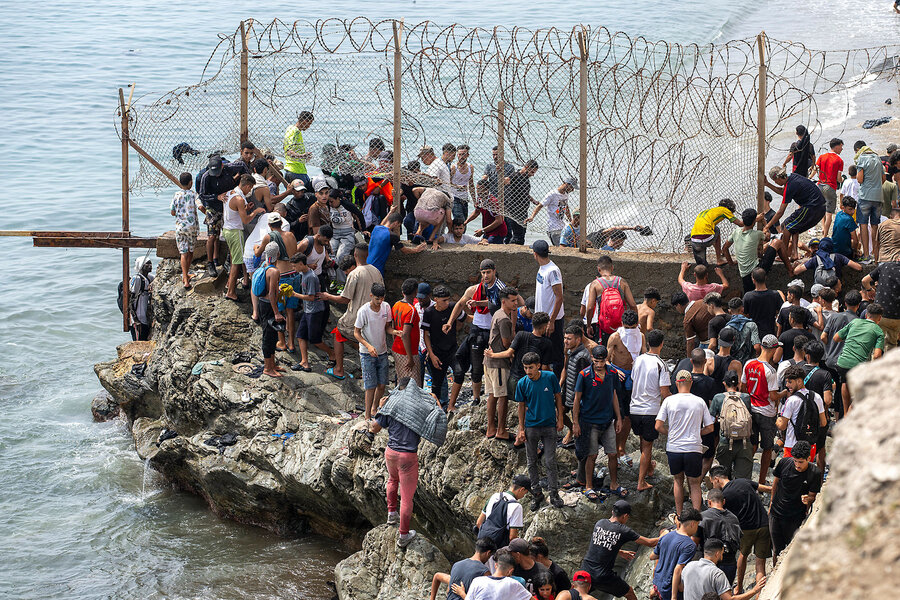
The surge of migrants into Ceuta, an autonomous 7-square-mile Spanish territory perched on the tip of North Africa, subsided as quickly as it swelled. But the images of young Moroccans marching up the shoreline, ditching inflatable tubes along their way, have forced Europe into a debate over how countries can manage migration humanely while maintaining control of their borders.Many of the 50,000 who flooded the enclave between Thursday and Friday – nearly doubling Ceuta’s population – have since returned to Morocco. By the weekend, Spain had installed a 500-meter floating barrier along the patch of Mediterranean coastline shared by the two countries. But the political response remains turbulent. Italy reacted by temporarily suspending Spain’s membership in Europe’s Schengen Agreement, which allows borderless travel between members, with Finland and Denmark backing the move. Twenty-two member states issued a joint letter calling for tighter coordination and control of Europe’s borders. Spain said some countries’ reactions to the incident were “selfish, polarizing, and unlawful.” Why We Wrote This Migration remains one of the thorniest issues across Europe, dividing opinion in many countries. Images of thousands of migrants surging from Morocco into the Spanish city of Ceuta, in north Africa, have led European Union ministers to try to find new solutions, balancing legality with compassion. The European Union has called an emergency meeting of interior ministers on Tuesday to discuss next steps. Demonstrators hold flags and banners as groups of far-right protesters gather in front of the Moroccan Embassy, following a mass border crossing in Spain's Ceuta enclave, in Madrid, Aug. 2, 2026. Ceuta, as one of the two European land borders in Africa, has long been a crossroads for African migration. As investigators continue to debate what triggered the surge, it has become a microcosm of a larger debate unfolding across the bloc: how governments can remain committed to humanitarian principles while also maintaining sovereignty, especially as migration stokes divisions in European politics.“The political landscape in Europe is so polarized,” says Riccardo Fabiani, the North Africa Project Director for the International Crisis Group. “If one country tries to take a third-way approach to migration, they will be exposed to criticism from both the right and the left, everywhere across Europe.”The exact reason for the surge, in which at least 67 migrants died trying to cross to Ceuta, remains unclear. But one answer might lie with a recent decision by Spain’s Supreme Court. On July 8, it ruled that those who crossed into Spain by sea or land – without passing a physical barrier – could not immediately be sent back to their home country. That has been interpreted by some as a green light for migrants to try to make it to Spanish territory.Spanish Prime Minister Pedro Sánchez said during a visit to Ceuta on Friday that criminal trafficking gangs had exploited the Supreme Court ruling to encourage Moroccans via social media to take their chances there.“The weaponization of migration is not new,” says María Belén Zanzuchi, a policy analyst at the Migration Policy Institute Europe. Violeta Santos Moura/Reuters Migrants try to make their way past Spanish police officers, following recent mass crossings of migrants on foot and by sea from Morocco into the Spanish territory of Ceuta, in north Africa, Aug. 1, 2026. Spain’s government, though, has taken steps over the past few months to be more welcoming toward migrants. It announced that it would offer residency permits to 500,000 undocumented people already in the country – one of the biggest migration decisions in Spanish history – stoking criticism from conservative politicians.The surge at Ceuta has reignited that criticism. “We cannot allow uncontrolled mass crossings ... or other hybrid threats to create the perception that illegal entry into the European Union is possible,” EU leaders wrote in a letter to European Commission President Ursula von der Leyen, European Council President António Costa, and Irish Prime Minister Micheál Martin. Ireland currently holds the presidency of the EU Council.EU ministers will discuss such measures as reintroducing internal border checks across Europe and a bolstered role for EU border agency Frontex.European countries have struggled to find common ground on migration since 2015, when more than 1 million people, mostly refugees and asylum seekers from the Middle East, arrived on the continent following a decision to welcome them by the then-German Chancellor Angela Merkel. It led to a backlash against her, similar to the reaction the Spanish prime minister is now facing. Spanish soldiers question a migrant following mass crossings of migrants on foot and by sea from Morocco into the Spanish territory of Ceuta, Aug. 1, 2026. Much of the focus on a solution, observers say, has involved providing legal pathways to migrants or better coordination between EU member states. Others believe more needs to be done by involving Europe’s neighbors – and the migrants themselves.“We should find ways to have human-centered approaches to borders, in respect of human needs of people who are crossing,” says Kelly Petillo, program manager for the Middle East and North Africa at the European Council on Foreign Relations. “And we need to listen to the needs of our partners.”Ms. Petillo says European countries lack the mechanisms to face migration surges together. The bloc has recently tested “return hubs” in third, non-EU countries – where failed asylum seekers can be sent – but these have had limited success. There are also concerns that they are unsafe and could give countries outside Europe too much leverage over the EU.Ultimately, some experts say that until Europe addresses issues like unemployment and stretched public services, migration will continue to be used as a scapegoat for the continent’s socioeconomic woes. A cohesive, EU-wide policy, they argue, will remain elusive.“At the end of the day, Spain succeeded in controlling the [Ceuta] situation,” says Ms. Zanzuchi. “But it has revealed significant gaps in [Europe’s] migration policy and shown that there is still a lot left to do.”
Europe seeks new solution after migrant surge in Spanish enclave
Full Article
Original Source
Read the full article at Csmonitor →KhanList aggregates and links to publicly available news content. We do not host full articles from third-party sources. Always verify important information with original sources.