
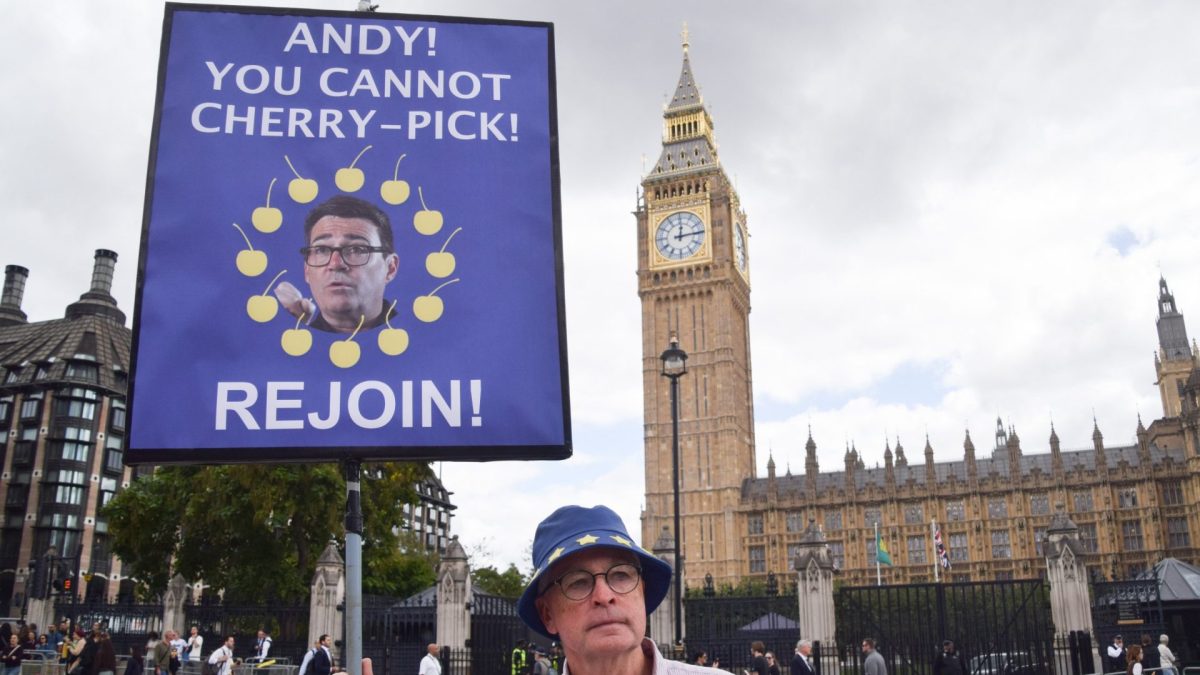
The European Union is ready to consider a proposal from Britain “in good faith” if it chooses to reverse Brexit, according to former European Council president Charles Michel. Michel, who was Belgian prime minister when Britain voted for Brexit in 2016, said it was possible that “conditions can be discussed and negotiated”. But he warned that London must first confirm what it wants from the relationship and cannot expect Brussels to abandon the principles that shaped the original negotiations. Shorts “I have experience of being in the room where the political dishes are cooked,” Michel told The i Paper in an interview at the Résidence Palace in Brussels, opposite the European Commission. “I know that if and when there is clarity on the UK side, the EU will be ready to consider that UK position and to deal with that UK position in good faith and with good intentions.” His comments come after Andy Burnham opened the door to the UK rejoining the EU, with the Prime Minister saying that Brexit had done “more harm than good”. In his Labour conference speech, Burnham blamed the UK’s departure from the EU for a loss of control over the economy and immigration, and pledged to set out different options for closer UK-EU relations later this year. Charles Michel, former prime minister of Belgium, says conditions ‘can be discussed and negotiated’ once the UK makes its position clear (Photo: Siavosh Hosseini/SOPA Images/LightRocket via Getty) Yet, Michel cautions that Burnham’s opening to possible membership begins a British debate rather than settles it. “It is the start of a debate within the UK,” he says. “We cannot be naive and give the impression that what was not acceptable yesterday could be accepted tomorrow. So, we cannot accept anything that would weaken the integrity of the single market.” Michel sees this change in tone as significant. “Until a few months ago, it was difficult to imagine that there would be such a growing debate, maybe a growing temptation within the UK to consider a certain rapprochement with the EU,” he says. But he does not assume the current mood will automatically lead to a return, noting that Britain could choose to remain outside while deepening its ties. That, too, would be a choice for British voters, he says. Burnham’s willingness to consider a return to the EU marks a departure from Keir Starmer’s cautious approach to repairing relations, under which he insisted Britain must remain outside the EU, single market and customs union. The new approach from Burnham also reflects growing disappointment with Brexit. Recent polling shows majority support for rejoining. The international backdrop has meanwhile changed the calculation on both sides. Brexit was decided in a different world, before the present accumulation of conflicts, geopolitical tensions and economic disruption. The Prime Minister has pledged to set out options for closer UK-EU relations later this year (Photo: Tobias Schwartz/AFP via Getty) For decades, Britain and EU countries understood their future as anchored in the transatlantic alliance. Now, uncertainty over that relationship is encouraging Europeans to develop their own capabilities and reconsider where influence comes from. Michel, who sat with British and EU leaders through years of Brexit wrangling, believes a more dangerous world has strengthened the case for closer ties. “The world is getting more multipolar,” he says. “We are in a moment where there are doubts about who is our friend and who is not our friend.” Michel sees an emerging British understanding that a closer relationship with Europe offers “a way to maximise the impact” of the UK within a larger entity. He also believes Canada’s interest in closer European ties – notably through last month’s EU “associate membership” announcement – as part of this wider search for partners sharing principles on trade, security, multilateralism and climate change. It is an encouraging assessment from someone who witnessed both the decision to leave the EU and the struggle to translate it into a workable relationship. “We didn’t want it, but we respected the choice made by the British voters,” he says. The same respect, he argues, should apply if Britain changes its mind. His confidence in a constructive response draws on that experience at the negotiating table. But his account also challenges the temptation in Westminster to start by asking what Brussels might offer. Before questions about the euro, Schengen or special arrangements can be answered, Britain needs to establish what it wants. Political goodwill, however, would not remove every obstacle. Above all, the EU would defend its single market. “It could be that the UK would like to join the EU, but with this condition and that condition, and maybe these conditions are impossible for the EU to accept. Maybe these conditions can be discussed and negotiated,” he says. If Britain chose to rejoin, talks would have to establish the practical arrangements, including possible transition periods. But Michel says the EU would not demand guarantees against a future government reversing course. Asked about the risk that Conservatives or Reform could overturn an agreement, he says: “That’s politics and that’s democracy.” How Britain authorises a change would be for Britain to decide, taking account of its institutions and political realities, Michel says. As for the EU, it should allow Britain’s debate to unfold rather than try to steer it. “It’s not our decision. It’s a debate for the British people, for British citizens, for British voters,” he says. “We cannot interfere in that debate.”
Europe ready to discuss Brexit reversal ‘in good faith’, says former EU chief
Full Article
Original Source
Read the full article at Inews →KhanList aggregates and links to publicly available news content. We do not host full articles from third-party sources. Always verify important information with original sources.