
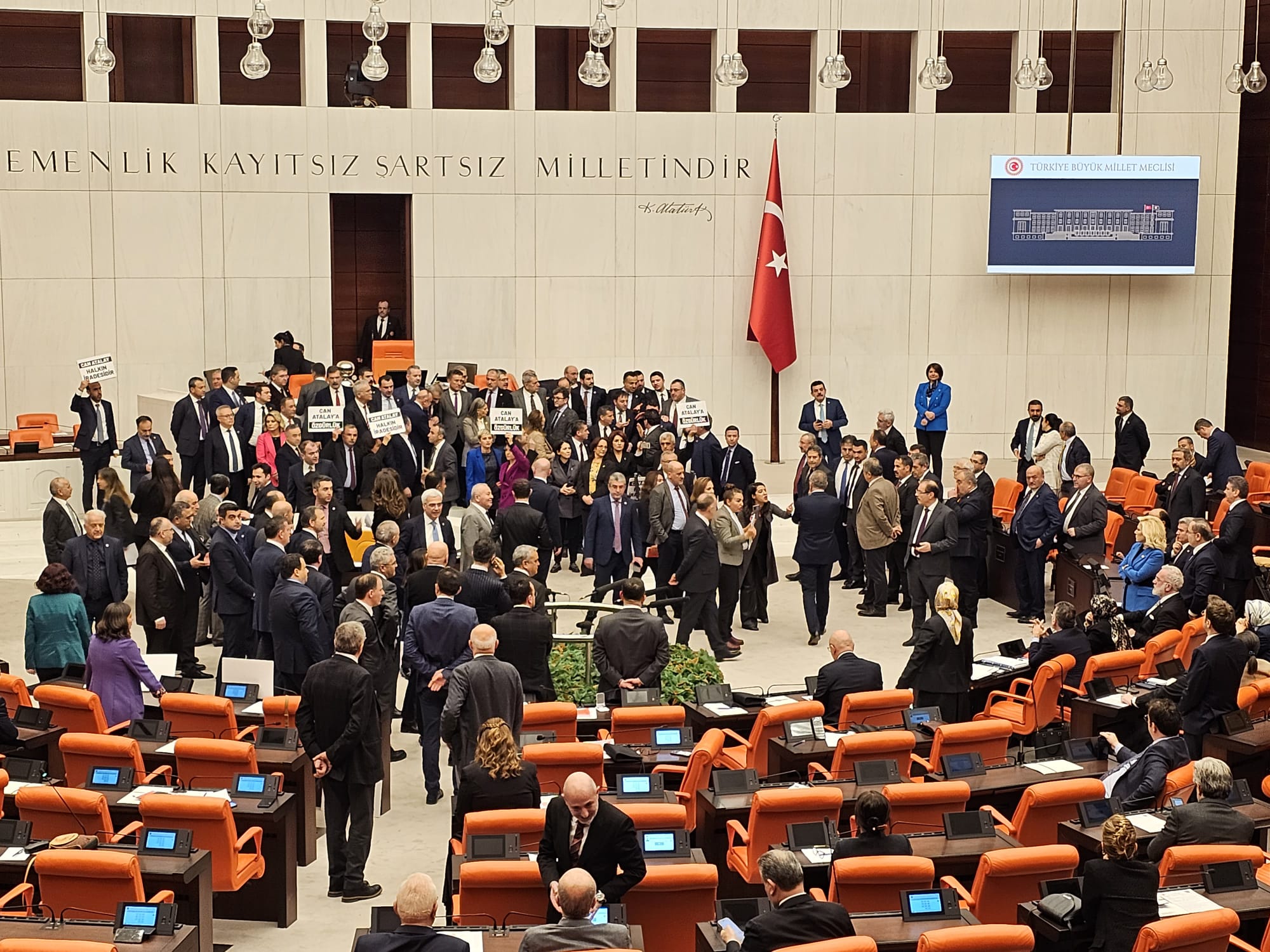
(CN) — Winning an election and two release orders never opened Can Atalay’s prison door. On Tuesday, Europe’s human rights court ordered Turkey to free him and let him serve in Parliament.The European Court of Human Rights sided with Şerafettin Can Atalay, a lawyer and human rights defender imprisoned over the nation’s 2013 Gezi Park protests. Elected while appealing his conviction, he sought release and enforcement of Turkish Constitutional Court judgments protecting his parliamentary rights.The rights court judges found his continued imprisonment unlawful and his exclusion from Parliament unjustified. The rules used to deny him parliamentary immunity weren’t predictable enough, and Turkey’s highest criminal court, the Court of Cassation, refused to enforce binding constitutional judgments, the court said.“As a result, the applicant remained in detention despite the Constitutional Court’s findings of a violation of his right to liberty and security and its orders for his release,” the judges wrote.They found that his imprisonment served a political purpose: silencing him and stifling pluralism. Their reasoning drew on the criminal court’s departure from its own precedents, criminal complaints against constitutional judges and presidential statements backing the defiance.Philip Leach, professor of human rights law at Middlesex University, said targeting a rights defender despite his parliamentary immunity struck at the democratic values the European rights convention protected.“This judgment represents another crystal clear marker of the ongoing severe repression of political and democratic rights in Turkey,” he said.Atalay was a lawyer and member of Taksim Solidarity, a coalition that coordinated the Gezi protests. He also represented families seeking accountability after disasters, according to Amnesty International.Prosecutors portrayed his organizing, telephone conversations and public statements as involvement in an attempted overthrow of the government. In April 2022, an Istanbul court sentenced him to 18 years. He was tried along with activist Osman Kaval, who also remains in prison on a life sentence despite multiple rulings that he should be freed.Then voters intervened. With his appeal pending, Atalay won a seat representing the Workers Party of Türkiye in May 2023. He requested release and suspension of proceedings under constitutional protections for lawmakers.The Court of Cassation refused, treating his offense as an exception to immunity, and upheld his conviction that September. The Constitutional Court ordered his release and suspension of proceedings in October and again in December. The criminal court refused to comply and filed criminal complaints against constitutional judges who backed the first judgment.Parliament announced the termination of his mandate in January 2024, leading to a brawl among lawmakers. Atalay turned to the Strasbourg rights court that April.Bertil Emrah Oder, professor of constitutional law at Koç University, described one top court disabling another as a distinct instrument of political exclusion. She said the European judges vindicated the Constitutional Court but understated the systemic problem by limiting their findings to Atalay’s circumstances.“Under the European human rights protection system, Strasbourg can declare, but only domestic authorities can comply,” she said.The European judges endorsed the Constitutional Court’s handling of Atalay’s applications, stopping short of declaring it generally ineffective as a route for challenging detention.Necdet Umut Orcan, head of the human rights law department at Marmara University, supported that restraint: Bypassing the Constitutional Court would weaken it and deny detainees a faster remedy. But he warned repeated defiance by Turkey’s highest criminal court, backed by the executive and Parliament, made it harder to treat the problem as exceptional.“Still, I don’t think the court can hold this position indefinitely,” he said, referring to the European rights court.Rights court Judge Saadet Yüksel of Turkey dissented on unlawful detention, electoral rights and political purpose. She considered the immunity exception sufficiently predictable through established judicial interpretations and found insufficient evidence of an ulterior motive. She nevertheless agreed that refusing to enforce constitutional judgments violated Atalay’s right to challenge his detention.Ayşegül Kars Kaynar, an associate professor of political science working at Turkey’s Grand National Assembly, warned that selectively withholding parliamentary protection entrenched unequal political rights. She also criticized the Constitutional Court’s failure to resolve Atalay’s latest application. Previous failures to comply left her doubtful the judgment would change Atalay’s situation.“What makes the Atalay case particularly consequential, however, is that it represents a challenge not merely to the constitution itself, but to the very principle of constitutionalism, citizenship and ultimately, to the foundations of the republican state,” she said.Müzeyyen Gözde Atasayan Bilal, a constitutional law scholar, said the judgment strengthened the Constitutional Court’s authority. Repairing the institutional breakdown, she said, required judicial independence, effective enforcement and respect for constitutional judgments.“The fundamental challenge is therefore not the absence of judicial protection, but the failure to give effect to binding judicial decisions,” she said.The judges awarded Atalay 32,500 euros (about $35,700) for nonfinancial harm and required broader measures to ensure constitutional judgments were implemented. His lawyers and the Turkish government did not respond to requests for comment.Either party can request referral to the Grand Chamber within three months, though acceptance is not automatic. If neither does, or a request is rejected, the judgment becomes final, with compliance supervised by the Council of Europe’s Committee of Ministers.Turkey was told to deliver what Atalay’s earlier victories never secured: his release and the ability to take his seat.Courthouse News reporter Eunseo Hong is based in the Netherlands.Subscribe to our free newslettersOur weekly newsletter Closing Arguments offers the latest about ongoing trials, major litigation and rulings in courthouses around the U.S. and the world, while the monthly Under the Lights dishes the legal dirt from Hollywood, sports, Big Tech and the arts.Additional Reads
Europe orders Turkey to free jailed lawmaker who prompted judicial crisis
Full Article
Original Source
Read the full article at Courthousenews →KhanList aggregates and links to publicly available news content. We do not host full articles from third-party sources. Always verify important information with original sources.