
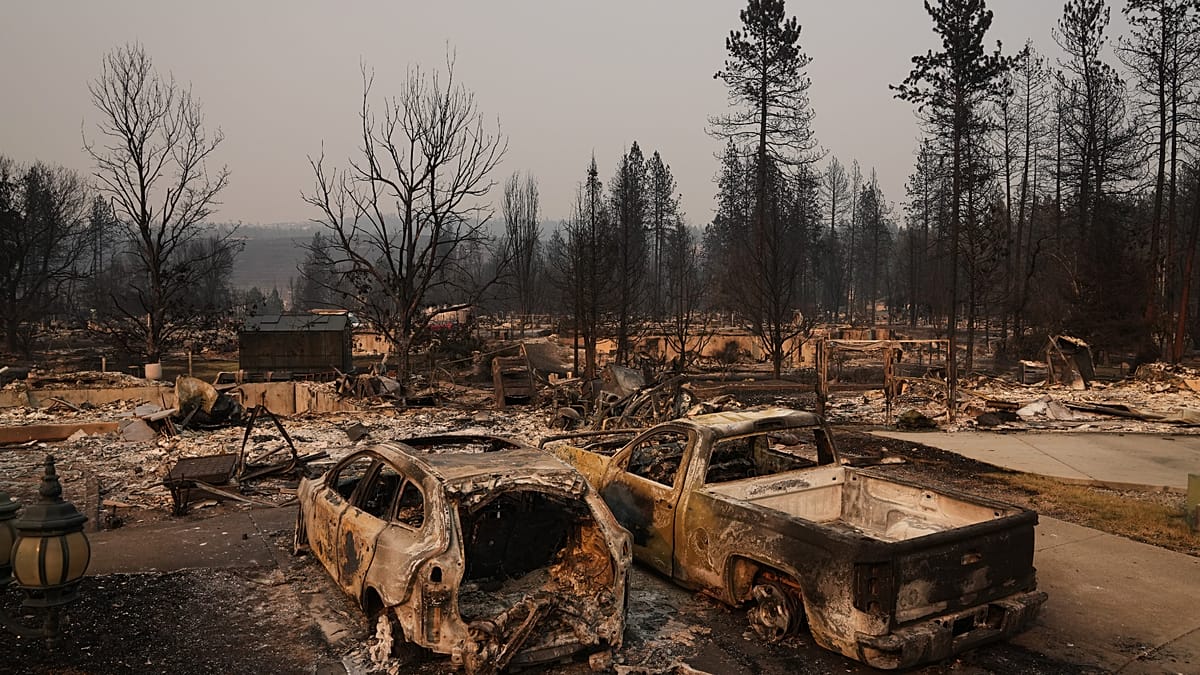
The European Commission will unveil new climate rules on Tuesday requiring EU governments to clarify who is responsible for protecting citizens from climate disasters, Climate Action Commissioner Wopke Hoekstra told Euronews. ADVERTISEMENT ADVERTISEMENT The move comes as Brussels warns that Europe must prepare for increasingly extreme weather, including scenarios involving 3°C of global warming by 2100. Hoekstra warned that the world is heading towards a temporary or potentially prolonged overshoot of the Paris Agreement’s 1.5°C warming limit, making it essential for governments to prepare for more extreme heat and climate disasters, even if efforts to cut emissions succeed. “It is up to member states to decide where they want to put that responsibility. But what we do make mandatory is that they do have to appoint and articulate where the responsibility is going to lie,” Hoekstra said. While the EU continues to pursue emissions reductions, the costs of adapting to a hotter world are becoming harder to ignore, from rebuilding after wildfires and floods to protecting homes, roads and public infrastructure. The Dutch Commissioner estimated the economic damage from this summer's extreme weather at more than €100 billion. Asked what a 3°C rise above pre-industrial temperatures could mean for Europeans, Hoekstra pointed to heat plans for cities and the need to prepare infrastructure for a hotter future, rather than relying on historical weather patterns. The reference trajectory is based on scientific research, including work by the Intergovernmental Panel on Climate Change and advanced European climate modeling, he said. The Commission's projections envisage 2°C of global warming by 2050 and 3°C by 2100 for Europe, reflecting Brussels' assessment that Europe is warming roughly twice as fast as the global average. The trajectory is intended to be translated into national and local risk assessments, taking account of the uneven distribution of climate impacts. “Even if we get all of this right, we have no way to avoid more summers than the one we saw last year,” the Commissioner said, arguing that readiness, resilience and preparedness must become the priority alongside emissions cuts. The proposed legislation would require EU countries to specify whether national, regional or local authorities are responsible for preparing for climate disasters. Governments would retain flexibility over how they allocate responsibilities, but would have to specify who is accountable — an attempt to prevent political disputes over who failed to prepare when floods or wildfires destroy homes. The Commission also wants climate scenarios to be considered when planning new roads, bridges and neighbourhoods, recognising that infrastructure designed for past weather conditions may no longer be fit for purpose. "We want to introduce a culture of preparedness and resilience by design, rather than dealing with the damages in the aftermath, which is often very ad hoc and doesn't always build back better," a senior Commission official said on Monday on condition of anonymity. No new money However, the question of how to pay for climate adaptation remains unresolved. No new financial commitment to household support is expected from the Commission's climate resilience strategy, despite concerns that ordinary citizens may struggle to afford the investments needed to adapt. Hoekstra pointed to the Commission's proposal to devote 35% of the EU budget to climate and nature. But the strategy's effectiveness will depend partly on the outcome of ongoing negotiations over the EU's next multiannual budget, with climate spending competing against priorities such as defence, security, competitiveness and agricultural support. The Commission is also counting on the recently announced €30 billion from the European Investment Bank for climate adaptation through 2030. Nonetheless, the lack of new funding is a potential weakness in the Commission's ambition. The Commissioner argued that preventive investment is economically worth it but did not announce a new household support scheme or explain how the EU would ensure that lower-income households could afford necessary improvements. In an attempt to fill the bloc's climate protection gap, Brussels wants to work with the insurance sector, as Commissioner Hoekstra pointed out that many areas in Europe are underinsured against climate disasters. According to the senior Commission official, only around 25% of assets exposed to climate impacts are insured, leaving governments and property owners vulnerable to substantial losses. “The fact that so many areas are underinsured” is one of the issues the Commission will examine, Hoekstra said. The strategy could therefore expose another fault line between Brussels' climate ambitions and the cost-of-living pressures facing European voters.
Europe must prepare for a 3°C warmer world, EU climate chief warns
Full Article
Original Source
Read the full article at Euronews →KhanList aggregates and links to publicly available news content. We do not host full articles from third-party sources. Always verify important information with original sources.