
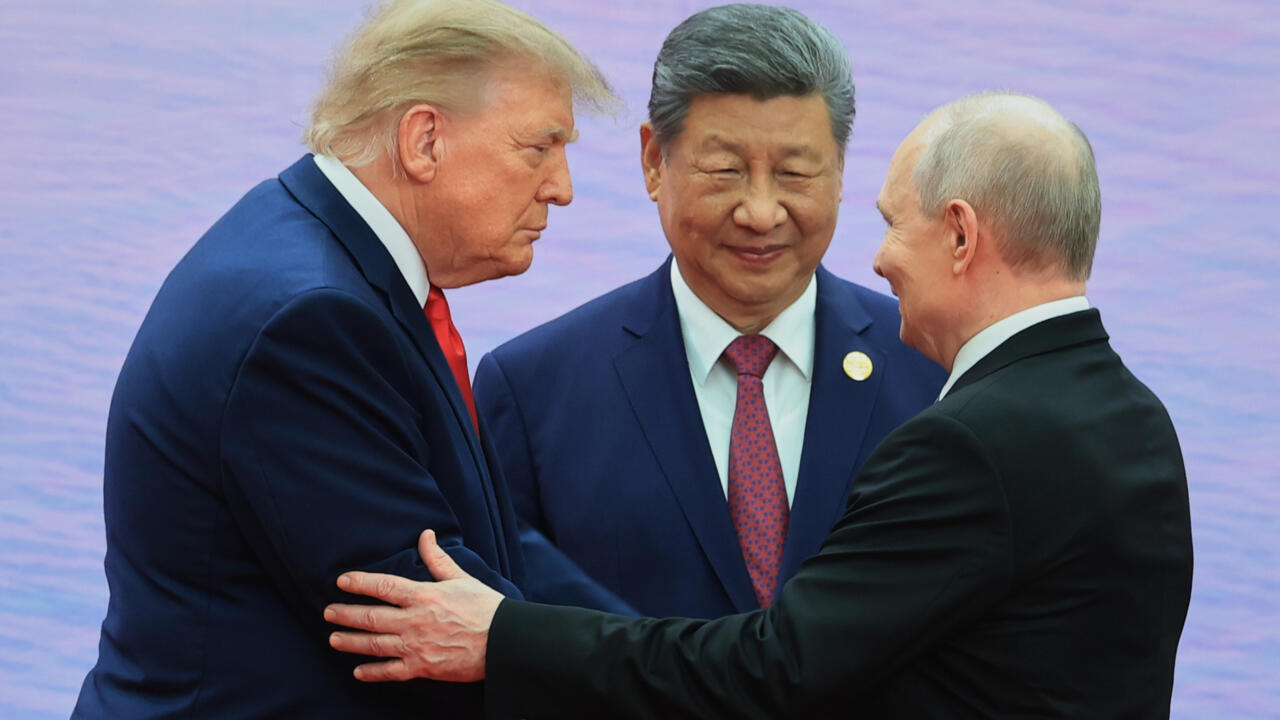
As Donald Trump, Xi Jinping and Vladimir Putin prepare for historic talks in China on Thursday, the European Union – the world's largest trading bloc – is conspicuously absent, raising questions about Europe's ability to turn its economic strength into diplomatic influence. When the leaders of the United States, China and Russia sit down together in Shenzhen on Thursday, their discussions could have far-reaching consequences for Europe – despite no European representative being at the table. US President Donald Trump has already held separate meetings with Chinese President Xi Jinping and Russian President Vladimir Putin ahead of the unprecedented three-way summit, taking place on the sidelines of the Asia-Pacific Economic Cooperation (APEC) forum. Their agenda includes the wars in Ukraine and Iran, nuclear arms control and competition over artificial intelligence. To display this content from X (Twitter), you must enable advertisement tracking and audience measurement. China has described the gathering as being of "groundbreaking significance" for international peace and stability. But for the European Union, which is not an APEC member, the summit highlights an uncomfortable reality: despite its enormous economic strength, the 27-nation bloc struggles to secure a decisive voice in global diplomacy. In 2025, EU trade with the rest of the world exceeded €8 trillion, representing almost 16 percent of global trade in goods and services – ahead of both the United States and China, according to EU figures. Yet when it comes to resolving major security crises, Europe frequently finds itself on the sidelines. Xi, Trump and Putin prepare for historic summit, but will it reset the world order? Ukraine and Iran expose Europe's diplomatic dilemma Nowhere is this contradiction more apparent than in Ukraine, where the EU has provided substantial financial and military support while struggling to influence diplomatic efforts to end the war. Any lasting settlement would have profound consequences for European security, sanctions policy and Ukraine's future relationship with the bloc. Nevertheless, Trump has repeatedly pursued direct negotiations with Moscow, while Russia has resisted European efforts to join peace discussions. Europe's economic relationship with Russia also gives it a significant stake in the outcome. Before Moscow's full-scale invasion in February 2022, Russia supplied around 40 percent of EU natural gas imports and a quarter of its oil. Those energy sales generated approximately €100 billion for Moscow in 2021. Europe has since dramatically reduced its dependence on Russian energy, turning increasingly towards the United States. American producers have benefited considerably. The US is now the EU's largest oil supplier and has accounted for nearly two-thirds of its liquefied natural gas imports so far this year. Any peace agreement that reopened European markets to Russian energy could therefore reshape commercial relationships on both sides of the Atlantic. The war in Iran has exposed similar limitations. European powers, including France, Britain and Germany, played a central role in negotiating the landmark 2015 agreement restricting Tehran's nuclear programme. Almost nine months into the current conflict, however, European governments have largely been confined to diplomatic appeals. The EU could potentially help protect shipping through the Strait of Hormuz or monitor a renewed nuclear agreement, but regional intermediaries such as Pakistan and Qatar have assumed more prominent diplomatic roles. Macron gathers European leaders in push for Ukraine security guarantees Can Europe turn economic muscle into political power? Part of the problem lies in the EU's institutional structure. Unlike the United States or China, the bloc has neither a unified foreign policy nor a military command. Its 27 members retain considerable authority over security and diplomacy, while many foreign-policy decisions require unanimity. That makes responding quickly to international developments difficult, particularly when governments disagree over relations with Russia, China or Washington. The EU's military capabilities reveal another contradiction. Member states collectively spent €418 billion on defence in 2025 – an increase of 20 percent on the previous year, reflecting growing concerns over Russia and pressure from Trump for Europe to shoulder more of its security burden. But increased spending has not produced a unified European military. Armed forces remain under national command, while collective defence continues to depend heavily on NATO and American military capabilities. European governments increasingly acknowledge the need for change. France, Germany and nine other EU members have recently called for reforms to accelerate foreign-policy decisions and reduce the ability of individual governments to block collective action. Yet differences over Russia, competing national priorities and the growing influence of parties sceptical of deeper European integration complicate those ambitions. For France, which has long championed European strategic autonomy, the Shenzhen summit offers another illustration of the case for a stronger, more independent European voice. Paris argues that Europe must be capable of defending its interests without relying exclusively on Washington – an ambition given fresh urgency by Trump's increasingly transactional approach to international relations. Achieving that autonomy, however, will require more than increased defence budgets or institutional reform. It will demand closer coordination and a willingness to compromise over national interests. (with newswires)
Europe left out in the cold as Trump, Xi and Putin meet in China
Full Article
Original Source
Read the full article at Rfi →KhanList aggregates and links to publicly available news content. We do not host full articles from third-party sources. Always verify important information with original sources.