
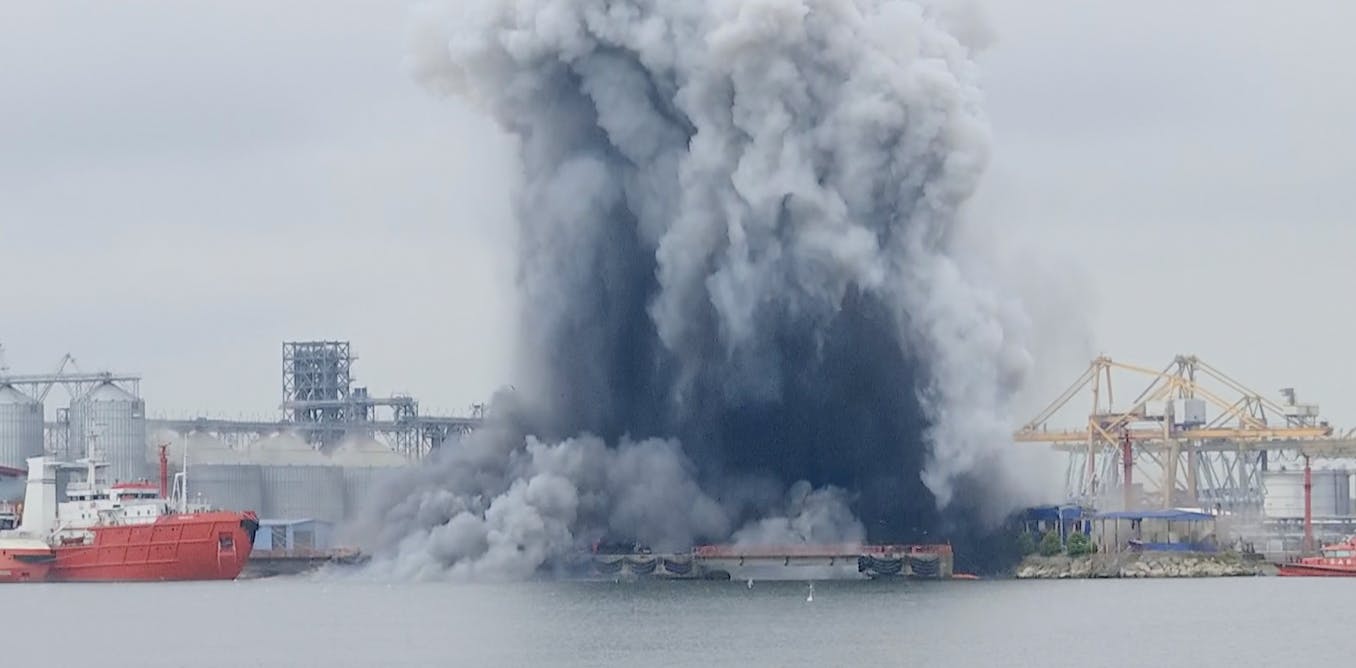
Russia’s full scale war of aggression against Ukraine has entered its fifth year. The war is stuck in a violent stalemate characterised by an escalating exchange of drone and missile attacks that target critical infrastructure and civilians in Ukraine. The conflict is also spilling out beyond the borders of the those two countries and into continental Europe more broadly in unconventional and indirect ways. Russia has been attacking European countries using what’s called “hybrid warfare”: the use of unconventional methods as part of a multi-domain warfighting approach. These methods aim to disrupt and disable an opponent’s actions without engaging in open hostilities. Just last month, Russia attempted drone attacks on Germany’s Leipzig Airport. The escalating, intensifying attacks on countries such as Germany and Romania amount to an undeclared war against the West, with the potential for escalation. The conflict grey zone Since the beginning of the invasion in February 2022, Russia has been attacking NATO’s European member states with a mix of tactics. These have included sabotage, assassination attempts and cyber attacks on energy grids and communication infrastructure. It has also launched physical attacks on NATO’s critical undersea cable infrastructure. These attacks were taking place below the threshold of conventional open warfare in the so-called “grey zone of conflict”. They were unconventional, non-attributable or falling short of physical conflict. An example of this type of conflict is the Nord Stream gas pipeline sabotage in September 2022. This was a clandestine operation that damaged two main natural gas pipelines in the Baltic Sea and effectively put a stop to any Russian-Germany liquid gas energy business. German prosecutors blame Ukraine, but there are conflicting views on who was behind it. Russia and Belarus were accused of weaponising migrants in 2021 by opening up to the Middle East, then funnelling migrants to the borders with European Union countries. The strategy aimed to destabilise their neighbours and killed dozens of migrants. Russia has stepped up hybrid warfare operations against Europe since then. According to a recent report by the United States Congressional Research Service: the number of Russian hybrid attacks in Europe quadrupled from 2023 to 2024; another investigation compiled at least 151 incidents of reported Russian operations from February 2022 to March 2026. Read more: Explainer: what is ‘hybrid warfare’ and what is meant by the ‘grey zone’? Ratcheting up the attacks Whether it’s arson attacks against Western arms manufacturing sites or coordinated GPS jamming of Western navigation systems targeting civilian navigation and aviation, Russia is stepping up its operations. All of them have the potential to create a civilian mass casualty event. These operations still fall under the umbrella of hybrid warfare, as both deniability and lack of attribution are still key elements of Russia’s approach. But they are starting to test Western resilience. German Chancellor Friedrich Merz, when addressing the Leipzig Airport incident, warned the attackers would have to “pay a price” and that Germany was increasingly becoming a target of such attacks. Germany’s government has since officially blamed Russia. Romania has also come under Russian attack. European Commission President Ursula von der Leyen reacted to reports of the Romanian military destroying a naval drone near one of its oil platforms in the Black Sea by calling out an “escalating campaign of threats” against the European Union and its critical infrastructure. This recent incident follows months of Russian drone incursions into Romanian airspace, as well as increased drone strikes close to Romania’s border. The action has affected civilians. In May 2026, a Russian drone hit an apartment building in Romania and injured two people. These incidents demonstrate Russia’s increasing willingness to openly use military force. The NATO response NATO has ramped up its air policing along its Eastern border to secure the airspace. As part of its commitment to its collective security mandate (also called Article 5), where an attack against one member is treated as an attack against all members, it has also provided more air defence capabilities to affected border states. These actions are in addition to existing NATO counters to Russian clandestine operations of sabotage and other hybrid warfare tactics. NATO’s operations Baltic Sentry, Eastern Sentry and Arctic Sentry enhance the organisation’s capability to counter Russian threats to NATO interests on land, air and sea. It seems clear the nature of Russia’s undeclared war against the West for its support of Ukraine has progressed beyond its original hybrid warfare form. NATO has increased air policing, especially around Romania, in the wake of Russian attacks. Andreea Alexandru/AP Maintaining the illusion that such Russian operations still fall below the threshold of conventional war and so do not need a more forceful response as deterrence has the potential to escalate further. NATO has to make it clear to the Kremlin that any further acts that cause civilian deaths or create large scale destruction will be regarded as an armed attack. This will in turn trigger its collective defence response. NATO leaders in the past clarified that hybrid attacks may amount to an armed attack. However, this red line is questionable given US President Donald Trump’s increased criticism of, and even hostility towards, NATO and other allies. He’s repeatedly cast doubt on the value of the collective security mandate, indicating unwillingness to defend NATO members. He also consistently downplays the Russian threat. So Russia is deliberately testing NATO’s resolve. It’s an undeclared war, with attacks intensifying. But with Trump’s commitment to the organisation doubtful, it’s hard to see how the increasingly tenuous situation progresses from here.
Europe is under increased Russian attack. Are we seeing an undeclared war?
Full Article
Original Source
Read the full article at Theconversation →KhanList aggregates and links to publicly available news content. We do not host full articles from third-party sources. Always verify important information with original sources.