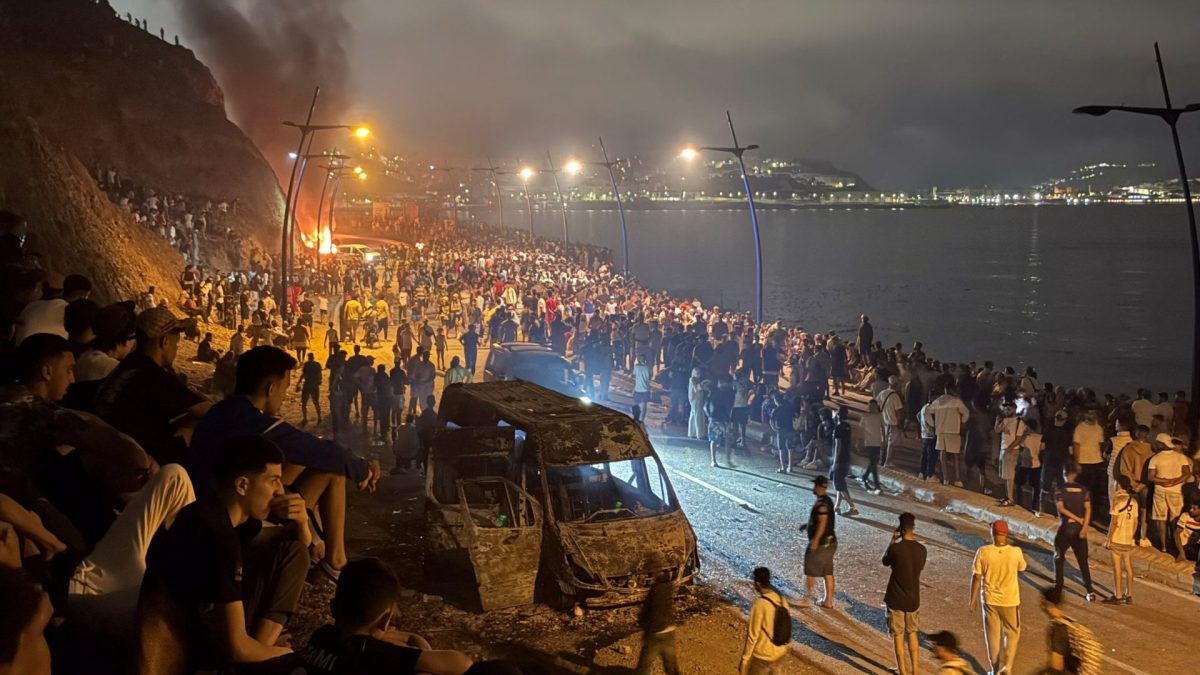
The images emerging from Ceuta, the tiny Spanish enclave perched on the north African coast, are shocking. Thousands of migrants clambering ashore after swimming around the breakwater that separates Morocco from Spanish territory. Discarded rubber rings strewn across the coastline. Hundreds of new arrivals, many of them young, sleeping rough as reception centres are pushed beyond breaking point. Some 60,000 migrants have poured into Ceuta in just 24 hours, according to Ceuta’s President, Juan Jesús Vivas, in what is believed to be the largest single day of irregular arrivals ever recorded anywhere in the European Union. Spain’s central government claimed on Friday that around 25,000 migrants had already gone back out of a number they put closer to 50,000. But at least 57 people have died attempting the perilous crossing, their lifeless bodies pulled from the choppy waters of the Mediterranean Sea. This apparent collapse in border security may seem unprecedented, but it should not come as a surprise. What is unfolding has laid bare a problem that European leaders have spent the past decade trying to manage rather than solve. Ceuta has been here before. Along with nearby Melilla, it forms the EU’s only land border with Africa, making the enclave a natural pressure point whenever migration routes shift or diplomatic tensions flare. The latest surge has been blamed on an apparent loophole created by a recent Spanish legal ruling (Photo: Marcos Moreno/Anadolu via Getty) Back in May 2021, around 8,000 migrants crossed into Ceuta after Morocco deliberately relaxed border controls during a diplomatic row with Madrid after Brahim Ghali, the leader of the separatist Polisario Front, was admitted to Spain for medical treatment. This time, however, the trigger appears to be different. The latest surge has been blamed on an apparent loophole created by a recent Spanish legal ruling, under which migrants who reach Ceuta by sea, unlike those intercepted crossing by land, cannot immediately be returned to Morocco and must instead have a lengthy asylum claim processed. That development has prompted a chorus of criticism from European leaders, many of whom have been quick to place the blame squarely on the shoulders of Spain’s left-wing Prime Minister, Pedro Sánchez. The European Commission President, Ursula von der Leyen, described the scenes as “unacceptable”, insisting that “we cannot allow anyone to come to our Union without abiding by the rules”. Others have gone further. France has reinforced checks along its southern border, while Italy has announced it is temporarily suspending passport-free Schengen Zone arrangements with Spain until it regains control of its external frontier. While Italy and Spain do not share a border, this will affect people travelling by plane or boat between the two. The governments of Sweden and Finland have expressed support for Italy’s move. Members of Moroccan security forces gather at the site of clashes near Fnideq, on the Morocco-Spain border, on Friday (Photo: Abdel Majid Bziouat/AFP) “Spain has completely failed to protect the external border of the Schengen area from infiltration,” were the damning words of Mari Rantanen, Finland’s interior minister, on Friday. In many ways, Sánchez is an easy target for European leaders searching for someone to blame. Unlike many of his counterparts, he has largely resisted the anti-migration rhetoric that has swept the continent, arguing instead that immigration is vital to offset Spain’s ageing population and chronic labour shortages. That approach was crystallised earlier this year when his government launched a controversial migrant regularisation programme that attracted around 1.2 million applications from undocumented migrants already living in Spain. But to portray this solely as a crisis of Sánchez’s making is to let the rest of Europe off the hook rather too conveniently. Ever since more than one million migrants and refugees entered Europe during the 2015 crisis – a moment that was supposed to be the wake-up call that forced the continent to act – successive EU leaders have promised stronger borders, faster asylum procedures and more effective returns. Refugees escorted by Slovenian police as they walk towards a refugee camp in Brezice, Slovenia, in October 2015. More than a million people entered Europe during the 2015 migration crisis (Photo: Ales Beno/Anadolu Agency/Getty) Two years ago, member states finally agreed a long-awaited migration pact after years of political wrangling, with many hailing it as the breakthrough Europe had been waiting for. Yet if Ceuta is anything to go by, then the bloc still has a long way to go. The uncomfortable truth is that no European government, whether on the left or the right, has found a durable solution to irregular migration at its borders. Britain’s small boats crisis illustrates the point perfectly. Years of increasingly tough rhetoric, emergency legislation, deportation plans and billions of pounds of public money have all failed to deter those determined to cross the English Channel. The same pattern has played out across Europe, where migration routes have simply adapted to every new obstacle placed in their way. That means unless Brussels and national governments finally get serious about building a coherent migration and asylum system that is both effective and enforceable, Ceuta is unlikely to be a one-off.
Europe has failed on illegal migration. The scenes from Ceuta will happen again
Full Article
Original Source
Read the full article at Inews →KhanList aggregates and links to publicly available news content. We do not host full articles from third-party sources. Always verify important information with original sources.