
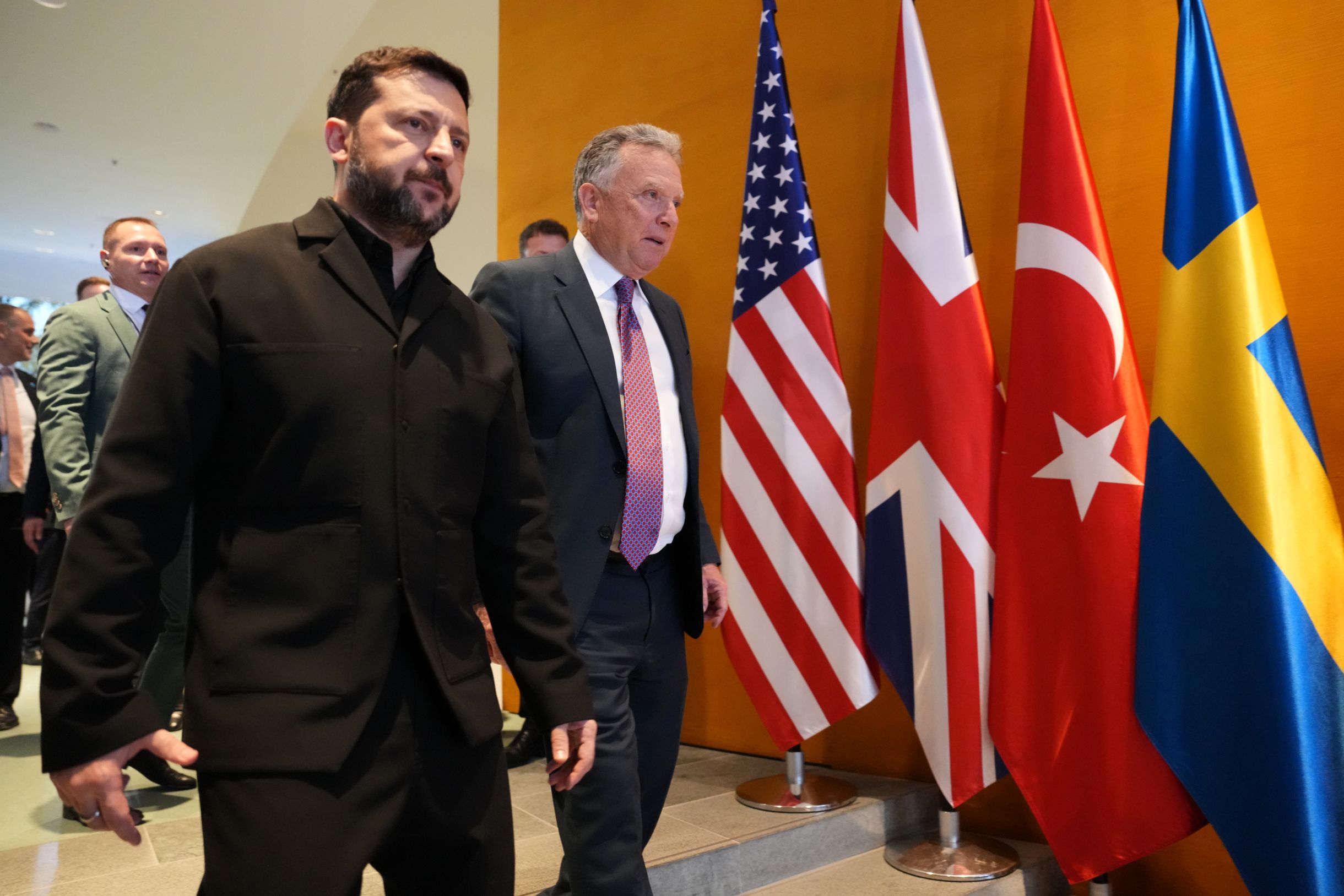
In China, Trump greeted Putin as his “friend.” It was a troubling moment for Europeans worried the two leaders are working out a deal over Ukraine without them and Kyiv. (CN) — European leaders convened Thursday in Berlin to renew their support for Ukraine, strategize on countering Russia and assess Europe’s response to historic trilateral talks in China among the world’s superpowers — the United States, China and Russia.In Europe, the summit in Shenzhen, China, was viewed as a threatening show of superpower disregard for smaller countries and it drew comparisons with the 1945 Yalta conference that saw postwar Europe divided up between the U.S. and the Soviet Union.German Chancellor Friedrich Merz warned against a “Yalta-style” deal over Ukraine by President Donald Trump, Russian President Vladimir Putin and Chinese President Xi Jinping. In a statement about wanting to promote peace, the three superpowers did not mention Ukraine.“We will continue to support Kyiv for as long as is necessary,” Merz said at a news conference. “Negotiations can only succeed if Ukraine and Europe are part of the process together. A ‘Yalta-style’ format will not bring about peace.”Most immediately, the Shenzhen summit seemed to embolden Putin, who was greeted by Trump with the words, “He’s my friend.” Analysts saw the summit as a diplomatic win for Putin by burnishing his international prestige.At a post-summit news conference in China, Putin accused European leaders of derailing efforts to end the war in Ukraine.“We have no desire to go on with this conflict, but the question is not about us,” Putin said. “Ukraine and Europe are not yet ready to make compromises to resolve the conflict.”In an apparent surprise call to the Berlin gathering, Trump too seemed to blame Europe for keeping the war going. He reportedly scolded European leaders for continuing to fund Ukraine’s war effort. He made the call from Air Force One during his flight back to the U.S., news reports said.Since returning to power in Washington, Trump has pressured Ukraine to make concessions to end the war, but European leaders have opposed that and provided Ukraine with the funds to keep fighting. This week, the EU said it was preparing to unlock a new loan worth 45 billion euros ($49 billion) for Ukraine.Putin also vowed to hit back hard for Ukraine’s devastating attack on Russia’s bridge to Crimea, the Ukrainian peninsula Russia illegally annexed in 2014.“After the strikes on the Crimean Bridge, there will be no negotiations,” Putin said, as reported by Russian media. “There will be retaliation. Our response will be much more painful.”This week, Russia also has warned France and the Netherlands for their involvement in the war.That came after France acknowledged some French troops are in Ukraine to provide training and to repair French-made weapons systems and after a Dutch company took credit for building missiles used to bring down a critical section of the Crimean Bridge.Shortly after the China summit ended, Ukrainian officials accused Russian drones of targeting the Dutch and Austrian embassies in Kyiv. No one was reported injured in the attacks, according to news reports.The Berlin summit brought together nearly 40 countries that back Ukraine, a group known as the “coalition of the willing.” They discussed how best to help the besieged country endure the coming winter.The talks involved Ukrainian President Volodymyr Zelenskyy and Trump’s special envoys, Jared Kushner and Steve Witkoff.The coalition was formed after Trump withdrew support from Ukraine shortly after taking office in February 2025.Since then, European nations, including the United Kingdom, have become Ukraine’s biggest backers and vowed to keep helping Kyiv until it defeats Russia and forces its troops off its territory.Meanwhile, Europe has begun to formulate a plan on entering negotiations to end war. Trump launched the talks, but so far they have been limited to Russia, Ukraine and the U.S.The European side will be represented by Germany, France, Britain, Poland, Italy, the EU and NATO.But Russia has not said whether it will open talks with the Europeans and the prospect for negotiations appeared even more in doubt following the Crimean Bridge strikes.The hope of negotiations already had dimmed after Russia revived a demand that peace talks must not only focus on Ukraine but include broader discussions on NATO’s presence in Europe. The Kremlin wants NATO forces to withdraw from former Soviet bloc countries, an impossible demand for European leaders.“Putin’s demands are about much more than Ukraine,” said Danish Prime Minister Mette Frederiksen in a statement. “They are about European security on Russian terms. We must never accept that.”To counter Russia, she said Europe must “put Ukraine in the strongest possible position — both at the front and in the negotiating room.”In Berlin, European and American diplomats discussed possible security guarantees for Kyiv after the war ends.The U.S. has talked about giving Kyiv NATO-like guarantees in exchange for ceding the Donbass region of eastern Ukraine to Russia. But neither Ukraine nor Russia would likely agree to such terms.Meanwhile, NATO troops are carrying out large-scale military exercises in Poland to prepare for a NATO peacekeeping mission in Ukraine.But the Kremlin says it would not agree to the presence of NATO troops in Ukraine following a ceasefire.Courthouse News reporter Cain Burdeau is based in the European Union.Subscribe to our free newslettersOur weekly newsletter Closing Arguments offers the latest about ongoing trials, major litigation and rulings in courthouses around the U.S. and the world, while the monthly Under the Lights dishes the legal dirt from Hollywood, sports, Big Tech and the arts.Additional Reads
Europe fears a new Yalta: Berlin summit rejects superpower deal over Ukraine
Full Article
Original Source
Read the full article at Courthousenews →KhanList aggregates and links to publicly available news content. We do not host full articles from third-party sources. Always verify important information with original sources.