
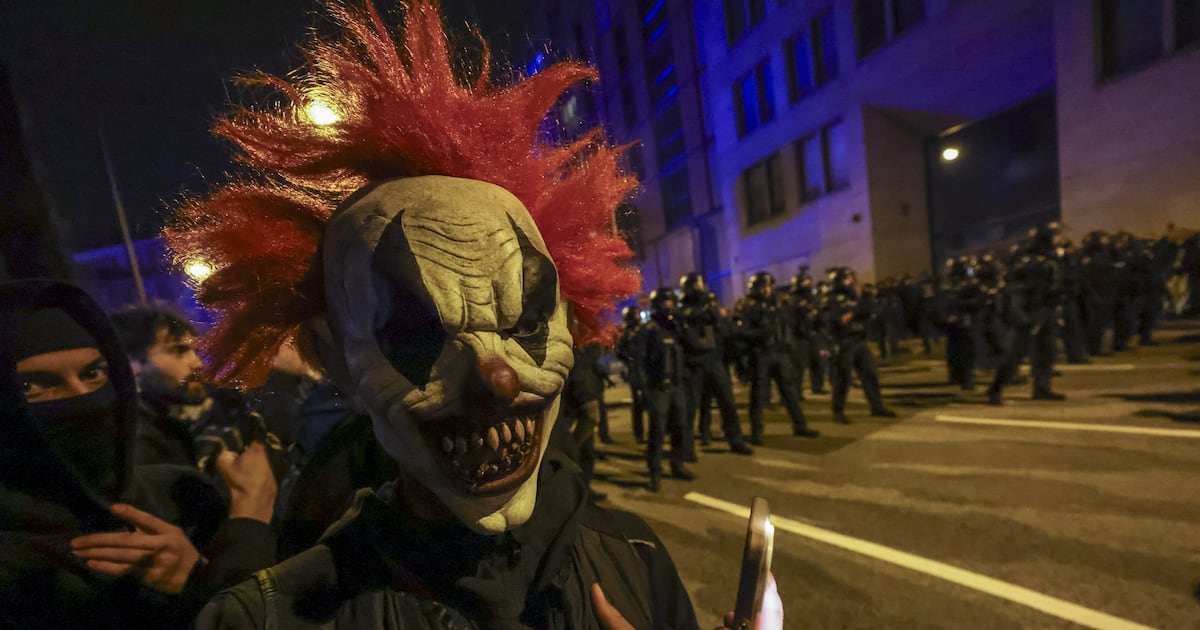
Central shopping districts in cities across Europe were boarded up with plywood over the weekend to avoid windows being smashed in flash looting incited by anonymous accounts over social media.Often accompanied by images of burning street debris and calls for a repeat of recent looting in France, the images posted online look similar across different countries, and often appear to be generated by artificial intelligence.Their politics are unclear: some do not state any political demands, while others call for action on wide-ranging issues from the cost of living, to education, to opposition to war.Organisers are typically anonymous, and the accounts sharing the calls for protests often direct people to join Telegram or WhatsApp groups that are not publicly visible, often using QR codes.READ MOREA large mobilisation of police prevented unrest from materialising in most places. Frankfurt in Germany was an exception, where some looting followed a largely peaceful “Gen Z” protest about education and the cost of living earlier in the day.Police officers stand in front of demonstrators during a mass youth demonstration in Düsseldorf, Germany on Saturday. Photograph: Buesra Tasdemir/EPA In recent days, Spanish police made several arrests of people aged between 16 and 20 accused of running Telegram channels set up to direct targeted looting of city centres.The accounts in Spain use the name “Blocus”, the word used by French students to refer to the occupation of their high schools. However, police accuse organisers of using the appearance of a political protest “as a cover” for planned looting and arson.“The recruitment process began with videos on TikTok and posters, created using artificial intelligence and QR codes, from where interested parties were directed to WhatsApp and Telegram groups and, later, to private channels,” a police statement said.Participants in the channels were asked to share links with their classmates with the aim of reaching “minors”, the statement read.“The messages instructed participants to bring backpacks, school supplies, and banners to mimic a student protest, but also to wear black clothing and masks to hinder identification.”Groups were set up with the objective “to direct the looting in real time toward the businesses considered most vulnerable”.“The plan was to gather participants at a central location on October 31st and then communicate, via private chat, which establishments lacked police presence,” the police statement read. “The conversations mentioned jewellery stores, luxury boutiques, and department stores.”A flower kiosk damaged during riots in Barcelona on October 24th. Photograph: Manaure Quintero/AFP via Getty Images About 14 shops in Barcelona were looted in a night of organised unrest on October 24th.Spanish police arrested one 18-year-old on suspicion of directing people in how to make Molotov cocktails “to create chaos and distract the police”, while planning the looting of specific businesses in the city of Valencia on October 31st.In the Netherlands, a heavy police presence was deployed in The Hague and in Maastricht and people were advised to avoid the city centre, where many shops were shut and boarded up in response to the online calls.Small groups of young people and football supporters gathered in the centre, some of them declaring that they were there as counter-protesters, to protect shops.Police arrested 34 people in The Hague for wearing face coverings or for possession of illegal fireworks, Dutch media reported.Clashes erupt between protesters and the police at the end of a demonstration in Paris on Saturday. Photograph: Nathan Laine/Bloomberg In France, large student protests have continued but have been largely peaceful since October 17th. Monday was the first day back at school after the half-term break, and students barricaded the entrance of some high schools, preventing teaching from entering.The French government has offered more funding for education and to scrap an unpopular university admissions system to try to prevent further protests, though organisers have said they will continue.The next big protest is expected to be November 5th. Unions have called a strike, and students and yellow vest protesters have said they will take part in marches across the country.Anonymous social media accounts continue to call for protests in Italy, Germany, and the Netherlands, with one account claiming a “Gen Z Revolution” protest will take place on O’Connell Street in Dublin on November 20th. A Dutch-language Telegram channel used to organise this weekend’s gathering has called for new incidents next weekend.
Europe confronts a new threat: protest movements with no visible leaders
Full Article
Original Source
Read the full article at Irishtimes →KhanList aggregates and links to publicly available news content. We do not host full articles from third-party sources. Always verify important information with original sources.