
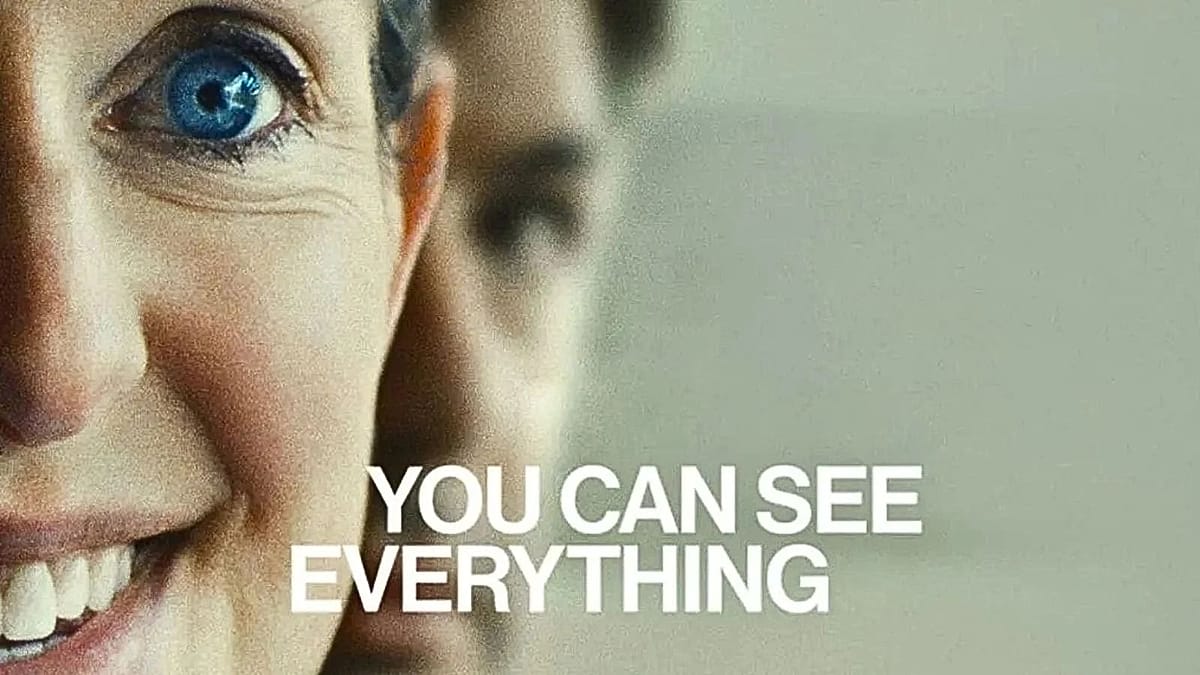
NB: This is a spoiler-free review. ADVERTISEMENT ADVERTISEMENT In 2015, Forbes named biomedical entrepreneur Elizabeth Holmes the youngest and wealthiest self-made female billionaire in the US, based on a $9-billion valuation of her company, Theranos. It all came crashing down when the company's revolutionary method of conducting blood tests through a single drop of blood was revealed to have been a scam. Holmes was found guilty of misleading everyone, convicted of defrauding investors, and sentenced to more than 11 years in prison in 2022. The spectacular rise and fall of the disgraced entrepreneur became a Silicon Valley cautionary tale - one which has been adapted into numerous podcasts and books, as well as an HBO documentary by Alex Gibney titled The Inventor: Out for Blood in Silicon Valley and the miniseries The Dropout, for which Amanda Seyfried won an Emmy for playing Holmes. Having exhausted her multiple appeals, You Can See Everything starts 34 days before the infamous fraudster reports to federal prison in May 2023. The Theranos founder and her husband Billy Evans invite a film crew to document her life... Co-directors Nathan Fielder and Lance Oppenheim enter their rented home with the offer of “radical transparency”. For those of you unfamiliar with those names, Oppenheim's work has blended nonfiction storytelling with cinematic formalism, with documentaries including Some Kind Of Heaven and Spermworld, and is perhaps best known for his narrative directorial debut Primetime. As for Fielder, he has made a name for himself as the creator and host of the satirical docu-reality series Nathan For You, in which he plays a fictional version of himself. His follow-up series, The Rehearsal, is another docu-comedy show which blends awkward comedy and irony in a bid to satirically explore the blurring ideas of reality, artifice and performance. Three words which make him and Oppenheim the perfect co-helmers of a film about Elizabeth Holmes. The pair have crafted a fascinating film that resists easy summary or explanation. It's simply one that needs to be experienced and will spark endless discussion and debate. Still, here goes – with no spoilers ahead. For the first part of You Can See Everything, Fielder lurks in the rented beach house, observing Holmes and Evans' quotidian, and asks blunt questions about Theranos and life after the conviction. Holmes obfuscates, stares at a skeptical Fielder with her unblinking bugeyes, and unwaveringly asserts that "the world believes a reality about me that isn't true". The convicted scammer is adamant that she hasn’t committed a crime – so much so that she comes off as more than a pathological liar. Holmes seems to believe in her version of events and has bypassed the reality of her manipulation. Either she's a master storyteller, like Oppenheim and Fielder, or she lives in some sort of alternate reality of her own making. Or both. Throughout, Fielder says the quiet things out loud, and even calls out Evans, asking him: "Why are you being so weird and cryptic with your words?" The footage is revealing, tense, at times shocking, and often dryly hilarious. Halfway through the film, Holmes goes to prison. Two years pass. The claustrophobic huis clos ends and perspectives shift (and not for the last time), as Evans assumes his wife's place as the documentary's secondary and unnerving subject. He was already a troubling presence in the beach house, evidently just as manipulative as Holmes and with no compunction about being filmed in the shower, with a full-frontal shot which no one asked for. Plus, seriously: What kind of sociopath brushes his teeth while showering? Like his saucer-eyed wife, Evans never seems to blink, and we witness him trying to control the narrative of the documentary. Concurrently, he announces that he can speak for Holmes and has turned her incarceration into a business model of sorts, believing Theranos 2.0 is on its way. What follows – like the film as a whole, in fact – deserves to go unspoiled and is best seen with no foreknowledge whatsoever. What is fascinating about You Can See Everything is its ever-deepening layers and the way it subverts itself and the audience's perceptions through its very deliberate motions. It starts off about two people gaslighting themselves and others. There's a sizeable amount of schadenfreude that decries from this, as seeing the imminent final act of snake oil saleswoman feels like just retribution. However, it feels like tense game of "Who's playing who?", with the folie à deux shared by Holmes and Evans quickly becoming a folie à trois with Fielder. It then becomes an unnerving folie à plenty with the viewers, as witnessing the footage is akin to plunging into another person's parallel reality in which their delusion has taken hold and threatens to spread. It then morphs from a manipulator who has convinced herself that she wasn't manipulating anyone to a woman seemingly being manipulated by a partner who attempts to manipulate others via manipulating the documentary and its filmmakers, who see through the manipulation and lead the audience back to the question: Who's manipulating who? Still with us? Good. And just when you think you've got You Can See Everything figured out, a surprise guest star or a new thematic strand is introduced, leading to more meditations in what can only be described as an ever-multiplying matryoshka doll. As the riveting mise en abyme touches upon deception, so too does it explore the limits of performance, language and communication. From the text message sent by Holmes to Fielder - "You can totally see everything" (with the word 'can' doing a lot of heavy lifting) - to that standout scene in which Fielder shows the couple the famous Abbott and Costello routine "Who's on First?", a single word or a supposed misunderstanding can be used as a loophole. Or worse, can be twisted to alter perception. In this respect, You Can See Everything becomes a damning portrait of our modern times, in which Fielder and Oppenheim expose how we are exploited by grifters who have drunk their own Kool Aid and expect us to follow suit. Elon Musk is mentioned several times during the documentary, and that's no fluke. Whether it's the X founder attempting to impose and manipulate under the guise of progress and his version of free speech; the Sam Altmans of this world encouraging us to surrender the very act of critical thought to machines; the Zuckerbergs who cloak their insidiousness in so-called innovation... The fact is we are constantly allowing ourselves to be fooled by charlatans in the age of the con artist. Why? Is it because they've understood that the stories and lies we tell ourselves can be exploited? That language and intent have become elusive and malleable concepts? Can it be because truth isn't just the first casualty of war; it's also the first thing to go when we willingly give up our ability to think critically? Not that You Can See Everything topples into nihilism, asserts that no truths can be known, or ignores the crucial matter of accountability. It just dares to question and go further. In its final moments, it unexpectedly reveals a blink-and-you'll-miss-it moment pertaining to the arbitrary labels of fiction and nonfiction, confronting the nature of objectivity within documentary filmmaking, and questioning how our judgements are shaped. It sounds like a lot. And it is a head trip when you replay the film in your mind or discuss it with a fellow moviegoer. As Feilder says in the film's closing moments: "It's very complicated". But as thought-provoking, confounding and heady as You Can See Everything can be, it is also simply an absurdist and fascinating watch from start to finish. No matter how deep you choose to go down the rabbit hole, you can file it alongside the likes of Cameraperson, Grizzly Man, Citizenfour, The Act Of Killing, The Imposter and No Other Land as a defining piece of modern documentary filmmaking. You can also hope that history will be made when Academy nominations come a knockin'... No documentary has ever been nominated for Best Picture at the Oscars. Maybe that can change with one of the strangest and most mesmerising films of the year. You Can See Everything is out now in the UK, Ireland and Norway. Its staggered release in European cinemas continues this year, with theatrical release dates in Italy (27 November), Germany (3 December), Spain (25 December) and France, Belgium and Luxembourg (30 December).
Euronews Culture's Film of the Week: 'You Can See Everything' - Is this Elizabeth Holmes doc 2026's best film?
Full Article
Original Source
Read the full article at Euronews →KhanList aggregates and links to publicly available news content. We do not host full articles from third-party sources. Always verify important information with original sources.