
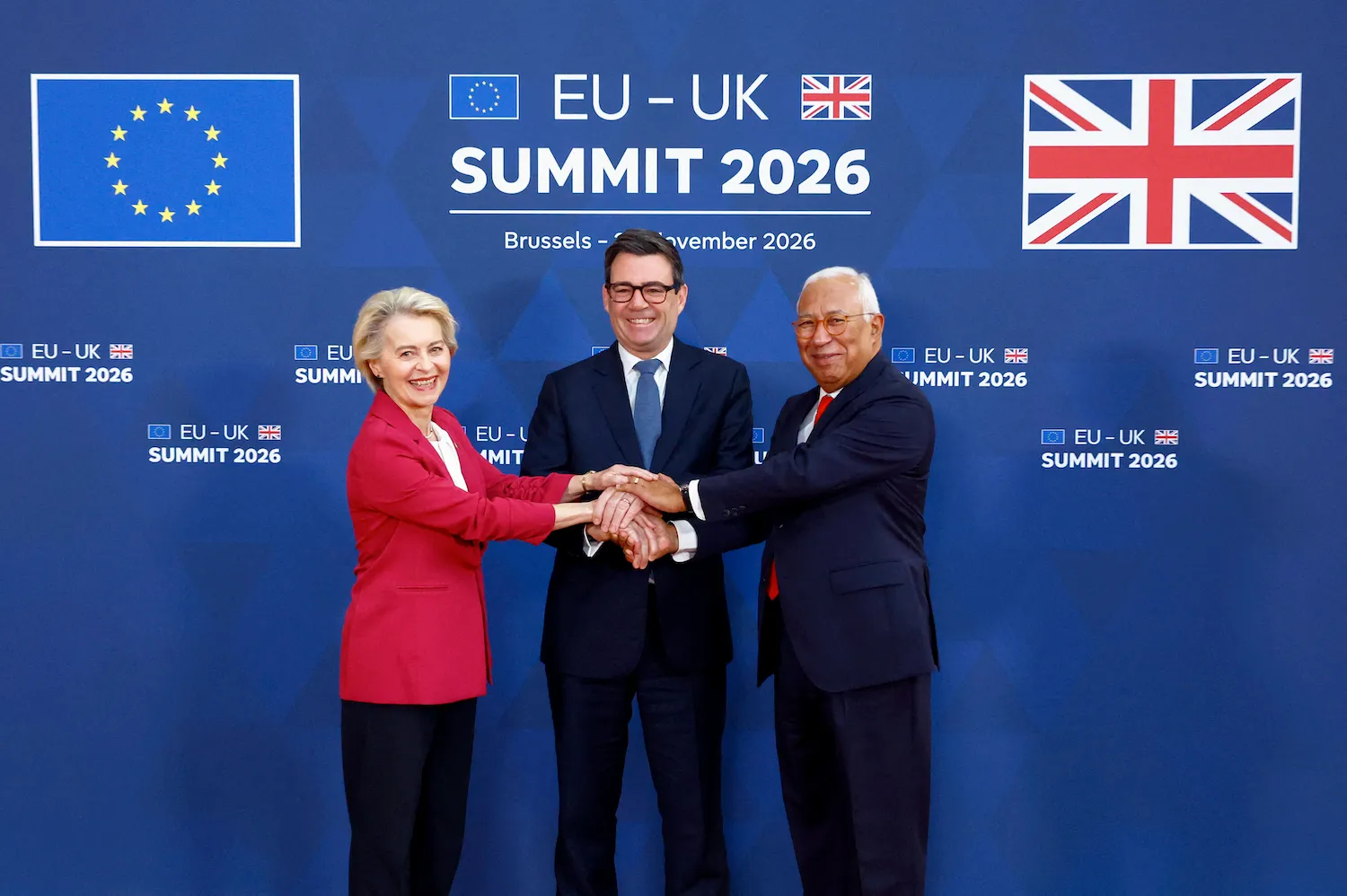
Welcome back to World Brief, where we’re looking at joint EU-U.K. efforts to reverse Brexit, Russia’s latest incursions into Poland, and the future of Myanmar’s Rohingya population. A Brexit Reset Ten years after the United Kingdom voted to leave the European Union, Brexit is back on the table. This time, though, London appears eager to reverse some of the barriers created by Brexit and bridge the decade-long divide between Britain and the bloc. Welcome back to World Brief, where we’re looking at joint EU-U.K. efforts to reverse Brexit, Russia’s latest incursions into Poland, and the future of Myanmar’s Rohingya population. A Brexit Reset Ten years after the United Kingdom voted to leave the European Union, Brexit is back on the table. This time, though, London appears eager to reverse some of the barriers created by Brexit and bridge the decade-long divide between Britain and the bloc. At a highly anticipated EU-U.K. summit in Brussels on Friday, British and EU leaders unveiled a modest deal to begin resetting the relationship. Under the agreement, the EU and United Kingdom will realign their carbon emissions trading systems; relax restrictions on food and agricultural trade—a major win for British farmers who have long complained about tedious export paperwork; and kick-start a “youth experience” program focused on travel, study, and work. Although these are minor changes compared to the breadth of the 2016 Brexit framework, British Prime Minister Andy Burnham said on Friday that the deal could inject more than $22 billion into the U.K. economy in what he called the “single biggest growth measure we could take in this Parliament.” “Today we draw the line on a decade of drift and division by reconnecting with old friends, by building a much more constructive relationship with our nearest neighbors and our largest market,” Burnham said. According to a YouGov poll published in June, a majority of Britons believe that leaving the EU was a mistake and that London should move toward rejoining the bloc. Burnham has capitalized on this discontent, ignoring warnings from Conservative and Reform UK lawmakers who are against reopening the Brexit debate. “It’s like the emperor’s new clothes—where no one is prepared to say the obvious truth,” Burnham said on Monday ahead of the summit. “We have lost more than we have gained in the last 10 years.” A National Bureau of Economic Research working paper found that by the end of 2025, Brexit had cut British GDP by 6 percent to 8 percent and investment by 12 percent to 13 percent. Analysts suggest that global insecurity fueled by Russia’s war in Ukraine, the U.S. trade war, and energy market unpredictability have further convinced Britons that a post-Brexit world comes with greater instability. “Our security and defence partnership, as well as our united support for Ukraine, are central to our commitment to address together the growing geopolitical challenges we face,” European Council President António Costa wrote on X on Friday, adding that the “EU and the UK are both stronger when we work together.” It is unclear how much closer the bridging of ties will go. For every step toward dismantling Brexit, Burnham is expected to face backlash back home. “This is a total betrayal of Brexit Britain,” far-right Reform UK leader Niger Farage, a chief architect of the 2016 vote, said last month after Burnham floated restoring freedom of movement with the EU. On Brussels’s side, though, the EU remains open to having “the closest possible relationship” with the United Kingdom, Costa said. Today’s Most Read Shenzhen Was No Yalta Conference by James Palmer America and China Are Trying to Alter Their Economic Bargain by Aaron L. Friedberg The U.S. Tech Outage Wave, Explained by John Haltiwanger What We’re Following Missile incursions. Two Russian cruise missiles and a suspected drone entered Poland on Friday, adding to the growing number of reported Russian incursions into NATO territory in recent months. The incidents occurred while Russia was carrying out a massive overnight bombardment on Ukraine. The intrusions coincided with European military exercises in Poland that began on Nov. 9; one Russian missile reportedly crashed only 22 miles from where the drills were taking place. No injuries were reported; however, Polish Defense Minister Wladyslaw Kosiniak-Kamysz said it was “not accidental” that Russia’s incursions and the European military drills occurred in tandem. “We are dealing with an intentional provocation” by Moscow, Polish Prime Minister Donald Tusk added. Moscow has yet to comment. According to Ukrainian Deputy Energy Minister Artem Nekrasov, Russia’s nighttime barrage also triggered emergency outages across 11 Ukrainian regions as strikes on critical energy infrastructure forced three nuclear power plants to reduce generation. Russian attacks on Friday also reportedly hit apartment buildings, medical facilities, and bridges. Moscow’s Defense Ministry said it targeted sites where weapons were being manufactured. Genocide ruling. Myanmar’s military-run government on Friday denounced an International Court of Justice (ICJ) ruling that found the country’s security forces guilty of genocide against its minority Rohingya Muslim community. The landmark decision, issued on Thursday, marked the first time that the court has found a country to be directly responsible for the crime. “The court finds that Myanmar’s security forces killed thousands of Rohingya civilians, perpetrated widespread acts of sexual violence, as well as acts of extreme violence against children, and attacked fleeing Rohingya as they sought to flee in large numbers,” ICJ President Yuji Iwasawa said during a readout of the 9-6 ruling. Myanmar’s Foreign Ministry called the decision a “great disappointment” and noted that the judgment was not unanimous. It also said that the roughly 1.3 million Rohingya refugees in neighboring Bangladesh will only be allowed to return “when situations permit.” However, Tom Andrews, the former U.N. special rapporteur on human rights in Myanmar, told Foreign Policy that a 9-6 result is still a “strong majority.” But he said that the international community must take additional steps to ensure that the country’s ruling junta faces real repercussions for its actions. “Because the thing is, if we establish that there is no consequence for genocide, then we can be guaranteed that genocide is going to happen again,” Andrews said. “And it’s only by imposing consequences that we can begin to see justice prevail, not only in this case but in future cases.” Resetting relations. Chinese President Xi Jinping celebrated a “comprehensive turnaround” in his country’s relationship with Australia on Friday. Speaking on the sidelines of the Asia-Pacific Economic Cooperation summit, Xi said that Beijing is eager to set aside the two nations’ differences and expand cooperation in several critical sectors, such as artificial intelligence, energy, agriculture, and mining. China is Australia’s top trading partner. However, ties between the Indo-Pacific powers began to deteriorate in 2020 after Canberra called for an inquiry into the origins of the COVID-19 pandemic, prompting China to impose punitive tariffs on Australian goods. In recent years, though, Australian Prime Minister Anthony Albanese has sought to restore bilateral relations, especially as the future of his country’s critical iron ore industry comes under threat. For decades, Chinese iron ore purchases have invigorated Australia’s economy; the vital resource was exempt from China’s 2020 duties. But with Beijing diversifying its partnerships in Africa and Latin America, where iron ore can be supplied more cheaply, as well as exercising increased leverage over iron ore pricing, Canberra is worried that its export earnings will take a major hit. What in the World? On Wednesday, Iranian forces targeted a U.S. air base located in which country? A. Kuwait B. Cyprus C. Oman D. Germany Odds and Ends While Trump can brag about Xi meeting him on the tarmac in Shenzhen, China, this week, Mexican President Claudia Sheinbaum has something she can brag about from her trip, too: going viral on Chinese social media. After spending the roughly 21-hour trip from Mexico City to Shenzhen (with a stopover in Tijuana, Mexico) sitting in a middle seat on an economy flight, Sheinbaum was greeted at the airport by a military guard and a dancing troupe. But they didn’t meet her at her plane—instead, she arrived to the welcome ceremony via airport bus. Her down-to-earth travel style seems to have appealed to many Chinese netizens: A hashtag about her arrival was seen 10 million times on the Chinese social media platform Weibo, according to Bloomberg. And the Answer Is… A. Kuwait The tit-for-tat strikes between Iran and the United States this week marked an end to a roughly two-month lull in such attacks, FP’s John Haltiwanger and Rishi Iyengar write in Situation Report. To take the rest of FP’s weekly international news quiz, click here, or sign up to be alerted when a new one is published.
EU, U.K. Agree to a Brexit Reset
Full Article
Original Source
Read the full article at Foreignpolicy →KhanList aggregates and links to publicly available news content. We do not host full articles from third-party sources. Always verify important information with original sources.