
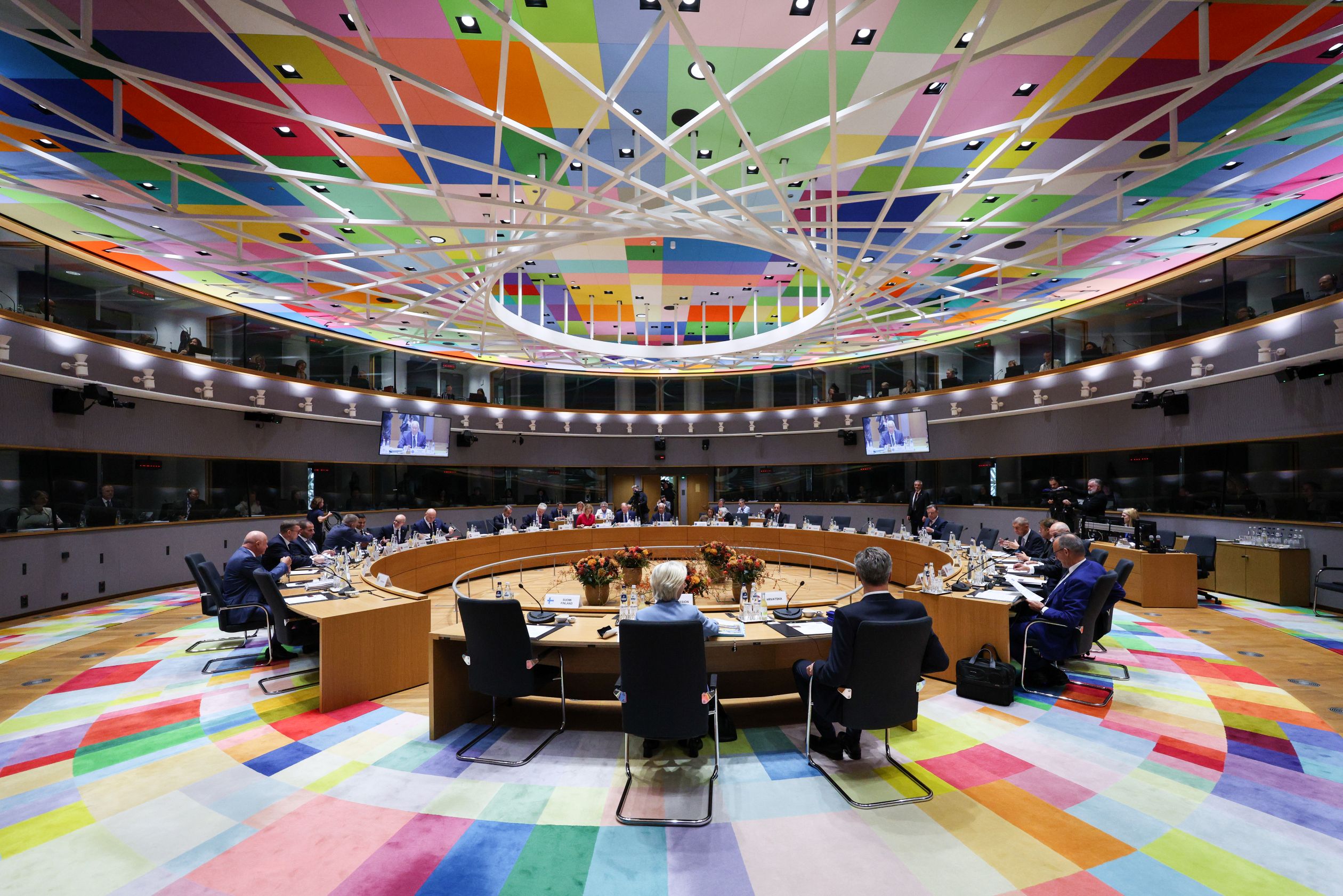
The European Union's 27 leaders are meeting as they race to negotiate deals before next year's French presidential election, with a far-right anti-EU politician leading the polls.(CN) — The divisions and array of crises facing the European Union were on full display Thursday as the bloc’s 27 leaders met for a two-day summit in Brussels.By Thursday evening, it looked like EU brass risked ending the meeting Friday without major breakthroughs on some of its most pressing problems.The bloc’s 27 national leaders met behind closed doors to deal with soaring fuel prices, a ballooning trade deficit with China, funding the next seven-year, 2-trillion-euro ($2.2 trillion) EU budget, maintaining high levels of support for Ukraine and deterring an increasingly aggressive Russia.But the opening day of the summit was marked by disagreement. Most EU decisions require unanimity among member states, and that threshold consistently hampers the EU’s ability to make decisions.To rein in fuel prices, European leaders discussed relaxing or scrapping environmental rules targeting carbon emissions and looked at relaxing fiscal rules to help businesses and households cover the steep rise in fuel prices. But those proposals were shot down.On China, officials appeared ready to step back from taking tough trade measures against Beijing following a deal struck last week that curbs Chinese exports of hybrid cars into Europe.Under the deal, the EU will allow 350,000 Chinese hybrid cars onto the European market annually over four years.In return, China agreed to ease export restrictions on rare earths essential for European companies and lifted tariffs on EU car parts, olive oil and footwear.For now, the EU appeared satisfied with that arrangement and scaled back talk of hitting China with trade measures that risked sparking a wider trade conflict. Views differ widely on how to confront China, which Europe accuses of unfairly subsidizing its industries and barring European companies from entering some sectors.Europe has become increasingly alarmed over its growing trade deficit with China. Chinese imports surged by 25% last year with the deficit hitting a record-high 360 billion euros.European businesses and policymakers say Chinese goods are throttling key economic sectors, such as car manufacturing, and wiping out tens of thousands of industrial jobs. But Europe’s export-driven economies rely heavily on China and many economists warn against a trade war.Divisions opened up over funding the next EU budget too.Led by Germany, a group of richer countries that pay more into the EU budget than they get back are demanding cuts while a majority of states fought for higher spending.Across Europe, national budgets are strapped as governments step up spending on defense to counter Russia and seek to boost productivity through public investments at a time of slow economic growth. These fiscal pressures have made the EU budget talks even more fraught.“We are facing very, very difficult negotiations,” German Chancellor Friedrich Merz told reporters when he arrived at the summit. He said leaders were “still very far apart” and that budget talks would carry over to the next European Council summit in December.“Pack a few extra shirts,” he quipped, suggesting the December summit could last longer than scheduled. European Council summits are well known for going far into the night.Merz has called for cuts of hundreds of billions of euros to the budget.There is a sense of urgency to get a budget deal sealed before presidential elections next year in France due to the possibility that far-right anti-EU leader Marine Le Pen may take over in Paris. She is ahead in the polls.Le Pen has talked about slashing France’s contribution to the EU budget, arguing the debt-strapped nation needs to cut back on its expenses. She also has railed against the allocation of 100 billion euros in the EU budget for Ukraine.She went to Brussels on the eve of the summit and called it a “democratic scandal” that EU leaders were rushing to pass the 2028-2034 EU budget before France’s spring election.Courthouse News reporter Cain Burdeau is based in the European Union.Subscribe to our free newslettersOur weekly newsletter Closing Arguments offers the latest about ongoing trials, major litigation and rulings in courthouses around the U.S. and the world, while the monthly Under the Lights dishes the legal dirt from Hollywood, sports, Big Tech and the arts.Additional Reads
EU summit exposes rifts as leaders struggle for breakthroughs on fuel, budget
Full Article
Original Source
Read the full article at Courthousenews →KhanList aggregates and links to publicly available news content. We do not host full articles from third-party sources. Always verify important information with original sources.