
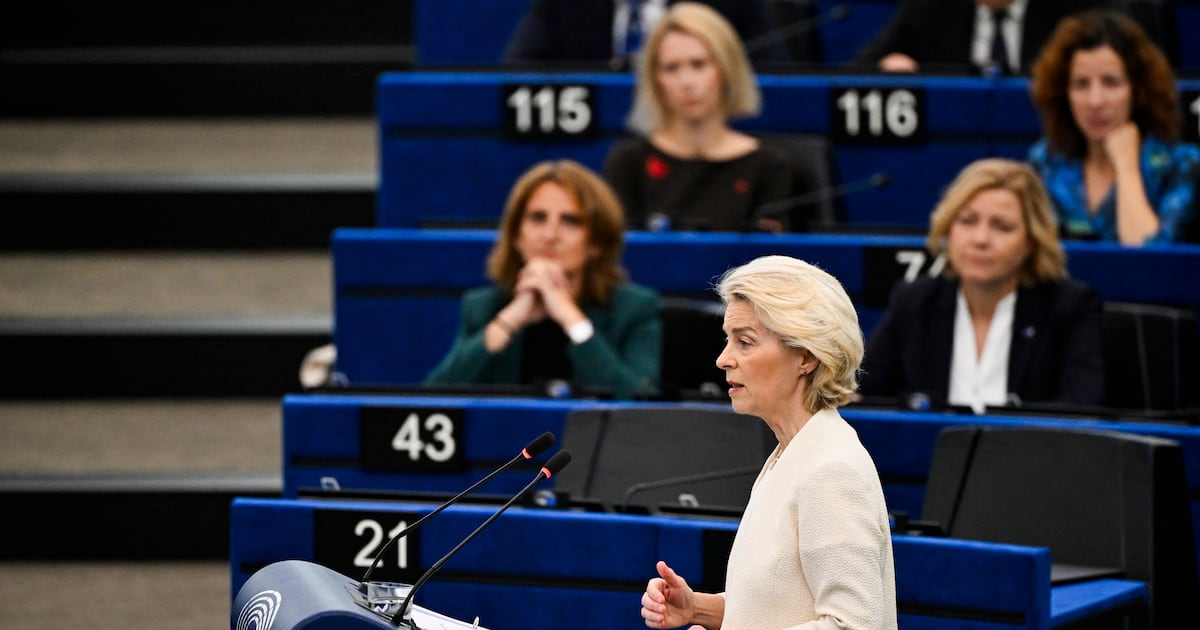
European Commission president Ursula von der Leyen said the European Union is opening the door for Canada to become the first associate member, a status that does not exist under the bloc’s treaties.“Partnerships are a strategic choice for Europe. But they also respond to the fracture in the international rules-based system,” von der Leyen said in her annual state-of-the-union address in Strasbourg.Canadian prime minister Mark Carney, who was present in the European Parliament’s Strasbourg chamber for the speech, is due to deliver his own address to MEPs on Thursday. “We believe that power does not belong to the strongest, the richest or the loudest -but to all of us. That democracies have the freedom to choose with whom to work,” von der Leyen said. READ MORE“We see the world with the same eyes: from AI to climate change, from the Arctic to geopolitics. And we have stood together: on Ukraine, on defence, on raw materials and on supply chains. But above all ... Europe and Canada believe in democracy.” She said Europe finds itself in an “openly hostile” world where old relationships have “frayed” and an aggressive Russia wages a war on the Continent. The head of the EU’s powerful executive warned that hybrid attacks were being carried out by “Russian operatives” on Europe soil, which constituted attacks on individual member states, but also the wider union. “We should be under no illusions about what is happening here, hybrid threats facing Europe are less and less hybrid and less and less threats. Cyberattacks and sabotage, arson and drone incursions, they are ramping up every day,” the German politician said. The EU’s system of decision-making had not kept pace with a changing and more dangerous world, the commission president said. There was an urgent need for a consensus on how EU states should respond to Moscow’s hybrid incidents and incursions, which she said “fall below armed aggression but clearly threaten our national security”. Von der Leyen proposed the new mechanism that would “flank” Nato’s existing article four procedure that allows a member of the western military alliance to report security concerns for debate. This is separate to Nato’s article five clause, the key security guarantee of the alliance, which treats a military attack on one member as an attack on the entire group. Delivering her speech to MEPs, von der Leyen said the EU lacked a common playbook to counter Russia’s hybrid attacks. “I believe it is time for Europe’s own Article 4 – or an emergency security protocol. When triggered by one member state, all member states would convene to co-ordinate a European response to deter further escalation and to mitigate the impact,” von der Leyen said. The president of the commission, the powerful Brussels-based body that proposes EU laws and regulations, said Europe would “defend each and every single square metre of its territory”. Von der Leyen called for summits focused on security bringing together the EU’s 27 national leaders and the leaders of the UK, Ukraine, Canada and other allies. Von der Leyen criticised Israel’s E1 plan to expand settlements in Occupied Palestinian Territories as “unacceptable”.The centre-right politician said the commission last year had proposed an EU-Israel free trade deal be suspended, but member states had been “unable to build the necessary majorities”, to approve such sanctions on Israel.More recently the commission has been criticised for refusing to table a proposed ban on trade coming from illegal Israeli settlements.Elsewhere in her lengthy address, von der Leyen said Europe’s economy had withstood the impact of the Iran war “better than expected”, but businesses were facing real pressure from higher energy prices. The EU’s trade deficit with China had reached a “tipping point” that was leading to the “unsustainable” closure of factories and plants in the industrial heartlands of Europe, she said. Negotiations between Brussels and Beijing had to rebalance the trading relationship, the commission president said. Von der Leyen said a heatwave that swept across Europe this summer was a “mere preview” of a heating climate. “There can be no repeat of this summer. This is why we will also soon present a European heatwave plan. We need better early warning systems and better health preparedness,” she said. As expected, the commission president announced plans for EU restrictions to prohibit children under the age of 13 from accessing social media platforms, called the EU Kids Act. Between the ages of 13 and 15 teenagers would have access to “mini accounts” set up and supervised by their parents, which had limited features and restrictions on screen time, she said.
EU opens door for Canada to become first associate member, EU Commission president says
Full Article
Original Source
Read the full article at Irishtimes →KhanList aggregates and links to publicly available news content. We do not host full articles from third-party sources. Always verify important information with original sources.