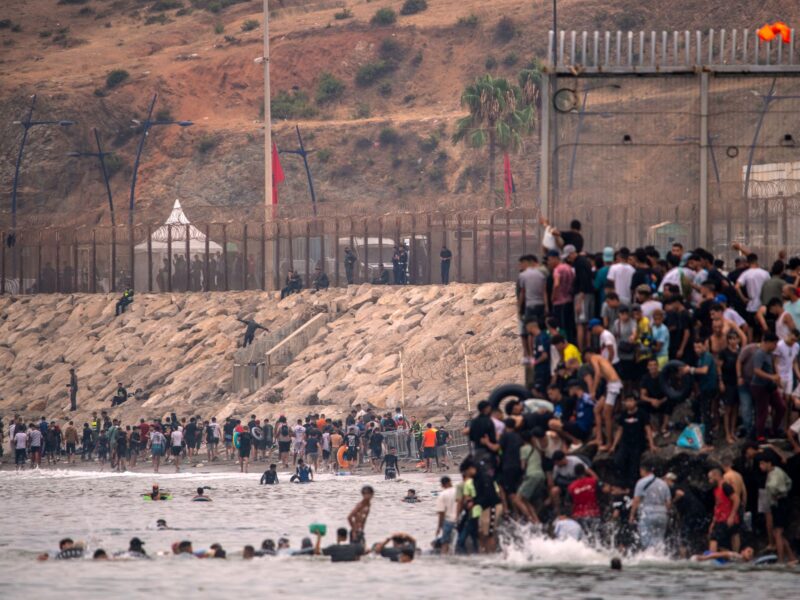
(CN) — The European Union’s harsh new legal framework against migration — the source of fierce disagreement between Europe’s right and left — came into sharp focus Tuesday at an emergency meeting following last week’s deadly storming of Spain’s heavily guarded colonial-era exclave of Ceuta on the coast of Morocco.Over two days of chaos, dozens of people, mostly young Moroccan men, died as they tried to swim across bays, climb barbed-wire fences and breach gates around Ceuta. Many drowned or were crushed in stampedes, authorities said. Investigations are underway by Spanish authorities.A lot remains unclear about what led more than 70,000 people to storm Ceuta, a fortified Spanish city of about 80,000 people on the African side of the Strait of Gibraltar.It is one of two Spanish exclaves in North Africa that have long been the scene of clashes between border agents and migrants seeking to force their way past fences as a route into the European Union. Adding to tensions, Morocco claims the cities as its own.But last week’s storming was by far the largest ever and left Spanish border agents unable to stop the mass of people.For about 48 hours between late Thursday and Saturday, Ceuta was overwhelmed as the intruders took over parks, boulevards and stores.Over the weekend, Spain deployed large military contingents to patrol the city and bring it back under control. About 200 people who breached Ceuta’s fences remained under processing for asylum, though they were mostly boys and young men protected from expulsion by their status as unaccompanied minors.By Tuesday, the death toll had risen to at least 83, according to the Associated Press. The AP said 72 bodies were recovered on the Spanish side of Ceuta’s 5-mile border with Morocco.So far, Spanish authorities have limited themselves to blaming human traffickers, but experts believe other actors, including Morocco’s officialdom, may have been involved in stoking the mayhem for cynical political reasons.The fallout from last week’s dramatic events have proved very damaging to Spanish Prime Minister Pedro Sanchez, one of Europe’s last remaining left-leaning leaders amid a surge in conservative and far-right parties in most EU countries.His grip on power was already under immense strain due to corruption probes and a right-wing opposition gelling into a formidable force. Only last week, Spain’s center-right Popular Party announced it was open to reversing a policy against governing with Spain’s ultra-nationalist far-right Vox party.Speaking to reporters in Brussels, the European Commission’s top official for migration said the events in Ceuta underscored the need to do even more to seal the bloc’s borders against “illegal migration.”His comments came amid acrimonious debates over the extent to which the EU should safeguard the lives and rights of people seeking refuge from poverty, war, climate change, persecution and disease.Conceived in the aftermath of the horrors of World War II, the European Union was engineered in a manner to become a beacon of human rights. But that aspiration has been gravely weakened by the bloc’s stone-cold attitude toward migrant deaths in the past decade, its cooperation with authoritarian regimes and more recent refusal to punish Israel for its wide-scale human rights violations in occupied Palestinian territories.In June, Europe began enforcing a harsher migration regime that grants authorities sweeping powers to arrest and deport migrants and set up camps outside the bloc where migrants can be processed. Many human rights experts say the laws do not comply with international standards to protect the vulnerable.The so-called Pact on Migration and Asylum has not been vetted yet by the EU’s top courts and parts of it could be reversed.Far-right Italian Prime Minister Giorgia Meloni played a big role in getting the tougher laws passed after she seized power in Rome following the coronavirus pandemic. Meloni, like others on Europe’s extreme right, has long railed against immigration from Muslim countries as an existential threat to Italy and Europe’s Christian values.She’s gone further than others in blocking humanitarian vessels from bringing rescued migrants to Italy and she broke a taboo by establishing special camps for migrants in Albania.The legality of her Albania experiment remains contested with the European Court of Justice, the EU’s top court, sending signals that it may uphold them as permissible under EU law. The new pact was written in part to legalize the use of processing centers outside the EU.The far-right’s version of migration as fundamentally baleful to Europe has fused with a common public apprehension that migration is transforming Europe into unrecognizably violent multi-ethnic societies.In the wake of the assault on Ceuta, politicians across a surprising number of parties and countries lambasted Sanchez as partly responsible for the disaster in Ceuta due to his embrace of immigrants.Last month, Sanchez’s left-wing coalition government went against the anti-immigrant trend by opening a path to citizenship for more than 1 million people living in Spain without a residency permit. Most of those eligible are from Latin America.On Tuesday, Magnus Brunner, the EU commissioner for migration, also took aim at Sanchez.“I do understand that with the images we saw, the citizens of Europe were concerned,” Brunner told reporters following the emergency meeting.He said there was broad agreement across the EU that the provisions in the new migration pact should be carried swiftly.He touted so-called “return hubs,” expedited border screenings and asylum processing centers outside the EU as the next steps to take to rein in mass migration.However, many experts warn these policies run foul of international asylum protections and warn Europe is turning its back on a core mission to uphold human rights.The mood in Brussels though is definitely toughening.In a rare rebuke from a European Commission official toward a national leader, Brunner called out Sanchez for his amnesty law for immigrants living off the books.“It’s not a good signal for the rest of Europe,” he said.He said the Ceuta crisis was a “test of our European resilience” and “security of our external borders.”“For the time being, Europe I think has definitely passed this test,” he said. “People did not manage to enter the Schengen area.”He was referring to the EU’s core principle that borders within the bloc must remain open to cross free of border checks. Schengen is a border town in Luxembourg where European leaders in 1985 signed an agreement to do away with border checks to facilitate the movement of goods and people.Brunner praised Europe for reining in immigration.“The numbers show this,” he said. “Illegal migration decreased by 55% last year and it’s [down by] 40% this year.”About 49,000 people have crossed EU borders this year without permission, a massive drop from 2015 when about 1 million people, most them fleeing the Syrian civil war, marched across European borders in search of refuge.He said the number of people entering the EU without permission this year was “roughly about the same as one week in the Greek islands in October 2015.”“By every measure, Europe has not had this much control over illegal migration in decades,” he said.Over the weekend, 22 of the EU’s 27 member states signed a letter criticizing Sanchez for his migrant amnesty.Courthouse News reporter Cain Burdeau is based in the European Union.Subscribe to our free newslettersOur weekly newsletter Closing Arguments offers the latest about ongoing trials, major litigation and rulings in courthouses around the U.S. and the world, while the monthly Under the Lights dishes the legal dirt from Hollywood, sports, Big Tech and the arts.Additional Reads
EU migration chief praises border crackdown as Ceuta death toll rises
Full Article
Original Source
Read the full article at Courthousenews →KhanList aggregates and links to publicly available news content. We do not host full articles from third-party sources. Always verify important information with original sources.