
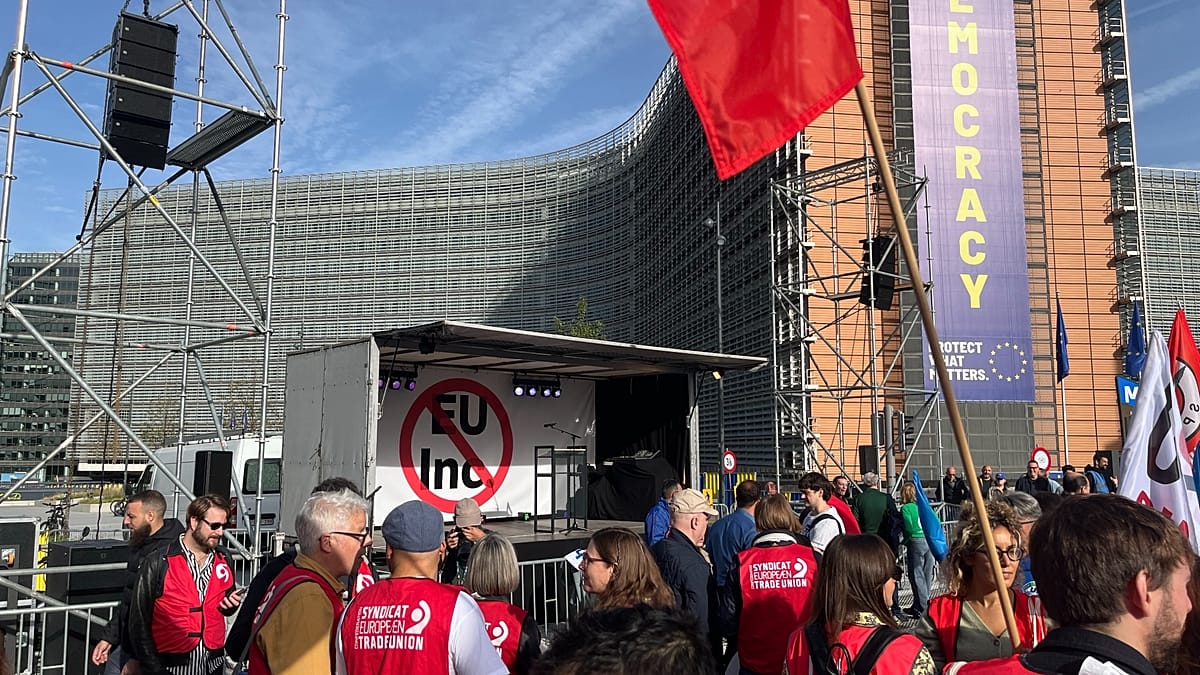
The European Parliament's Committee on Legal Affairs (JURI) failed to vote on its draft report on EU Inc on October 19. ADVERTISEMENT ADVERTISEMENT Known as the “28th regime,” EU Inc. creates unified company rules to reduce fragmentation across the EU’s 27 legal systems, making it faster and cheaper to launch and scale businesses. It would give startups a single pan-European digital company form without changing national company, tax residency or social security rules. But it faces strong opposition. The European Trade Union Confederation (ETUC) warns that loopholes in the current proposal trigger a race to the bottom in pay and workers’ protections, while EU Inc’s founders say months of negotiations are watering down the reforms’ core. What EU Inc promises EU Inc is an EU-wide company type with a single, harmonised rulebook. It would be optional and complement existing national company laws and forms, giving founders another option when starting a business. Under the regime, businesses can register in one member state via the central EU interface takes 48 hours. Minimum capital is €1, and no opening deposit is required. All procedures, including formation, filing, governance, share issuance, and liquidation, are fully digital and incur no notary or chamber fees. Fast, fully digital access to insolvency procedures is included. Existing companies can convert into an EU Inc without dissolving and reincorporating. With a harmonised European Employee Stock Option, Eu Inc would change how equity compensation works, ensuring employees receive options under the same rules and tax principles, wherever they live. Some aspects won’t change. Contracts, working time, dismissal protection, collective bargaining, and works councils remain governed by the country where employees work. Social security remains determined by where they physically work. The proposal creates no new tax regime or changes to tax residency, as companies remain taxed where their effective management sits. Workers’ rights drive the deadlock The Commission presented its proposal on 18 March 2026, aiming to reach an agreement by year-end. However, co-legislators appear far from agreement. The Council examined the text in June, and its working party is now reviewing the Irish Presidency’s second compromise text. Parliamentary negotiations have stalled after JURI failed twice to secure a majority for rapporteur René Repasi’s (S&D) draft report. Repasi named no sticking points, but workers’ rights appear to be the biggest issue. “We have made progress, but we still need to find the right balance for a final agreement Repasi said. For EU Inc to be a “seal of quality”, it needs legal certainty and safeguards for workers against misuse which, he pointed out, has been "entirely absent from the Commission proposal". Should EU Inc become a “vehicle for circumventing labour law rather than a driver of high-quality innovation, it will have failed to deliver on its promise", the rapporteur added. On 24 September and 20 October, ETUC protested the proposal’s lack of safeguards in Brussels and Strasbourg. ETUC Deputy General Secretary Isabelle Schömann warns EU Inc could encourage “regime shopping”. Companies may register in states with weaker labour protections and collective bargaining, then operate elsewhere to evade stronger laws and enable social and fiscal dumping. ETUC says the proposal lets companies avoid informing and consulting workers. Since employees’ board representation varies by country and depends on a company’s registration location, firms could register where it doesn’t exist, excluding workers from decisions. Businesses could replace wages or employment contracts with stock options, as no clear ban prevents paying workers in shares or supplementing low wages with them, Schömann said. For Repasi, options are valuable for attracting and retaining talent, but he warned that “such schemes should never replace fair wages, pensions or social security contributions”. EU Inc companies could use fast-tracked liquidation, even if they have outstanding payments. This means unpaid wages, severance, or social security contributions for laid-off workers, while social security authorities have only limited time to review and object, according to ETUC’s own legal analysis report. “Faster procedures can reduce unnecessary administrative burdens, but speed must not come at the expense of creditors’ rights, employees’ claims or the effective enforcement of legal obligations”, Repasi warned. Negotiators want to reach an agreement by year-end. However, this will depend on the "willingness of all parties to work constructively,” the rapporteur said, calling on the Commission to be “an honest broker”. “It must facilitate a fair process and help both co-legislators find common ground, without favouring one position over the other”, Repasi told Euronews. For Schömann, negotiators are overlooking one crucial aspect. Access to investment is the biggest obstacle for startups and scale-ups, and it is essential to keeping them in Europe, she said, but “we don't see where these new businesses will get access to investment” through the EU Inc reform. Is EU Inc still keeping its promise? Although trade unions are pushing for stronger worker protections, EU Inc's founders are warning that months of negotiations are watering down the reforms' core. On 15 October 2026, the EU-INC campaign issued an urgent warning to European leaders, accusing policymakers of weakening the proposal through months of negotiations. Backed by more than 26,000 founders, investors and entrepreneurs across Europe, including figures associated with Stripe, Klarna, Mistral AI and Atomico, the campaign declared: “The EU Inc you championed - one that will enable Europe to compete at scale - no longer exists.” Simon Schaefer, co-initiator of the EU-INC campaign, told Euronews that the original ambition had been to create a genuinely European legal framework, rather than one dependent on national courts. "Instead, the commission has chosen the version in which national member state courts [are] responsible for dispute resolution. And that alone is [...] not the major moonshot that we originally asked for because it does have 27 flavours to a degree", he said. According to the campaign, allowing member states to introduce national exceptions and different requirements risks creating 27 variations of the same framework. Schaefer argues that, if a fully unified European system is no longer achievable, startups must at least be able to choose the member state offering the most suitable corporate framework. "The company or corporate law, company law, labor law, tax law, all of these things are so intertwined and so complex that we believe the best possible outcome of the current proposal of the commission is for 1 2 3 member States in Europe [to] build the possible framework for startup[s]", he said. One major disagreement is about the proposed central European company registry, which was removed from an initial Council compromise draft. Founders argue that a single register for standardised company information is essential for simplifying banking, investment and compliance procedures across borders. They also oppose restrictions on employee stock options, including limits based on company size and turnover. Such restrictions could prevent growing businesses from benefiting from the framework. But the question of who should benefit from EU Inc is also raising concerns. Although designed primarily for startups, the Commission's proposal contains no general restrictions on company size or age. Large, established businesses could also choose EU Inc, raising questions about whether simplified rules intended for young companies could be used by corporations seeking more favourable governance arrangements. The proposal also has a central contradiction: companies could register in one member state while being managed from another. Because tax residency remains governed by national rules, a company registered in Ireland but operating from Germany could still face German tax obligations and cross-border compliance questions. For Schaefer, however, this is one of the proposal's most important advantages: "The free choice of administrative HQ would make the same possible for within Europe. So, you could register your company in any choosing in any country of member state of your choosing, but you could still physically be in another member state and pay your taxes there." A single registration process would not necessarily mean a single legal environment. National laws would also continue filling gaps in the European framework, potentially preserving differences between member states, even if the rules for setting up a company are harmonised. Another issue is the legal basis. The Commission relies on Article 114 of the EU treaties, which allows the alignment of national legislation to improve the single market. However, the European Company Law Experts group questions whether this provision can legally support a separate, optional company structure. Then there's the problem of the speedy digital registration process, which has raised concerns about fraud prevention. The proposal retains certain administrative, judicial or notarial checks, but Germany's Federal Chamber of Notaries argues that identity verification and legal safeguards are insufficient, potentially increasing the risks of shell companies, fraud and money laundering. The Commission, however, maintains that safeguards against abuse will still be in place. And responding to trade unions' concerns that EU Inc could weaken workers' rights, Schaefer argued that safeguards should target abuses directly, including preventing businesses from using stock options to circumvent minimum wage requirements. "We are available and willing and wanting to design the right tools to prevent fraud. We're in unison with the trade unions that we do not want to abuse workers' rights. It should never happen", Schaefer said. The EU-INC campaign wants EU leaders to restore five essential elements: freedom to register in any member state, access for companies of all sizes and sectors, a single European registry, harmonised stock options taxed when shares are sold, and national tax and employment obligations linked to actual economic activity. But if the negotiations compromise those demands, the campaign could seek to delay the legislation rather than accept a watered-down version, Schaefer warned. "If we see an indicator that it will not or that there's too much compromise then we will try to Find a way to delay it and to do it proper. For us speed is not the main decisive factor. For us getting it right is almost more important right now than the actual speed."
EU Inc: Why the Commission's perfect startup plan might be falling apart
Full Article
Original Source
Read the full article at Euronews →KhanList aggregates and links to publicly available news content. We do not host full articles from third-party sources. Always verify important information with original sources.