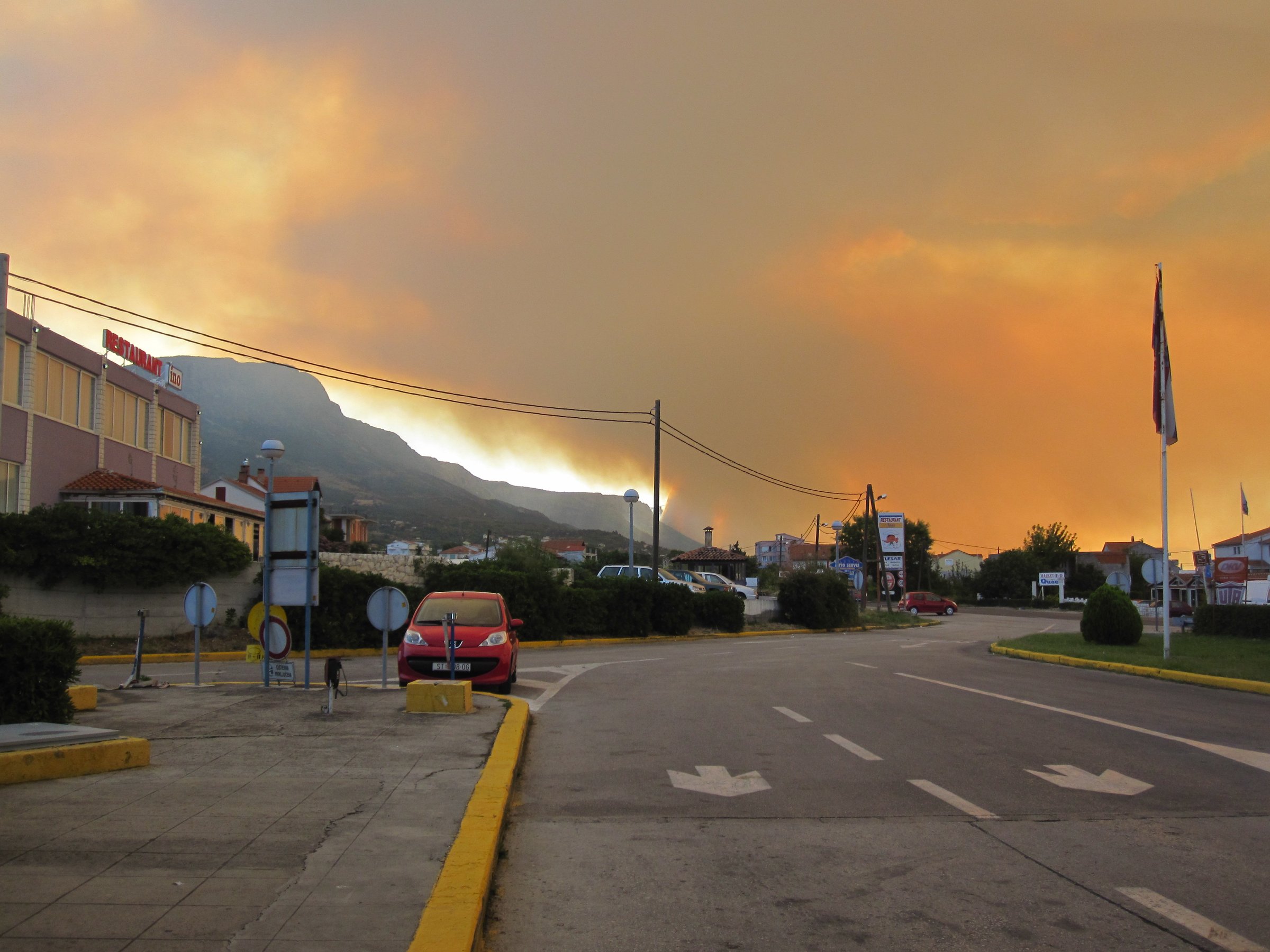
A Dutch bank has warned that Europe risks falling into a “doom loop” in which climate damage slows economic growth, prompting governments to weaken climate policy, and so leaving the continent even more exposed to future heatwaves. Triodos Bank puts the price of this summer’s record temperatures at €180bn in a recent analysis, wiping out all forecasted growth this year. And the bank’s economists said that Brussels was“making the problem worse” by weakening the EU’s carbon pricing system for industry and energy companies. Operational since 2005, the EU’s Emission Trading System (ETS) puts a price on industrial pollution by making companies pay for permits covering every tonne of CO2 they emit. By the commission’s own estimates, emissions from the more than 10,000 installations covered by the system have fallen by 50 percent since its launch, including a 24-percent drop in 2023 and a further 11 percent in 2024. But national governments and a powerful business lobby pushed the commission on 17 July to water down the rules in the name of protecting the bloc’s competitiveness. The decision was made as record wildfires were consuming Europe’s forests and tens of thousands died across the continent due to heat exposure, the economists noted. But rather than protecting growth, they say, the EU is pushing the costs of climate change further into the future. Climate change is bad for business Climate change slows economic growth and undermines competitiveness. Faced with higher costs, partly due to the effects of climate, governments may be tempted again to further weaken green policies in an effort to keep growth in the black. But in doing so, they risk creating a self-reinforcing cycle that damages both the economy and climate action, the bank says. “Let's call this what it is: a doom loop,” wrote the Triodos Bank economists Hans Stegeman, Joeri de Wilde, and Ernst Hobma. In such a scenario, “emissions and exposure both rise” and “the next heatwave, starting from a hotter baseline, [will] cost more than the last.” "Something should have happened by now," they also said: "A summer this hot, this visible, this costly … This ought to be the kind of shock that makes people, and the institutions that represent them, move." Instead, they argued, EU policy makers have treated the "economic logic" that produces global warming as "sacrosanct" even as the environmental damage of that system was becoming “undeniable.” Zero growth Most of the bank’s estimated €180bn economic hit comes from people struggling to work due to the heat, the bank argues. Lost labour productivity alone accounts for around 0.6 percentage points of EU output, especially in sectors such as construction or agriculture where work often takes place outside. Farm losses, constrained power generation and disrupted rail, road, and river transport account for roughly 0.15 points each. France has had the worst of it, losing an estimated 1.4 points of growth, pushing it into redrecessionary territory of minus 0.6 percent growth this year. The Netherlands loses 0.8 points, with overall growth expected to come close to zero this year. Poland, which has had fewer exceptional heat days, still grows around 2.9 percent.Triodos also counted some 25,000 heat-related deaths across Europe this summer, including an estimated 20,400 in France, Germany, Spain and Italy during a single week of heat in late June. Some 434,976 hectares burned across the EU by 30 July, mostly in Spain, Italy and France, and already more than in any full year on record. The bank values the deaths at €1.5bn to €7bn and the burned land at up to €4.6bn in lost ecosystem services, though it says both are probably underestimates. Even if this summer's heatwaves are "bruising" economically, an economy growing at 1.1 percent losing roughly the same again is not yet catastrophic, they write. But climate change remains unaddressed, future heatwaves will become ever more damaging. "These bruises accumulate and will accelerate if we don't take action," they said. And so Europe's choice is to continue to delay efforts to mitigate climate change and subscribe to ever more costly summer heatwaves, or to "start treating climate change like the burning emergency it presents to our wellbeing and our economies."
EU fuelling economic ‘doom loop’ by weakening climate rules during record heatwave, Dutch bank says
Full Article
Original Source
Read the full article at Euobserver →KhanList aggregates and links to publicly available news content. We do not host full articles from third-party sources. Always verify important information with original sources.