
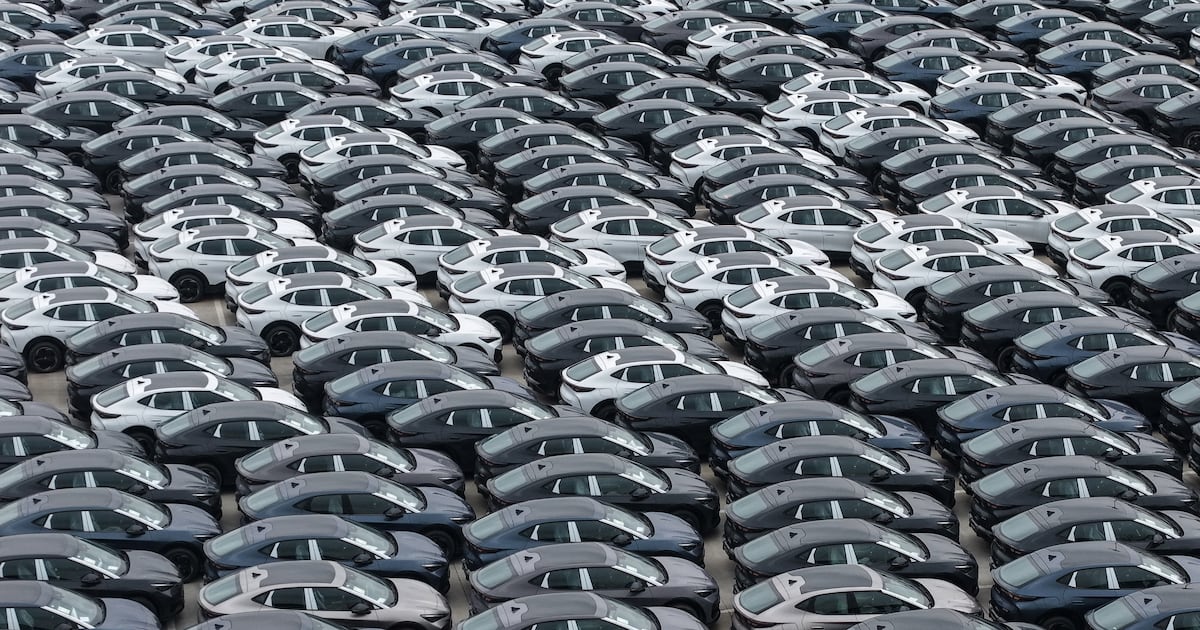
China and the European Union have reached a deal on hybrid cars that could mean Chinese exports to Europe cut by more than half, according to EU trade commissioner Maroš Šefčovič. The agreement came after two days of talks in Beijing between the commissioner and Chinese commerce minister Wang Wentao aimed at averting a trade war.“We have reached a shared understanding to moderate China’s exports of hybrids and plug-in hybrids to the EU,” Šefčovič told reporters in Beijing after the talks ended on Friday. “This opens the prospect of cutting China’s exports by more than a half.”READ MOREIn the days leading up to the talks, EU leaders threatened to introduce measures that could shut Chinese goods out of the single market overnight if Beijing did not agree to take action to address the trade imbalance. [ ‘We’re at a tipping point’: EU prepares its toughest weapon yet against ChinaOpens in new window ]The EU imports €1 billion more in Chinese goods every day than China’s imports of European goods, and some sectors, including the car industry, are especially vulnerable to the surge in imports.EU trade commissioner Maros Sefcovic attending a press conference at the delegation of the European Union to China, in Beijing. Photograph: EPA Šefčovič said that China had agreed to lower tariffs on a number of European products ranging from car parts to olive oil and footwear, worth almost €4 billion. He said the duty saved was the equivalent of a quarter of the savings secured under some of the EU’s most ambitious trade agreements with countries such as Japan and Australia.China agreed to ease the export of rare earths and permanent magnets that are essential to advanced manufacturing and which Beijing has used as leverage in its trade negotiations with a number of partners, including the United States. Šefčovič said the outcome of his negotiations in Beijing was a first step towards rebalancing the trade relationship, but it was far from the end.“It’s a crucial first step, but only a first step in the process of rebalancing. As [European Commission] president [Ursula] von der Leyen has said, dialogue needs results. And where the dialogue cannot deliver, the EU will use its tools to ensure a rebalancing. Naturally, the president will now assess the outcomes and discuss next steps with the leaders at the upcoming European Council in Brussels. That is where the final decision lies,” he said.Before Šefčovič spoke to reporters, China’s commerce ministry released a joint statement from the two sides, describing the talks as “pragmatic and productive”. They agreed to meet next March again and to maintain close communication in the meantime, including in a video call in January.“Both sides reaffirmed their commitment, as key trading partners, to properly managing their differences within the framework of World Trade Organisation (WTO) rules, and to continuing to stabilise bilateral economic and trade relations while making them more balanced,” noted a statement.Before the formal talks began on Thursday, Šefčovič met representatives of the European Union Chamber of Commerce in China, who briefed him on the reality faced by European businesses operating in China. The chamber’s president, Jens Eskelund, said Chinese market access and regulatory barriers handicapped European companies not only in the Chinese market but throughout the world.“What happens in China does not just stay in China. The lack of a level playing field, present in many industries in the country, has facilitated Chinese firms to build the scale and technological capabilities required to offer lower prices in third markets that European suppliers competing on market terms cannot match. The result is global competition on unequal terms,” he said.[ Europe wants to get tough on China. The risks could be enormousOpens in new window ]
EU and China strike deal to curb car exports and avert trade war
Full Article
Original Source
Read the full article at Irishtimes →KhanList aggregates and links to publicly available news content. We do not host full articles from third-party sources. Always verify important information with original sources.