
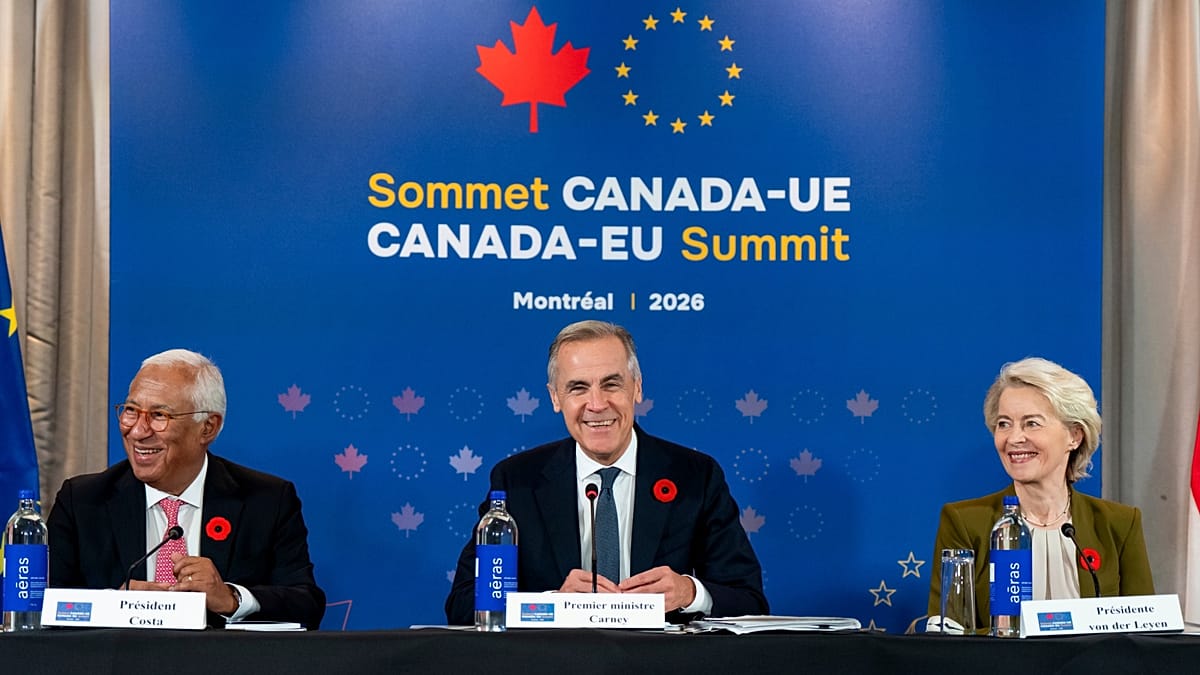
The European Union and Canada have long been friends. But it was not until Donald Trump 2.0 that they realised just how inseparable they had become. ADVERTISEMENT ADVERTISEMENT The two sides are set to bring their partnership to unprecedented depth and breadth at Friday's EU-Canada summit in Montréal, in the French-speaking province of Quebec. "It has become clear that there's much more that we can do together," Ursula von der Leyen, the president of the European Commission, said in a speech at the C.D. Howe Institute peppered with Canadian references, from Emily Carr to Leonard Cohen. "Canada and the European Union are two complementary systems." The choice of venue is fitting: with its stately architecture and Baroque facades, Montréal has often been hailed as one of the most European-looking cities in North America. The setting also reflects the bloc's ambition to make Canada its closest non-European ally, a title traditionally held by the United States. But Trump's re-election flipped the picture on its head. The US president's punishing tariffs, threats of annexation, affinity for Russia and relentless attacks on the multilateral system have left Europeans bruised, battered and increasingly distrustful of any policy with Washington's mark. In Canada, the shock has been maximised by its entrenched reliance on the US economy. The search for alternative allies is now an existential imperative. Trump's attempt to turn Canada into "the 51st state" has demolished a neighbourly bond that stretches back centuries and was believed to be immune to partisan shifts. The shared sense of vulnerability has been on full display in the lead-up to the summit. Von der Leyen invited Canadian Prime Minister Mark Carney to her State of the Union speech in September. The Commission chief stunned the audience when she proposed to make Canada the bloc's first-ever "associate member". Carney delivered his own speech in Strasbourg to pitch an "alliance for the future" built on shared prosperity and security. This alliance, Carney said ahead of the summit, should be "strong enough so that no one can dictate our choices" and "open enough that others can join", a not-so-subtle rebuke to Trump's "America First" maximalism. The meeting is expected to expand cooperation across multiple areas, including trade, investment, supply chains, AI, climate, security and the Arctic, and advance Canada's integration into EU programmes, such as Horizon and Erasmus. Critical raw materials and liquefied natural gas (LNG) – two strategic exports that Canada is ready to increase – are also high on the agenda. The EU is seeking minerals to cut off its dependency on China, which Beijing has accused of weaponising, and new energy providers to bring down retail prices. Another top-priority issue is support for Ukraine. The war-weary country is facing a €70 billion gap in its 2027 budget as Russia escalates its war of aggression, devastates the levers of the domestic economy and blockades the Black Sea routes. The EU is willing to cover two-thirds of the shortfall, roughly €46 billion, and wants other allies, such as Canada, to take care of the remaining third. The assistance will have to be fresh and come on top of what has already been pledged, which means Canada's inclusion in the bloc's €90 billion support loan will not count. Signalling the importance of the summit, von der Leyen is joined in Montréal by European Council President António Costa, High Representative Kaja Kallas and nine Commissioners. The turnout reflects the institutional dimension of the new alliance. The plan envisions closer links between the governments, parliaments and courts on each side. Brussels is considering holding a meeting between the entire College of Commissioners and the Canadian cabinet sometime next year. This format, which is reserved for rare occasions of importance, was last used with India, another trading partner that Trump's disruption has brought closer to Europe. "We're embarking on the start of a journey," a senior EU official said. "Let's be honest, this is a tiny bit of uncharted territory." The summit was off to an awkward note: just hours before von der Leyen flew to Montréal, her native country, Germany, mounted a forceful push to remove all mention of "associate membership" from the final joint declaration. Instead, the text speaks of a commitment to an "ever closer association". Germany, it must be noted, introduced the label of "associate member" earlier this year in the context of Ukraine. Despite its mixed reviews, Berlin has never let go of the idea. Von der Leyen, though, was undaunted by the setback. Speaking at the C.D. Howe Institute, she doubled down on her project to "open a new frontier together". "Our idea is simple: it is an association without accession. But we can replace accession with a common ambition and vision," she said. "We can build a partnership that comes closer to membership than anything we have done before." Later, Carney backed her call, saying "we're in the process of forging a new alliance for the future, with Canada as an associate member".
EU and Canada to seal new alliance in Montréal under Trump's shadow
Full Article
Original Source
Read the full article at Euronews →KhanList aggregates and links to publicly available news content. We do not host full articles from third-party sources. Always verify important information with original sources.