
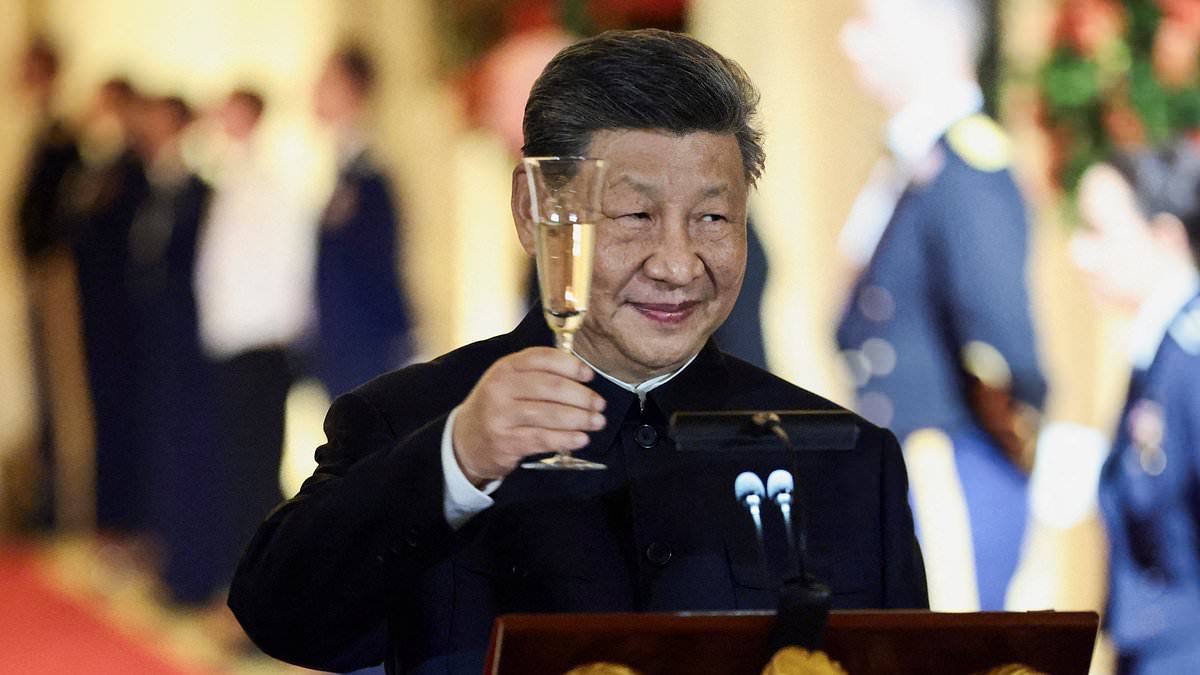
The EU and China are edging closer to a trade war, with the bloc’s commerce chief warning that its trade deficit with China is ‘unsustainable’ as he began two days of talks in Beijing aimed at averting an escalating confrontation.Beijing, meanwhile, hit back by warning that Europe lacks the capacity to wage a trade war, issuing a blunt challenge: ‘Let them try.’Writing on X on Thursday, European Commissioner for Trade and Economic Security Maros Sefcovic said: 'Day one in China, with one goal: begin rebalancing our... unsustainable trade deficit.' 'I started by hearing directly from EU businesses here. The message around the table was clear: the need to improve access to the Chinese market, while boosting our economic security,' he added.Last year, every day, China exported to the EU around a billion euros more in goods and services than went the other way, according to European figures.Many in Europe blame this on unfair trade practices by Beijing, including state subsidies and price dumping, undercutting European rivals in industries from cars to chemicals.The Asian giant could throttle supplies of items such as rare earth minerals that are vital for the continent's industrial sector – or throw up barriers to European exports to China.The two days of discussions by Mr Sefcovic in Beijing come as France and Germany, the bloc's two biggest powers, threaten to up the ante. Last year, every day, China exported to the EU around a billion euros more in goods and services than went the other way, according to European figures (pictured: Xi Jinping) In a letter earlier this week, President Emmanuel Macron and Chancellor Friedrich Merz called for a 'credible instrument' to respond quickly to any escalation by BeijingIn a letter earlier this week, President Emmanuel Macron and Chancellor Friedrich Merz called for a 'credible instrument' to respond quickly to any escalation by Beijing.The proposed weapon – to be discussed at an EU leaders' summit next week – would give the European Commission the power to respond to a trade aggression within days.Among other actions, it proposed making it easier for the European Commission to use the bloc's so-called 'trade bazooka', the Anti-Coercion Instrument. This is a never-used-before raft of measures for blocking or restricting trade and investment from countries found to be putting undue pressure on EU member nations or corporations.Yet not all EU nations agree on such tough measures. Spain, the eurozone's fourth-largest economy, has been less adversarial toward China in recent years. Prime Minister Pedro Sanchez has visited Beijing four times in three years. Far-Right and Left-wing lawmakers from Ireland to Bulgaria formed an unusual coalition on Wednesday to vote against resolution calling for tougher China policies.China immediately warned Paris and Berlin on Tuesday against 'protectionist' measures.'They should avoid going down the wrong path in the wrong way, only to ultimately suffer the consequences themselves,' the commerce ministry said in a statement.And an editorial in China's state run Global Times newspaper read: 'The EU does not have the capacity to wage a trade war against China. If it is truly determined to do so, then let it try.' China's foreign ministry said Thursday that Beijing hopes that it can work with Brussels 'in the same direction and address each other's concerns through dialogue and consultation'.'As a principle, China has always believed that adhering to openness and cooperation and resolving economic and trade differences through equal dialogue and consultation is in the common interests of both China and the EU,' spokesman Mao Ning told a regular briefing.The stakes are also high for President Xi Jinping, however, with China heavily reliant on exports in order to compensate for its stuttering domestic economy.The EU parliament's trade committee chief, Bernd Lange, said ahead of Mr Sefcovic's trip that this 'economic crisis in China' gives the bloc 'bargaining power'.'The EU has a well-supplied toolbox to counter unfair subsidies, dumping, discriminatory procurement, and economic coercion. These instruments must be applied consistently and, where necessary, enhanced,' Mr Lange said in a statement.EU and Chinese officials have been negotiating since June, and Mr Sefcovic raised hopes earlier this year when he said that he wanted 'tangible results by October'.Mr Sefcovic has identified three priorities: addressing surging imports in strategically important sectors, increasing European exports to China and improving access to critical raw materials.The EU is also seeking clearer export-licensing arrangements for rare earths and other materials after China introduced restrictions last year.Brussels hopes to manage Chinese exports through voluntary limits, for example on hybrid cars shipped to the bloc. Beijing, though, firmly opposes import quotas.Analysts are cautious about the prospects for a broad agreement being struck this week. Maros Sefcovic said: 'Day one in China, with one goal: begin rebalancing our... unsustainable trade deficit' The EU imports sizable amounts of Chinese lithium-ion batteries and hybrid electric vehicles (Pictured: Workers produce transmissions for new energy vehicles in Wuhu) Workers use machinery to dig at a rare earth mine in Ganxian county in central China's Jiangxi province'But if one sector could be identified in which an export-restraint agreement with China could be tested, that would be a good step,' Ignacio Garcia Bercero, from Brussels think-tank Bruegel, said.Zhu Tian, economics professor at Shanghai's China Europe International Business School, agreed, saying that the talks could yield agreements 'on some specific issues'.Politicians and economists across the 27-nation bloc consider China's massive subsidies and exports a major threat to core industrial sectors from steel foundries to car factories. China diverted many of its exports to the EU and other markets after the US raised tariffs.In a debate Tuesday in European Parliament in Strasbourg, lawmakers overwhelmingly expressed anxiety alongside defiance over trade with China. On Wednesday, they voted 454 to 86 on a resolution to toughen up on China that centered on a call for 'economic reciprocity and a proportionate EU response if China does not open its markets'.Ahead of the vote, Hilde Vautmans, the Belgian lawmaker who led the resolution, said that 'Europe has economic power, it's time we used it.'Despite the seeming European unity this week, it remains unclear what the EU can or is willing to do. It has already rolled out trade measures against Chinese steel imports and e-commerce small parcels.France's High Commission for Strategy and Planning in February called for swift action, like 30 per cent tariffs on many of China's exports, and a devaluation of the euro against the Chinese currency. Sales of German autos are plummeting in China but China is also poised to gobble up market share in Europe by undercutting European automakers on price thanks to heavy state subsidies. There have already been mass layoffs at major manufacturers like Volkswagen.The European Policy Centre in Brussels said in June that European battery producers, solar panels, steel, electric vehicles, chemicals and machinery are already haemorrhaging jobs and capacity and called for a trade investigative body modelled on Section 301 of the US Trade Act.European Commission President Ursula von der Leyen called the phenomenon another 'China shock' for Europe, similar to what happened in the U.S. in the early 2000s when hundreds of thousands of factory jobs in the American heartland were wiped out.The EU's ailing economy requires both a domestic overhaul and a more aggressive foreign trade policy, especially with China, said Tim Rühlig, a China analyst at the European Union Institute for Security Studies, the bloc's internal think tank.Rühlig also said that European businesses and political leadership bear some blame.'It's clear that just protecting yourself from China is not the future,' Rühlig said. 'But to have a chance of making yourself ready for future technologies and to remain competitive in the coming 15-20 years, you have to protect yourself.'It is impossible to disengage completely with China as the EU did with Russia following its invasion of Ukraine, Rühlig said, but there is robust momentum now to reset trade relations with Beijing.'Where do we make ourselves independent or at least more diverse? And where do we still work with the Chinese?' Rühlig asked.On Wednesday, US Secretary of State Marco Rubio during his Greece visit called for Europe to strengthen its alliance with the US as he urged Europe to 'awaken from its long slumber'.Mr Rubio said that Europe and the US are at 'a crossroads' where actions taken now 'will determine whether the West maintains its place at the head of the world or resigns itself to a future of atrophy and servitude and decline. We will either choose to act now or lose the choice to act at all.'This past weekend, ahead of Mr Sefcovic's meeting in China, Beijing launched an anti-dumping probe on EU exports of p-nitrotoluene, which is used in dyes and pharmaceuticals. China produces and exports more electric vehicles than any other country Trade ties between the US and China appear relatively stable following a summit between Chinese President Xi Jinping and President Donald Trump in WashingtonThe probe was initiated after Beijing warned last month that it would take retaliatory actions if the EU instituted tougher protectionist trade measures.'China has been battle-tested by successive rounds of external pressure and, so far, has largely stared down attempts to force a change in course,' said Zenglein.China's economy has been largely driven by exports as domestic demand remains sluggish. The EU imports sizable amounts of Chinese lithium-ion batteries and hybrid electric vehicles, and Chinese carmakers are also expanding production capacity in Europe.While China's trade surplus has intensified concerns among its major trading partners, trade ties between the US and China appear relatively stable following a summit between Chinese President Xi Jinping and President Donald Trump in Washington, wrote Bank of America economists, turning the attention to China-EU relations.When it comes to negotiations with the EU, Chinese investment in Europe is likely to be among Beijing's bargaining chips, Zenglein added, particularly as EU member states compete to attract capital, jobs and new manufacturing projects.
EU and Beijing heading for trade war as Brussels slams 'unsustainable' $1billion-a-day deficit - but China warns: 'Trade war? Let them try
Full Article
Original Source
Read the full article at Dailymail →KhanList aggregates and links to publicly available news content. We do not host full articles from third-party sources. Always verify important information with original sources.