
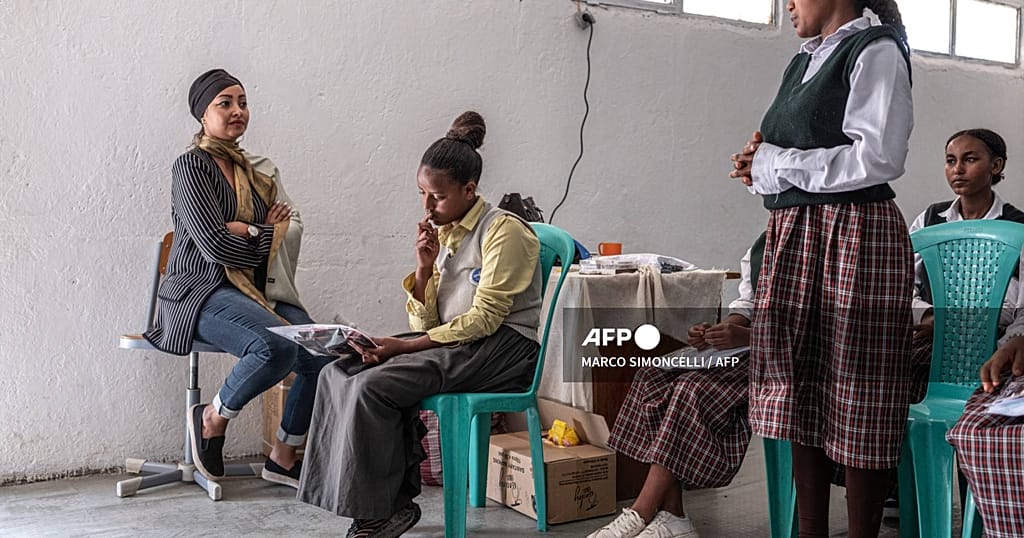
In a small workshop in the heart of Addis Ababa, the sound of sewing machines fills the air as women turn cotton fabric into reusable sanitary pads. For founder Hanan Ahmed, the work is about more than making an affordable alternative to disposable products. It is about restoring dignity, keeping girls in school and breaking the silence surrounding menstruation in Ethiopia. In a country that imports all its sanitary pads, their high cost puts them beyond the reach of many women and girls. For those unable to afford them, periods can mean missed school days, lost income and, in some cases, resorting to unsafe alternatives. For Ahmed, 41, the issue is deeply personal. Her own experience of menstruation-related embarrassment inspired her to leave the fashion industry and establish Han's With Care in 2021. "I used to be one of those girl who have a very heavy flow. So whenever my period come, it used to stain my clothes and the desk that I used to sit on. And because of that, like I don't come to school (for) like a week or two weeks, making up excuses. So I completely left the fashion industry and started this by the end of almost COVID, when COVID finished up. So I said, I just want to do my part in the community." Her company now produces washable cotton sanitary pads that can be reused for up to two years. With a production capacity of around 1,000 pads a day, the business supplies sponsors, including banks, which distribute the products free of charge to girls and women across the country. At Nigat Kokeb School in Addis Ababa, the initiative is already making a difference. For 15-year-old student Betselot Mahareg, reusable pads offer a practical solution while helping her avoid the embarrassment associated with leaks from disposable alternatives. "When we use the other one [the plastic pads, ed.], it can leak and touch our inner clothes, it touches our clothes, and then embarrassment arises. This one, first it is cloth, we can wash and re-use it; second, in a way that doesn't touch our clothes or inner clothes, I have understood that it is a great pad that we can handle properly and cleanly." But Ahmed's ambition goes beyond providing sanitary products. Changing attitudes towards menstruation, particularly among younger generations, is central to her mission. At the school, teacher Tigist Shewangizaw says preparing girls before their first period is essential to preventing fear, isolation and absenteeism. "Before it comes, we pass safety cues to young children so they don't panic before seeing their period, don't feel they are alone or scared in experiencing this, and we ensure they don't miss school." Despite progress in the capital, menstrual stigma remains deeply rooted in parts of the country. In some rural communities, girls can still face exclusion from their households when they begin menstruating. Hanan believes education and open conversations are essential to changing this reality. She is also determined to start that conversation at home, raising her own daughter to see menstruation not as something to hide, but as a natural part of growing up. "I do the same thing with my daughter at home. When she sees her period we celebrate it as her womanhood. So we're trying to create that kind of freedom to talk about period(s), be it in our social media, in our community, we are raising our voices." For Hanan, every reusable pad represents an opportunity to challenge shame, improve access to menstrual hygiene and give girls the confidence to participate fully in everyday life. Her hope is that, with greater public support and continued awareness, menstruation will no longer be a reason for girls to miss school or feel excluded. And in a country where the subject has long been surrounded by silence, she hopes that simply talking about periods will become a powerful first step towards change.
Ethiopia: Reusable sanitary pads help girls break the silence around menstruation
Full Article
Original Source
Read the full article at Africanews →KhanList aggregates and links to publicly available news content. We do not host full articles from third-party sources. Always verify important information with original sources.