
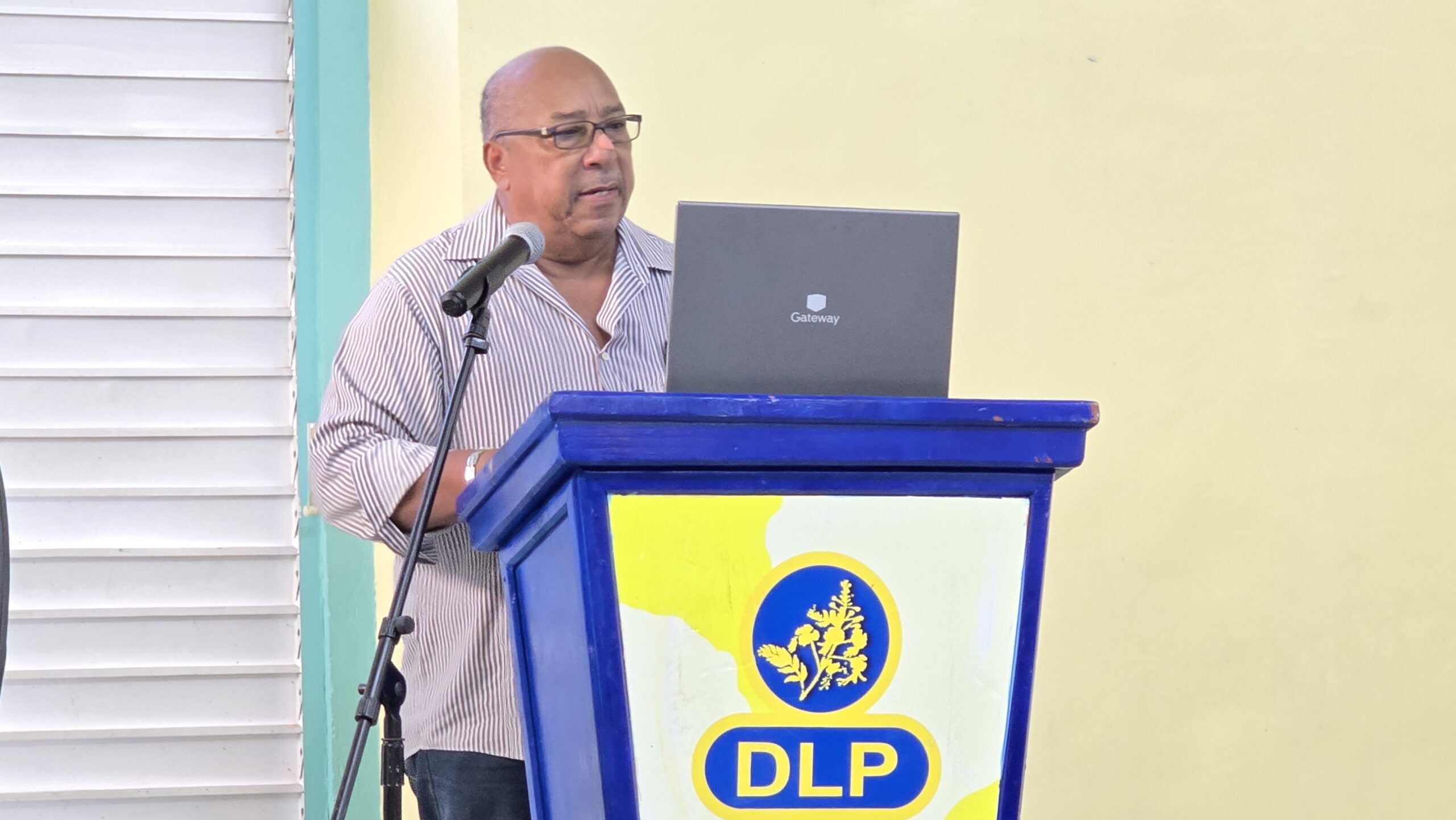
DLP President Dr David Estwick. (Photo by: Lourianne Graham) Democratic Labour Party President Dr David Estwick has called for a new development bank and laws requiring public institutions to buy 60 per cent of their goods domestically as part of a state-led economic model for Barbados. Estwick argued that Barbados needs an economic model in which the State leads development, and the private sector works alongside it, rather than one in which private business is expected to drive growth on its own. Speaking at a DLP St Michael East branch meeting at St Giles Primary School on Sunday, Estwick said the island’s size left it without the advantages enjoyed by larger economies, making a leading role for the State necessary. “A small developing country like Barbados has no comparative and competitive advantage with large states worldwide,” he said. “There is something called free trade, but free trade is not fair trade because we can’t trade with them fairly, because we can’t compete on price and we can’t compete on volume.” He suggested the business community was too small and risk-averse to carry development on its own. “It cannot be done by the private sector because the private sector is too small,” he said. “We have a private sector that not only is too small, it is risk-averse.” You Might Be Interested In This was evident in the number of young people leaving the Barbados Community College (BCC), University of the West Indies (UWI) and the Samuel Jackman Prescod Institute (SJPI) each year, whom he argued the private sector could not absorb. Estwick, a former minister of economic planning and development in the Freundel Stuart administration, also called for the establishment of a Barbados Development and Investment Bank, questioning the country’s previous decision to sell the Barbados National Bank. “What is critical for us here to develop Barbados is that we need a Barbados Development and Investment Bank,” he said. “We need one of them.” He described his proposed approach as democratic socialism and state-led capitalism, arguing that small countries such as Barbados needed a greater role for the state to overcome their limitations in competing internationally on price and volume. “I am standing behind democratic socialism, and I am standing behind state-led capitalism,” he said. He said the State should not withdraw from production but should focus on expanding the economy while creating opportunities for private businesses to grow. “We have to concentrate upon state-driven expansion of the economy,” he said. “We will work side by side with the private sector.” He also pointed to the size of government spending, saying the most recent estimates projected spending of $4.2bn in an economy valued at approximately $5bn. “We can no longer be afraid of having the State play a critical role in national development,” he said. Estwick outlined several key elements of the model he is proposing, including a greater role for the Central Bank in financing development. He said the bank should do more than buy Treasury bills when the government runs short of funds and should instead support projects that generate economic activity over the long term. “It should be working in regards to looking for development inputs that drive economic activity over the mean of the long term, and it should be supporting that development with domestic currency.” The second area concerned the State’s responsibility for providing services that private businesses could not operate profitably. The State had a critical role, he said, “particularly in those areas where the private sector cannot monetise a particular service and make a profit. That service will not be provided if the government does not step in to provide it.” He identified services at the Queen Elizabeth Hospital, transportation, polyclinics, roads, housing, drainage and welfare provision as areas from which the State could not withdraw. Another area was repositioning agriculture and manufacturing through a national procurement strategy backed by regulation and legislation. Estwick said state institutions, including hospitals, prisons and schools, should be required to purchase a set proportion of their goods domestically. “You must buy 60 per cent of all that you are taking in terms of your goods,” he said. “Make it the law.” He also proposed linking welfare spending to domestic production, with payments made through a card rather than vouchers and recipients receiving an incentive of 10 per cent or 15 per cent for purchasing domestic goods. “Taxpayers’ money should not be given to the persons to buy overseas goods,” he said, adding that domestic spending “must be driving domestic production and consumption and usage”. On the cost of living, Estwick proposed an inflation stability board or commission comprising representatives from the private sector, organised labour, economists and ordinary citizens. He said the body would monitor price increases on selected items and establish a threshold beyond which the Central Bank would intervene. He cautioned that a slower rate of inflation did not mean prices were falling. “If inflation is going up slower, it doesn’t mean the price is coming down,” he said. “It means the prices are going up, but they’re going up at a slower rate than before.” Estwick’s suggestion of a development bank would mean a return to the first attempt at public-funded business finance. Created in 1963 under the Errol Barrow administration and brought into operation in 1969, the Barbados Development Bank provided medium- and long-term finance to businesses and co-operatives, supporting tourism, manufacturing and agriculture. Weighed down by bad debts and financial distress, the BDB ultimately ceased to exist in 1995 after becoming insolvent. The Enterprise Growth Fund Limited, a government-owned public/private financial institution that began operations in January 1998, was established by the Owen Arthur administration to replace its development-financing role by funding and supporting small and medium-sized businesses. (LG)
Estwick calls for state-led growth, development bank
Full Article
Original Source
Read the full article at Barbadostoday →KhanList aggregates and links to publicly available news content. We do not host full articles from third-party sources. Always verify important information with original sources.