
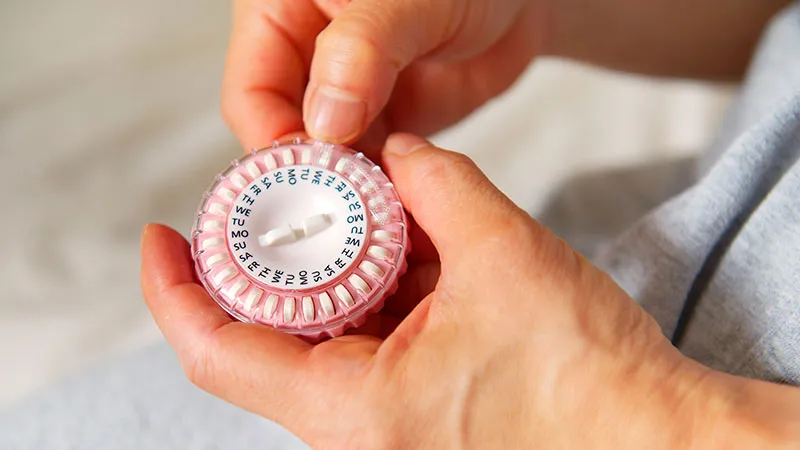
Longer exposure to estrogen over a woman’s lifetime is associated with better cerebrovascular health in later life, including less damage to the brain’s small blood vessels and healthier tissue.In a population-based study of more than 300 women, a longer reproductive span — the time between the first menstrual period and menopause — was associated with 8% lower odds of having two or more signs of cerebral small vessel disease (SVD). The condition affects tiny blood vessels in the brain and can damage surrounding brain tissue.A history of menopausal hormone therapy (MHT) was also associated with lower burden of cerebral SVD and greater white matter integrity. Women who had used oral contraceptives earlier in life and MHT after menopause had the lowest disease burden and greatest white matter integrity.“Our results suggest that hormonal exposure across different periods of a woman’s life may have cumulative effects also on the cerebrovascular health in later life. The findings suggest that the brain’s blood vessels may play an important role in the link between estrogen and brain aging,” senior investigator Anna Marseglia, assistant professor at the Department of Neurobiology, Care Sciences and Society, Karolinska Institutet in Stockholm, Sweden, said in a statement.The study was published online on November 4 in Neurology.The Role of Estrogen in Brain HealthEstrogen helps regulate blood vessel function and protect brain cells, but its levels decline sharply after menopause, potentially affecting brain and vascular health. Although previous research has examined MHT and dementia risk, less is known about how lifetime estrogen exposure relates to cerebrovascular health in older women. One marker of cerebrovascular health is cerebral SVD, which can be assessed using MRI to identify white matter lesions, small areas of tissue damage, microbleeds, and enlarged spaces around blood vessels. Such findings have been associated with an increased risk for stroke and cognitive impairment.To examine whether lifetime estrogen exposure is associated with cerebrovascular health later in life, researchers analyzed data from 352 women (mean age, 70 years) participating in the Gothenburg H70-1944 Birth Cohort in Sweden.All participants were cognitively unimpaired at baseline, and approximately one third were apolipoprotein E epsilon 4 (APOE e4) allele carriers, a genetic risk factor for Alzheimer’s disease (AD). Researchers assessed reproductive lifespan as well as self-reported oral contraceptive and MHT use.Participants underwent brain MRI to assess SVD burden, white matter integrity, and cortical thickness in regions vulnerable to AD-related neurodegeneration. A subset of 205 women underwent a follow-up MRI 5 years later.Each participant received an SVD score from 0 to 4, with one point for each of the following: extensive white matter changes, at least one small brain lesion (lacune), at least one central microbleed, and moderate-to-severe perivascular spaces, fluid-filled spaces surrounding small blood vessels in the basal ganglia.One SVD marker was present in 28.6% of participants, while 12% had at least two. Participants had an average reproductive span of 37.1 years. Overall, 72.7% reported a history of oral contraceptive use, and 60.8% reported current or previous MHT use.A longer reproductive span was associated with a lower SVD burden (odds ratio [OR], 0.92). MHT use was also linked to a lower SVD burden (OR, 0.41), as well as fewer perivascular spaces (OR, 0.57) and cerebral microbleeds (OR, 0.52). However, associations with individual SVD markers were less pronounced after accounting for multiple comparisons.Both oral contraceptives and MHT use were associated with greater white matter integrity, measured using fractional anisotropy on diffusion MRI. Women who reported using both therapies had the highest white matter integrity compared with women who had used neither (β = 0.45).In a joint analysis, women who had used both oral contraceptives and MHT had lower odds of having at least two SVD markers than women who had used neither (OR, 0.31).However, researchers found no evidence that using both therapies provided additional benefits beyond those seen with either one alone.Reproductive lifespan, oral contraceptive use, and MHT use were not significantly associated with measures of AD-related cortical thickness.In an exploratory analysis, MHT use was associated with greater cortical thickness in women who were APOE e4 carriers (β = 0.38), although the association was no longer statistically significant in adjusted analyses.Over approximately 5 years of follow-up, longitudinal analyses showed no significant differences in changes in white matter hyperintensities or cortical thickness.“While these findings do not establish cause and effect, they underscore the importance of considering women’s reproductive and hormonal history when studying brain aging and dementia risk not only in relation to Alzheimer’s disease but also vascular disease,” Marseglia said in a press release from the American Academy of Neurology.Need for Larger Studies, Longer Follow-upEstrogen exposure over a woman’s lifetime may help explain differences in brain vascular health later in life, Tracy E. Madsen, MD, assistant professor in the Department of Emergency Medicine at the Robert Larner MD College of Medicine at the University of Vermont in Burlington, wrote in an accompanying editorial.“Primary findings from the study suggest there may be a protective effect of both endogenous and exogenous estrogen on later life neurovascular health,” Madsen, who was not involved in the research, added.The timing of menopause is also an important consideration, she noted. The association between reproductive lifespan and lower SVD burden appeared to be influenced by age at menopause, rather than age at a woman’s first period.However, the findings do not establish whether MHT protects brain health. The study did not account for differences in hormone doses, formulations, or duration of use.As a result, Madsen noted, it is “difficult to understand how these findings would potentially translate to recommendations for women looking to prevent cognitive decline and the development of dementia.”Previous research, including findings from the Women’s Health Initiative, has raised concerns about the potential effects of hormone therapy on cognitive health. Although hormone therapy’s effects on cardiovascular health have been studied extensively, “data on cognition and dementia are not as robust,” Madsen noted.She called for larger studies with longer follow-up and more detailed information about hormone use to better understand how lifetime estrogen exposure may relate to brain health as women age.Disclosure information for study authors is available in the original study publication. Madsen reported having no relevant financial disclosures.
Estrogen Exposure Tied to Better Brain Health in Women
Full Article
Original Source
Read the full article at Medscape →KhanList aggregates and links to publicly available news content. We do not host full articles from third-party sources. Always verify important information with original sources.