
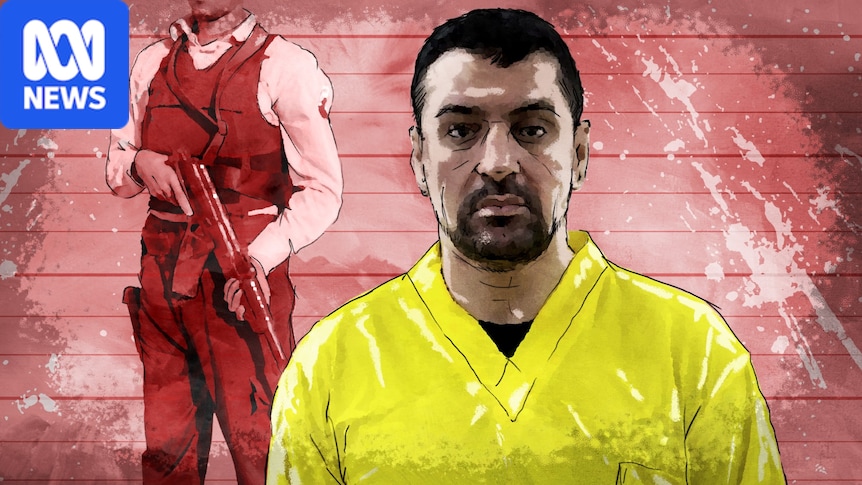
Australia's illicit tobacco trade has become so lucrative that criminal overlords have built a secret pipeline suspected of smuggling tens of millions of dollars in profits overseas.The ABC can reveal details of a sophisticated money laundering network that spans multiple states believed to be washing huge sums for the major cartels, including banished Iraqi kingpin Kazem Hamad, who allegedly used it to enrich himself in exile.Current and former law enforcement sources say the secret pipeline is believed to have funnelled cash out of the country by exploiting private ATMs, payment platforms and suburban businesses using an ancient money transfer method favoured by terrorists.At the centre of the network is an Iraqi asylum seeker who, despite being on a protection visa, authorities believe became a bagman for the cartels by collecting cash from shops they supplied with illicit tobacco.Law enforcement sources have identified private ATMs as a key money laundering method. (ABC News: Paul Sellenger)Here's how it worksThe bagman is suspected of funnelling millions of dollars to Dubai where Hamad, one of the most violent forces behind the so-called tobacco wars, was the puppet master of a group known as the "Commission".Authorities have linked the bagman to other businesses and networks believed to have laundered money on behalf of the Commission, including one of Hamad's former family members.It follows the Commission's audacious expansion across Australia allegedly spearheaded by figures related by blood, marriage or criminal connections to Hamad, who was jailed for life in Iraq earlier this year.For years, state and federal investigators have fought a public battle to extinguish the conflict marked by hundreds of firebombings, underworld assassinations and the murder of an innocent Melbourne woman by bumbling foot soldiers.There were hopes that Hamad's arrest and imprisonment earlier this year would destabilise his violent campaign but it appears to have had little impact, with terrifying violence continuing to spill onto suburban streets across the country. Untraceable cash network hijacked by criminalsUntil now, precisely how the nation's tobacco crime lords managed to move money in and out of the country has never been publicly aired.Hamad, who was deported from Australia for drug trafficking, was initially in Dubai and separated from his wealth by thousands of kilometres.If illegal tobacco cash is kept onshore, profits risk being seized by authorities as criminal proceeds.The ABC can reveal money was allegedly siphoned out of the country by figures like the bagman.Law enforcement sources say he travelled up and down Australia's east coast collecting duffel bags and boxes stuffed with cash.Hamad is believed to have moved significant amounts of funds via the bagman into a network of money transfer businesses in Melbourne and Sydney, which use an ancient transfer system known as hawala.What is hawala?The entire system is based on trust and relationships between hawala dealers. If a customer sends money overseas, their local dealer contacts a partner in the desired country who then pays the recipient from their own pocket.No money is ever physically moved because recipients are paid by someone in their own country. The dealers keep a running tally and periodically settle up.Hawala has long been exploited by terrorist groups and organised crime because of the ability to instantly transfer significant sums of money without physically shifting a single cent.Kaz Hamad is believed to have been funnelling cash into a network of money transfer businesses in Melbourne and Sydney that use the hawala system. (ABC News: Paul Sellenger)How far-reaching is this network?Law enforcement sources tie the Commission to a number of money transfer businesses, which are also known as hawala dealers.They link the businesses to Hamad's syndicate through the bagman, who also worked as a hawala dealer.In Australia, hawala dealers must be licensed and abide by anti-money laundering laws, but the network Hamad used allegedly regularly left out key details, such as who was paying them to send money overseas.Authorities believe the Commission used the bagman's registered hawala business to send millions of dollars to Dubai, where Hamad was in hiding.One former federal law enforcement source, who spoke on the condition of anonymity, said hawala networks were vulnerable to being misused by criminals who use the system to funnel billions of dollars around the world.The source said dealers were also known to have databases full of families, international students and gamblers to obscure who was receiving the money before it was delivered."There was a place in Dubai that had people using encrypted [communications] and their job was to facilitate transfers around the world," the former law enforcement source said."Every day there's cash couriers running around the world with money in suitcases, shoeboxes, backpacks."It's essentially unstoppable."How private ATMs are being usedLaw enforcement sources have also identified private ATMs as a key money laundering method used by tobacco syndicates to obscure the source of their profits.The machines can be refilled an unlimited amount of times with privately-sourced cash, and authorities believe they were being used as mini-banks by cartels.Hamad's bagman also allegedly played a key role for another major syndicate involved in Australia's illicit tobacco market: members of Queensland's notorious Al Dilami family.The family's name comes up in a 2023 Queensland police report, filed in court, which said there were "extensive" intelligence holdings linking some members of the clan to illicit tobacco.It is alleged the bagman was spotted collecting cash from several Queensland tobacconists linked to some Al Dilami family members.Bust unlikely to stem tide, sources sayThe bagman has since been charged after being busted with millions of dollars in his hire car.He pleaded guilty to dealing with the proceeds of crime but denied playing any active role, telling the judge through an Arabic translator it was his "first time" doing business interstate and that he believed the money in his car was from legal tobacco sales.Tobacco retailers targeted by the Commission receive an ultimatum: sell illegal cigarettes, pay a weekly tax as high as $25,000, or be firebombed. (ABC News: Paul Sellenger)He told the court his life had been threatened before fleeing his home country after he challenged the activities of local militias."I came to Australia because of the fact that I am against illegal things," he said."I swear by almighty god … if I knew that there was any harm that can be caused or anything illicit or drug-related, I swear to god, I wouldn't have got involved in any of this."He was given a community-based order.Sources told the ABC the bagman's conviction will do little to stem the flow of money being funnelled out of Australia.Why can't it be stopped?Current and former federal law enforcement sources have expressed frustration at the lack of resources their agencies are given to enforce existing laws.With prices for a pack of illegal cigarettes as low as $12, and federal taxes making genuine tobacco among the most expensive in the world, Australians have surged towards the illicit trade.The ABC has spoken to sources who argued a cut in the tobacco excise would hinder Hamad's access to billions of dollars in retail sales.Kazem Hamad is serving a life sentence in an Iraqi prison. (Supplied: Australian Federal Police)"It's the biggest fraud against the Australian people's revenue in living history, and that's the bit that's getting lost," one former federal law enforcement officer told the ABC."We're talking about a legal commodity. The only thing that makes this a crime is the government's excise," they said."They could get rid of it overnight or they could turn it off for two or three years and get rid of the killing."But bodies like the Cancer Council have urged the government to resist pressure to cut the excise, saying illicit tobacco was primarily an enforcement and health issue – not a tax one.The organisation says Australia has achieved "some of the lowest smoking rates in the world thanks to strong, evidence-based tobacco control policies that have saved thousands of lives"."Even if we were to cut the tobacco tax altogether, illicit products would remain cheaper, while legal tobacco would become more affordable," the organisation said in an open letter to government."Tobacco industry profits would skyrocket and smoking rates would increase, undoing decades of progress."Federal government claims days of 'low risk, high profit' to endBlack market tobacco now accounts for 80 per cent of all tobacco consumed in Australia, according to the Bureau of Statistics.Law enforcement sources have told the ABC almost all of the illegal market is effectively controlled or linked to Hamad, whose imprisonment is understood to have made little difference to the syndicate's operations.The Albanese government has ramped up enforcement as it continues to resist calls to cut the tax on tobacco, introducing a raft of bills and new laws to punish illegal importation.The federal government was earlier this week touting the sharp rise in legal tobacco purchases in Queensland following the state government's introduction of stronger powers in November to shut businesses found to be selling illicit tobacco.Assistant Minister for Customs Julian Hill said the Queensland results showed strong laws and enforcement was "helping turn the tide" on Australia's illicit tobacco trade.Victoria gave new powers to inspectors and police last month to shutter businesses caught selling illicit tobacco, with 61 stores since closed for breaches.Victoria Police and Tobacco Licensing Victoria said over the past four weeks they had seized two million cigarettes, over 40,000 vapes, over 120 kilograms of loose tobacco and $500,000 in cash.But a current federal police source told the ABC illicit tobacco still remained "low risk and high gain" for criminal networks, particularly those directed from overseas.They said the government's changes would capture "soldiers" but not "generals" like Hamad, who has relied on contract criminals, often children, to do his bidding from afar."We need to make it an organisational priority to disrupt the chain," the source said."We always get the small fish. We don't investigate hard enough to get the bosses. Never the big ones."Once the import networks are established then it's easy to switch to importing harder drugs."
'Essentially unstoppable': How tobacco cartels funnel cash offshore
Full Article
Original Source
Read the full article at Abc →KhanList aggregates and links to publicly available news content. We do not host full articles from third-party sources. Always verify important information with original sources.