
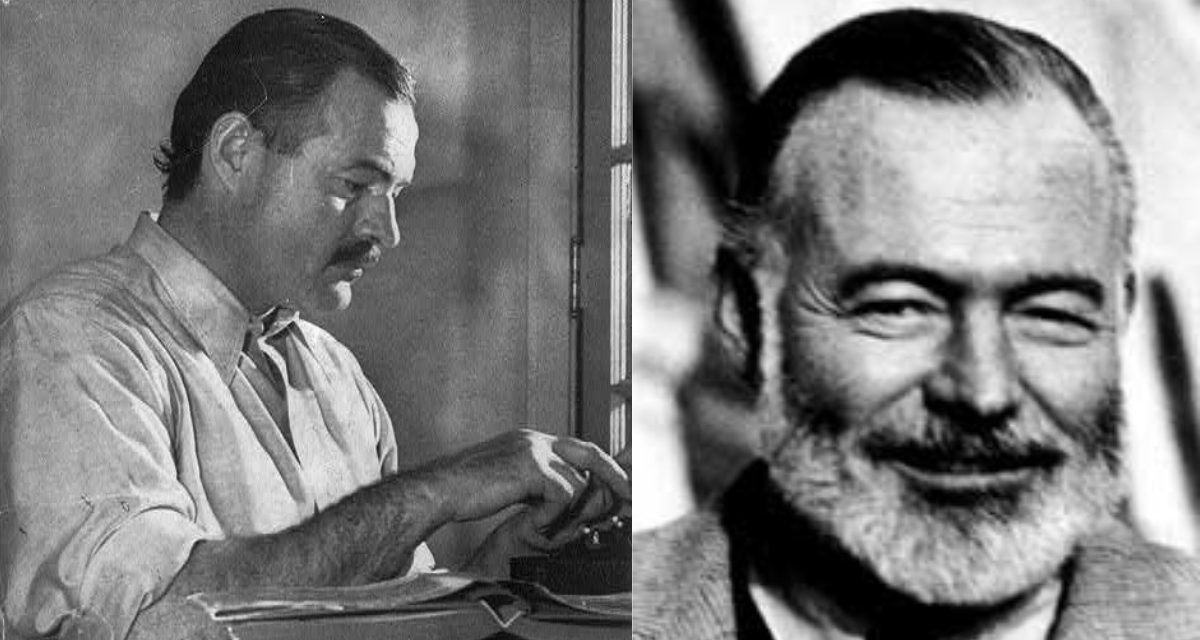
Ernest Hemingway is widely considered one of the great American novelists. He won both the Pulitzer Prize for Fiction and the Nobel Prize in Literature in 1953 and 1954, respectively. And Hemingway’s unique writing style was his own. “His short, declarative sentences, intentional repetition, and general absence of adjectives were a departure from the style of every previous novelist,” notes teacher Jessica Leader via PBS, which premiered Ken Burns and Lynn Novick’s six-hour documentary Hemingway in 2021. “Whereas authors before him conveyed meaning and mood through ornate descriptions of setting and detailed character sketches, Hemingway kept his writing terse and sparse.” Hemingway honed his writing style during his short journalism career at The Kansas City Star, where he worked from October 1917 to April 1918. The paper’s style guide gave him rules and a framework for crafting his writing. Hemingway’s 4 writing rules The Kansas City Star‘s style guide, The Star Copy Style Sheet, mainly helped Hemingway report on straightforward stories about the police and emergency rooms. “Those were the best rules I ever learned for the business of writing,” Hemingway said in 1940. “I’ve never forgotten them. No man with any talent, who feels and writes truly about the thing he is trying to say, can fail to write well if he abides with them.” The four rules that most resonated with him were: Rule #1: Use short sentences. Rule #2: Use short first paragraphs.Rule #3: Use vigorous English. Rule #4: Be positive, not negative. In 1952, Hemingway elaborated on his admiration for these rules, sharing, “You were never to say a man was seriously injured. All injuries are serious. He was, as I recall, slightly injured or dangerously injured. There were many other things like this…that made extremely good sense.” Hemingway looked up to Pete Wellington, the assistant city editor at The Kansas City Star, who was a stickler for following the rules. “Pete Wellington was a stern disciplinarian, very just and very harsh,” Hemingway reportedly said, “and I can never say properly how grateful I am to have worked under him.” Hemingway’s ‘Iceberg Theory’ of writing During his career, minimalism remained key to Hemingway’s writing style. He also formed what he called the “Iceberg Theory” of writing. The theory, also known as the theory of omission, was inspired by the iceberg metaphor. Hemingway explained the writing style in his 1932 nonfiction book, Death in the Afternoon: “If a writer of prose knows enough of what he is writing about he may omit things that he knows and the reader, if the writer is writing truly enough, will have a feeling of those things as strongly as though the writer had stated them. The dignity of movement of an iceberg is due to only one-eighth of it being above water. A writer who omits things because he does not know them only makes hollow places in his writing.” Leader explained to PBS, “Hemingway believed that writers should only show the tip of the iceberg of characters and plot but indicate what was below the surface so powerfully that readers would be able to intuit it, and do so more meaningfully than if the author had described it outright.”
Ernest Hemingway stuck to these 4 rules to become a better writer in 1917. They still apply today.
Full Article
Original Source
Read the full article at Upworthy →KhanList aggregates and links to publicly available news content. We do not host full articles from third-party sources. Always verify important information with original sources.