
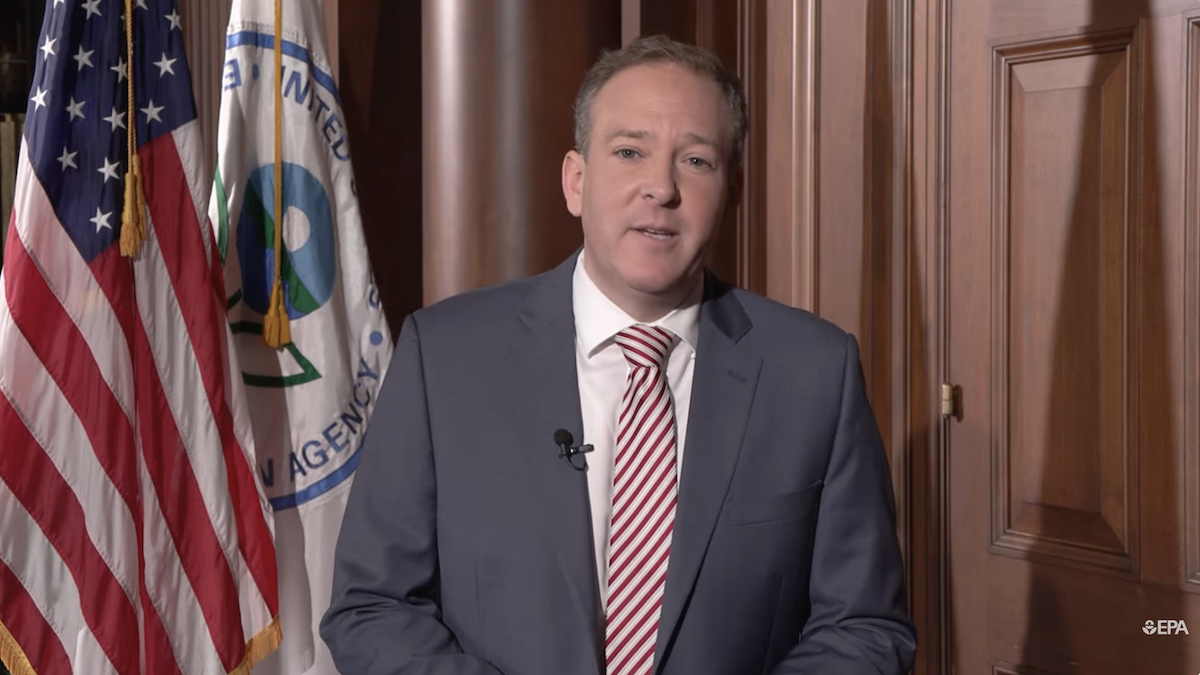
EPA Adminstrator Lee Zeldin speaks in an EPA announcement last year. Credit: EPA Research & Developments is a blog for brief updates that provide context for the flurry of news regarding law and policy changes that impact science and scientists today. Today, the Environmental Protection Agency will announce the repeal of federal limits on power plant carbon dioxide emissions, finalizing a proposed rule that the agency has been considering since last spring. The repeal means that coal-, oil-, and gas-powered electricity plants in the United States will no longer need to limit their carbon dioxide emissions in accordance with regulations set in 2024. Those rules required existing coal-powered and new gas-powered plants to control 90% of their carbon pollution. At the time, the Biden administration estimated that the rules would result in tens of billions of dollars’ worth of public health benefits. The agency is also expected to announce a separate proposal to eliminate all greenhouse gas standards from power plants beyond the Biden-era regulations by arguing that it lacks the authority to create such regulations under the Clean Air Act and that such emissions do not pose a public health threat. “Leaving this pollution unchecked ignores the Supreme Court, puts the public at risk, and flagrantly violates EPA’s legal responsibilities.” Lee Zeldin, EPA administrator, is expected to announce the news at a summit of energy administrators today in Houston, Texas, according to Bloomberg News. Last year, the agency justified the repeal of the 2024 regulations by arguing that carbon emissions are “global in nature,” and that any public health harms to U.S. residents could not be attributed to U.S. emissions alone. But the U.S. power sector contributes a large fraction of global greenhouse gas emissions: If it were its own country, it would be the fifth-biggest greenhouse gas emitter in the world, according to 2022 data. In a public comment on the proposal last year, lawyers and scholars at the New York University School of Law’s Institute for Policy Integrity wrote that the proposed repeal was “not supported by the law or the facts.” In the comment, authors pointed out that the proposal ignored the climate impacts of such a repeal, such as an estimated $225 billion in global health damages. In 2024, the Biden administration estimated that the regulations would have prevented up to 1,200 premature deaths, 360,000 cases of asthma symptoms, 48,000 school absence days, and 57,000 lost work days in 2035 alone. The repeal and the new proposal are expected to face challenges in court. “The Supreme Court has made clear that EPA has an obligation to control greenhouse gas emissions from power plants under the Clean Air Act,” Dena Adler, a senior attorney at the Institute for Policy Integrity, wrote in a statement about today’s announcement. “Leaving this pollution unchecked ignores the Supreme Court, puts the public at risk, and flagrantly violates EPA’s legal responsibilities.” If the Trump administration prevails, the rationale that the EPA lacks the authority to regulate emissions could make it difficult for future administrations to revisit similar regulations. The announcement comes during a presidential term in which the Trump administration has loosened emissions regulations for other pollutants, taken action to sustain a declining coal industry, and sowed doubts about the science of climate change. In February, the administration announced that coal-powered plants would now be able to emit more than twice as much mercury and revoked the 2009 scientific determination that provided a legal underpinning for major U.S. climate rules. The Trump administration has also ordered aging coal plants in five states to stay open, actions that have been repeatedly challenged in court. —Grace van Deelen (@gvd.bsky.social), Staff Writer These updates are made possible through information from the scientific community. Do you have a story about how changes in law or policy are affecting scientists or research? Send us a tip at [email protected]. Text © 2026. AGU. CC BY-NC-ND 3.0Except where otherwise noted, images are subject to copyright. Any reuse without express permission from the copyright owner is prohibited.
EPA Will Remove Carbon Dioxide Limits on Power Plants
Full Article
Original Source
Read the full article at Eos →KhanList aggregates and links to publicly available news content. We do not host full articles from third-party sources. Always verify important information with original sources.