
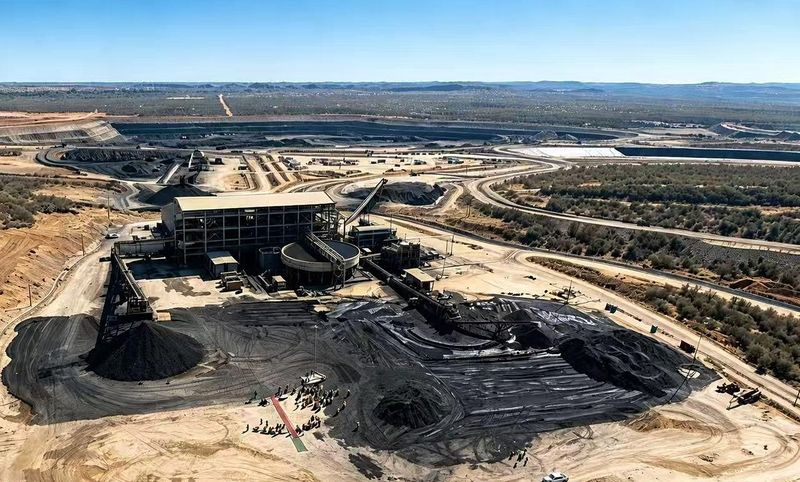
The coal mine at the heart of an ambitious Chinese-backed industrial development in northern Limpopo has ground to a halt, leaving behind excavated bushveld, destroyed ancient baobabs, uncertain jobs and the prospect of an enormous environmental rehabilitation bill.Makhado Colliery, controlled by China’s Kinetic Development Group through MC Mining, stopped operating on 1 October 2026, barely five months after commissioning began. The company disclosed the suspension on 30 October and confirmed it in a further announcement on 9 November.There is currently no committed funding to restart production.The shutdown comes less than two weeks after Maverick Earth investigated the project’s environmental and economic implications (here and here).Those investigations raised serious questions about the development’s environmental authorisations, economic viability and particularly its demand for water in an already water-stressed region.Now another question has become urgent: What happens when a mining company begins tearing apart an ecologically important landscape, only to run out of money before its operations prove financially sustainable?And who pays to put it back together?The mine lies within the Unesco-designated Vhembe Biosphere Reserve, a landscape of ancient baobabs, indigenous bushveld, wildlife corridors and vulnerable river catchments.Living Limpopo, which has spearheaded opposition to the development, says ancient trees and natural habitats have already been destroyed.“Open coal pits stand where baobabs stood for a thousand years. Critical Biodiversity Areas, mapped and designated by the state itself, have been stripped bare, on land the State holds in trust for the Mphephu Traditional Council. None of it can be undone,” it said in a statement issued on 9 November.The organisation’s Lauren Liebenberg described the mine as a failed gamble with an irreplaceable landscape. “We said it would fail. We said it would leave the land broken and the bill unpaid.”A mine without moneyMC Mining’s financial position makes grim reading.According to Living Limpopo, at the end of September the company reported just $170,000 in available cash and facilities. It had borrowed another $10.2-million during the quarter, while reporting no customer receipts.Although Makhado had delivered 4,846 tonnes of coal to the port of Matola in Mozambique, it had not established sustained commercial production.The company’s annual accounts reported a $17.8-million loss, with current liabilities of $54.4-million against current assets of $4.6-million. Its auditors have repeatedly warned about its ability to continue as a going concern.On 9 November, MC Mining announced a further $8-million bridge loan from Kinetic. But the money is intended to fund the suspension, restructuring and a business review, not a return to production.The company acknowledges that its mining operation and coal processing plant require further improvements and additional capital before production can resume.Voluntary severance arrangements have begun, with compulsory retrenchments still possible.MC Mining maintains that the suspension is temporary. But without committed restart funding, its future remains uncertain.Living Limpopo questions whether the mine was ever commercially viable.“We are entitled to ask whether this mine ever had a business, or was always a stock-exchange story dressed up as a colliery.”Digging for coal in a pristine bushveld site. (Photo: Living Limpopo) Public money, private miningThe shutdown has also placed South Africa’s Industrial Development Corporation (IDC) under scrutiny.It’s investment in Makhado came under parliamentary scrutiny on 10 November, when DA MP Toby Chance questioned it during the corporation’s annual-report presentation to the Portfolio Committee on Trade, Industry and Competition.The IDC is more than a lender seeking repayment. It holds 6.7% of Baobab Mining & Exploration, the company holding Makhado’s mining right and now the mine. Its involvement began in 2017 with a R240-million financing facility, of which R160-million was drawn, followed by repeated repayment extensions and restructuring. The arrangements also provide for conditional conversion of remaining debt into further equity.Chance’s intervention was not his first attempt to obtain answers. He had previously challenged the investment and the repeated repayment extensions. In its September 2025 response, the Industrial Development Corporation reported no default and said it expected full recovery.Fourteen months after that reassurance, the barely commissioned mine stands suspended, without committed funding to restart. The company’s 9 November announcement confirmed that mining had stopped on 1 October, that voluntary severance applications were under way and that the business plan was being “reviewed”.The question now extends beyond whether the IDC can recover its loan, says Living Limpopo: What justified its continued support, and what responsibility has it exercised as a public shareholder?Who pays for the damage?Rehabilitation is potentially the most expensive and enduring consequence of Makhado’s troubles.Living Limpopo’s parliamentary briefing cites about R82.1-million in financial guarantees associated with the mine.By comparison, independent consultants SRK estimated rehabilitation requirements across the full planned life of the mine at approximately R747-million, while noting that a complete whole-of-mine-life closure estimate had not been prepared.South African mining legislation requires companies to make financial provision for environmental rehabilitation and closure. Has sufficient funding been secured to rehabilitate the mine if operations never resume?Section 46 of the Mineral and Petroleum Resources Development Act provides for the state to undertake remedial measures where a mining company ceases to exist or cannot be traced. If the available provision is inadequate, public funds may be needed. Taxpayers could therefore become the funders of last resort.Living Limpopo warns that the consequences would extend far beyond unpaid bills.“The land will not be restored; it will be nursed as a perpetual invalid, at public expense, by your grandchildren,” it said in a statement.Can the bushveld ever recover?Even a fully funded rehabilitation programme cannot necessarily recreate what has been destroyed.Open-cast coal mining strips vegetation and soil, excavates underlying rock and alters the landscape. It can affect drainage, groundwater movement and ecological relationships developed over centuries.Rehabilitation can reshape excavations, stabilise disturbed ground, restore topsoil and replant indigenous vegetation.But repairing an open-pit mining site is not the same as restoring an ancient ecosystem, or the ecosystem services on which local communities depend and which sustain the regional economy.This distinction is particularly important in Vhembe, where baobabs can survive for many centuries, supporting birds, insects, mammals and other organisms, along with sustainable livelihoods in rural communities.A replacement baobab might eventually grow into a substantial tree. But it cannot replace a thousand-year-old survivor within a human lifetime. Nor can planting vegetation automatically restore lost biodiversity, soil structure and ecological connections.There are also serious questions about water.As detailed in Maverick Earth’s earlier investigation into the project’s water demands, the mine and proposed industrial developments occupy water-stressed catchments where communities, farmers and ecosystems already compete for limited supplies.Living Limpopo has reported elevated arsenic concentrations in boreholes near the mine, although the cause and extent of any contamination require independent investigation.An inadequately rehabilitated coal mine can become a long-term source of water pollution, potentially requiring costly management for decades.Even if Makhado never produces another tonne of coal, its environmental obligations remain.Map of the affected areas. (Source: Living Limpopo) History repeating itselfMC Mining has encountered similar controversy before.Under its former name, Coal of Africa, it developed Vele Colliery near the Mapungubwe World Heritage Site, provoking a lengthy struggle with environmental organisations.Construction was stopped by regulators in 2010 following environmental compliance failures, and the company subsequently paid a R9.25-million fine.Vele began producing coal in December 2011 but was mothballed in August 2013. It has operated for less than two years in the 15 years since.Living Limpopo sees a disturbing pattern.“Twice this company has gambled a living landscape on a failed venture, and twice the regulators have held its coat.”Makhado’s regulatory history is also contentious. As previously reported, construction proceeded while an appeal against its environmental authorisation remained unresolved.That appeal was dismissed on 6 October 2026, five days after mining operations had stopped.The company disputes allegations that construction was unlawful, but the sequence raises questions about environmental oversight when development proceeds before longstanding objections have been resolved.The bigger industrial gambleMakhado is only one part of the proposed transformation of northern Limpopo into a major coal-powered industrial region.Through MC Mining, Kinetic holds extensive mining rights across a 100,000-hectare area of the Greater Soutpansberg Coalfield, while also participating in the development of the controversial Musina-Makhado Special Economic Zone, including ferrochrome smelting, coke production and power generation facilities.As Daily Maverick reported on 28 October, the proposed development threatens a vast, ecologically sensitive region where conservation areas form potential wildlife connections between Mapungubwe and Kruger National Park.Its opponents have questioned whether the industrial projects have been adequately assessed together, particularly their combined demands on scarce water resources.Makhado’s suspension now raises further doubts about the financial assumptions underpinning the wider project and its economic collateral damage to tourism, agriculture and the emerging biodiversity economy.Living Limpopo wants the Industrial Development Corporation to refuse further production financing until an independent closure assessment has been completed and sufficient rehabilitation funding secured.Whether the mine reopens remains uncertain. What is certain is that the coal pits, damaged habitats and environmental obligations will not disappear when the machinery stops.The question now facing the government is whether those who helped enable the mine will ensure the landscape is made safe and its remaining biodiversity protected.Because if the money runs out, the promised development fails and ancient baobabs have already been destroyed, what exactly has South Africa gained? DM
ENVIRONMENTAL FALLOUT: Limpopo coal mine grinds to a halt, leaving scarred bushveld and questions over accountability
Full Article
Original Source
Read the full article at Dailymaverick →KhanList aggregates and links to publicly available news content. We do not host full articles from third-party sources. Always verify important information with original sources.