
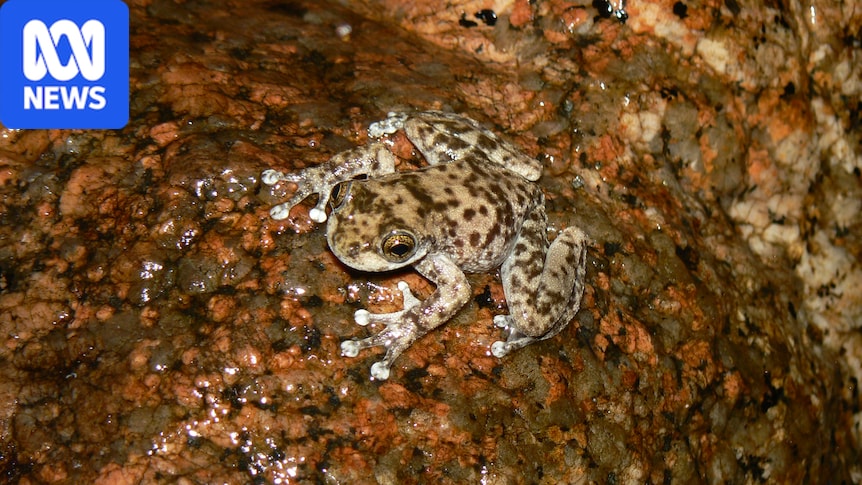
Queensland researchers have found two frog species are recovering from a fungus outbreak in the 1980s and 90s, while the population of a third species continues to struggle.James Cook University (JCU) researchers collected water samples from 11 sites throughout the World Heritage Daintree Rainforest to assess the status of species that had been severely hit by chytrid fungus outbreaks.Researchers looked for environmental DNA (eDNA) of three frog species: the critically endangered armoured mistfrog (Litoria lorica), the endangered waterfall frog (L. nannotis) and the endangered Australian lace-lid frog (L. dayi).The frogs are all only found in the Wet Tropics in north-east Queensland, with the armoured mistfrog believed to only exist in one remaining population.Cecilia Villacorta-Rath, the senior research officer with Tropwater JCU, said the frogs were ideal for study because they lived in similar environments and spent almost their whole life in water, making it much easier to detect their DNA downstream.Cecilia Villacorta-Rath says eDNA has many advantages, allowing researchers to monitor animals that can be hard to find. (Supplied: JCU TropWater)Dr Villacorta-Rath said the findings — published in July's Conservation Science and Practice journal — showed the waterfall frog and the Australian lace-lid frog populations had recovered to the point where they were detected in new territories."That was a nice surprise because they have recovered better than we, or the scientists, originally thought they had recovered," she said.But the sampling between October 2019 and January 2020 also showed one species, the armoured mistfrog, had not recovered well at all."We only encountered it at one site out of all those 11 sites," she said.Chytrid fungus and recoveryChytrid fungus (Batrachochytrium dendrobatidis) has been responsible for mass deaths of amphibians across the world and the extinction of at least four species in Australia.It attacks keratin in the animals' skin, which is believed to disrupt the important functions of the skin, sometimes causing death.The Australian lace-lid frog was badly hit by chytrid outbreaks. (Supplied: DH Fischer)Laura Grogan, a senior lecturer in wildlife science at the University of Queensland who was not involved with the research, said there had been varied recovery responses to chytrid fungus outbreaks in other frog species.She said while some species went extinct during the initial outbreaks, some now appeared to be recovering, if not fully recovered.Dr Grogan said this could have various causes, with a lot of variation between different species in terms of their susceptibility to the fungus."It can depend on the amount of infection load that's present or abundant in the environment itself," she said.She said variables included some populations developing a resistance to the fungus, changing their behaviour and exposure to the fungus, or even changes to the fungus itself.Water samples were taken from 11 sites in the Wet Tropics, where the frogs were known but also where they had not previously been recorded. (Supplied: JCU TropWater)Genetic diversity lossesDr Villacorta-Rath says the next steps in the research will be to look at the genetic diversity within the populations, also through eDNA collection.Dr Grogan said it was a vital step, because the mass deaths from the initial outbreaks could mean a genetic bottleneck in some populations, even when they appeared to have recovered."Some of the populations, even if they look as though they are abundant and there are a lot of animals in those populations, they are still genetically not as robust as they were originally," she said.Chytrid fungus badly hit species like waterfall frogs, attacking keratin in the frogs' skin. (Supplied: DH Fischer)She said this could leave them still vulnerable to other threats or changes in the weather or environment, and highly susceptible to chytrid fungus.Dr Grogan said even if a population was bouncing back, if another threat arrived such as an El Niño event, the populations could be more vulnerable because of the "multiple additive threatening processes happening synergistically"."It's still very highly virulent in the field, this fungus is still a major problem."
Environmental DNA shows some frog species bouncing back from fungus
Full Article
Original Source
Read the full article at Abc →KhanList aggregates and links to publicly available news content. We do not host full articles from third-party sources. Always verify important information with original sources.