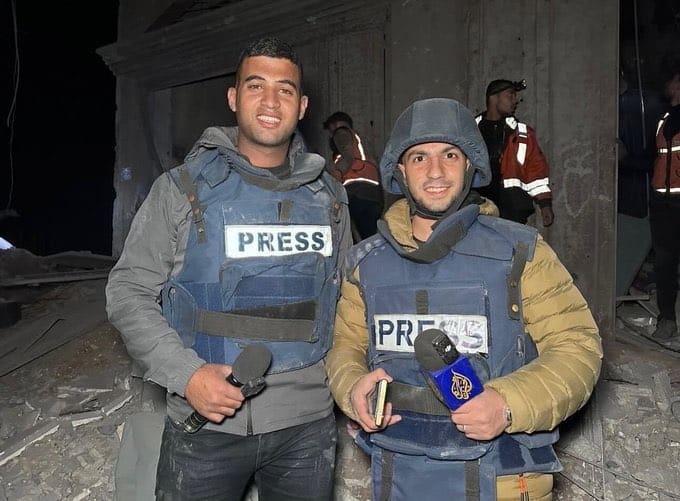
“I have lived through pain in all its details, tasted suffering and loss many times, yet I never once hesitated to convey the truth as it is, without distortion or falsification… I entrust you with Palestine… I urge you not to be silenced by chains, nor held back by borders… Do not forget Gaza.” – Anas al Sharif, Palestinian journalist martyred August 10, 2025 One year ago, on August 10, 2025, the Israeli occupation murdered the Pulitzer award-winning journalist, Anas Al-Sharif, alongside four of his colleagues in a targeted airstrike on an Al Jazeera tent outside of al-Shifa Hospital. He was one of the last surviving journalists in northern Gaza. As of the day of his martyrdom, 674 days into the genocide in Gaza, over 230 media personnel had been killed by Israel. By the time Anas was martyred, Palestinian journalists had made it a practice to write their wills, make what financial arrangements they had left to provide for their families, and go into the field prepared for imminent death. Two years of genocide had shown the occupation’s strategy of systematically targeting journalists, using the most brutal methods imaginable. In her last message to the world, Ayat Khaddoura, a 27-year-old freelance journalist from Beit Lahia, said, “We had big dreams, but our dream now is to be killed in one piece so they know who we are.” Ayat could not even be buried, as her body was torn to pieces by a strike on her home. Yahya Sobeih, 32, was an independent journalist from Gaza City. He had just celebrated the birth of his daughter, Sana, and had left the hospital briefly to buy some goods downtown when he was targeted by an airstrike. It killed him and his cousin, best friend, and brother-in-law. Every Palestinian journalist knew their reporting could cost them their life, and yet they brought the truth to the world anyway, leaving behind sons, daughters, spouses, parents, and the people of Gaza. Now, exactly one year later, the number of martyred journalists has climbed to over 270. Over 284 members of the press have been reported injured, missing, or arrested, and many have faced repeated assaults, threats, cyberattacks, and targeted killings of their families. Israel is deliberately and systematically targeting journalists in order to suppress coverage and documentation of its war crimes. “If the Israeli army kills me, the photos I took and the stories I told the world will live on. My name, my cause, and my voice will live on — and the occupation will die.” – Hassan Esleih, Palestinian journalist martyred May 13, 2025 This is a longstanding Israeli policy that has escalated rapidly since the genocide began. In 2022, Al Jazeera journalist Shireen Abu Akleh was shot in the head by an Israeli soldier while covering a raid on Jenin refugee camp. In 2018, Yaser Murtaja and Ahmed Abu Hussein were shot by Israeli forces while covering the Great March of Return in Gaza. In 2008, an Israeli tank fired on Fadel Shana, a 23-year-old Reuters journalist in Gaza. Then and now, for the Palestinian journalist, wearing the press vest is like wearing a target on your back. For Israel, the Palestinian journalist is an expression of everything the occupation is attempting to crush. Journalists remain on their land, refusing to leave even as bombs rain from the sky. They continue the coverage of Israeli atrocities, documenting and exposing the crimes against the Palestinian people that the West is paying for. They are symbols of hope and truth, not only for the Palestinian people, but also for the movement that has erupted around the world. And they express a steadfast commitment to their profession – not for the sake of the profession itself, but because, for the Palestinian journalist, reporting is a duty towards the Palestinian cause. “We will not leave. We will leave Gaza to heaven, and to heaven only.” – Rushdi Al-Sarraj, Palestinian journalist martyred October 22, 2023 For this reason, the Zionist project uses violence to attempt to crush every manifestation of what is true, steadfast, hopeful, and righteous, including and especially Palestinian journalists. Violence is at the core of the Zionist project, the engine through which it can achieve its objectives of eliminating the Palestinian people, as human beings and as a political body. But violence has a detrimental effect on public opinion, which is a key battleground given that the Zionist project would cease to exist without Western financial, political, and cultural backing. When Zionist war crimes committed against Palestinians began to shock the world, Zionists had to find a way to convince the West that it was, in fact, they, and not the Palestinians, who were the victims. For example, when the U.S. and UN condemned Israel after the Qibya massacre of 1953, when Israel razed a Palestinian village to the ground and murdered dozens of Palestinian women and children, Zionists realized that violence without consequences required an additional component: the unflinching support of Western institutions. AIPAC was founded in 1953 for this reason. These two pillars – violence and Western institutional support – are weapons that have been deployed against the Palestinian people as a whole, and Palestinian journalists in particular. But since the start of the genocide, when the true nature of Zionism was exposed to the world, Western institutional support has failed to translate into wins in the battle for public opinion. Billions of people around the world are now immune to Zionist propaganda. Israel’s quadrupled Hasbara budget will not be enough to recuperate the image of Zionism. Nor will its recent multi-million dollar operation to influence AI chatbots by poisoning data with pro-Israel websites (one of which promoted the Zionist claim that Palestinian journalists are “terrorists”). The demand for Palestinian liberation has been cemented in the consciousness of people on every continent. “[The occupation] will kill every human if you let it.” – Mohammed Al Kuwayfi, Palestinian journalist martyred September 15, 2025 In the face of this impasse, Israel is still resorting to the same two weapons it has in its arsenal to try to control the narrative. To stop stories of atrocities from getting out to the world, Israel kills the people who tell them. Israel has murdered the most journalists in any modern conflict and has done so with complete impunity. Meanwhile, Western media institutions will support Israel so long as the Middle East remains central to the interests of the U.S. and its allies. Mainstream coverage of Israeli war crimes against Palestinians continues to use passive language and uncritically parrot Israeli talking points, if they’re even covered at all. For example, aside from one mention in an opinion piece published ten days later, the Times’ coverage of Anas al-Sharif’s murder did not contain a single mention of the word “war crime” despite the fact that Israel openly acknowledged it had intentionally targeted journalists. The outlet’s first article on the killings spewed Israeli talking points attempting, and failing, to delegitimize Anas’ work and sacrifice by saying that he worked for Hamas. The second article was an attack on Al Jazeera, the outlet he worked for. Prior to the assassinations, several journalists such as Anas Al-Sharif and Saleh Aljafarawi were reportedly placed on Israel’s “red notice” list, showing a clear intent to kill journalists and break international law, yet Western media failed to properly report on these attacks. In a time when the Palestinian people are undergoing a genocide, passive, biased, and fabricated coverage is a moral stain on Western journalism. By attempting to protect Israel’s reputation, Western media outlets are perpetuating war crimes and digging the grave of journalistic integrity. Allowing the targeting of journalists in Gaza to continue in silence is setting a new precedent that media personnel are a fair target in war. The Western media wants Israel to get away with genocide because this, in turn, will absolve the West. Currently, there is a severe reduction in information coming out of Gaza, not due to a cessation of hostilities, but due to the deliberate targeting of journalists and intentional censorship on media platforms. It is up to every person of conscience to ensure that Israel and the media outlets that are complicit in Israel’s crimes are held accountable. On the anniversary of Anas’ martyrdom, we remember the charge he left us: “I entrust you with Palestine… I urge you not to be silenced by chains, nor held back by borders… Do not forget Gaza.” As people committed to the liberation of our homeland wherever we are, the Palestinian and Arab diaspora, alongside our allies, must play a key role in destabilizing the narrative pillar that upholds Zionism. We can do this by honoring the sacrifices of our people and by continuing to expose Zionist crimes on the ground, even and especially as they are left out of the news. We can also continue to pressure and call out Western media institutions for manufacturing consent for genocide. “Do not stop speaking about Gaza. Do not let the world look away. Keep fighting, keep telling our stories, until Palestine is free.” – Hossam Shabat, Palestinian journalist martyred March 24, 2025 That is why from August 10-16, we are calling a week of action in honor of Anas al Sharif and the 260 martyred journalists in Gaza. In cities across the U.S., Canada, and Britain, we will be hosting actions and events that expose Western media complicity and highlight the unreported news coming out of Gaza. We have put out a call for art that honors the martyred journalists of Palestine. And we are demanding newsrooms report honestly on Israel’s expansionist project in the region, call for the protection of Palestinian journalists who still face daily threats to their lives, and push for Israel to lift the ban on foreign press entering Gaza. Until these demands are met, we will continue to boycott, divest, and unsubscribe from complicit media outlets. Anas Al-Sharif was well aware of the target on his back by reporting on the genocide in Gaza, yet did it with unwavering courage and commitment. That is not just a testament to his own conviction in the Palestinian cause and the person he was, but it demonstrates the belief Anas had in all of us. He knew that we would be there to carry on in his absence, that we wouldn’t let the world forget, and that his and his colleagues’ sacrifice would never be in vain. People everywhere have been moved by the heroism and courage of Palestinian journalists. One year after his martyrdom, conveying and demanding the truth is as essential a task as ever for the Palestinian diaspora and every friend of Palestine. Palestinian Youth MovementThe Palestinian Youth Movement (PYM) is a grassroots, international movement that organizes Palestinian and Arab youth to struggle for Palestinian liberation. We believe that Palestinian youth have a right and responsibility, even in the far diaspora, to be active participants in working to liberate our people and land from the river to the sea.
Entrusted with Palestine: Honoring the martyred journalists of Gaza through action
Full Article
Original Source
Read the full article at Mondoweiss →KhanList aggregates and links to publicly available news content. We do not host full articles from third-party sources. Always verify important information with original sources.