
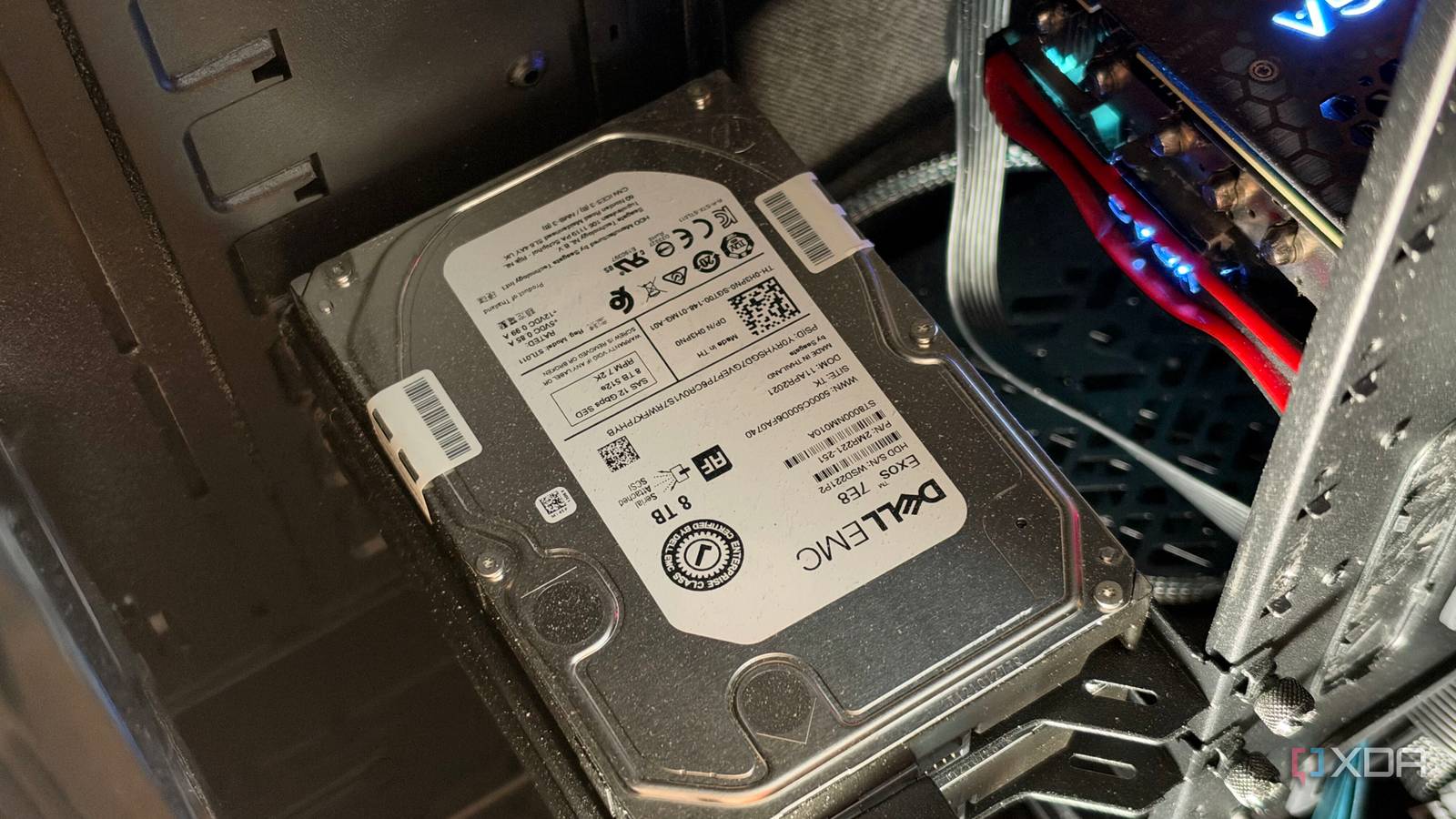
Published Oct 6, 2026, 7:00 AM EDT His love of PCs and their components was born out of trying to squeeze every ounce of performance out of the family computer. Tinkering with his own build at age 10 turned into building PCs for friends and family, fostering a passion that would ultimately take shape as a career path. Besides being the first call for tech support for those close to him, Ty is a computer science student, with his focus being cloud computing and networking. He also competed in semi-pro Counter-Strike for 8 years, making him intimately familiar with everything to do with peripherals. When I built my NAS, I bought used enterprise drives, partly due to their reputation for being rock solid for long periods of time. Backblaze's latest Drive Stats report is a great reminder that the "enterprise" label isn't always a guarantee of reliability. Across 354,415 hard drives, almost all of them enterprise models, lifetime failure rates range from about half a percent to nearly 6%. Enterprise gear might have more lofty design targets and a more lengthy warranty, but the model is much more indicative of how long you can expect a drive to last. Enterprise drives all fail at wildly different rates The "enterprise" label means almost nothing Backblaze's lifetime table puts the fleet-wide annualized failure rate (AFR) at 1.41%. That average might not sound remarkable on the surface, but that AFR number hides a lot underneath it. At the very bottom of that list lies the Toshiba 24TB MG11ACA24TE at 0.5%, and at the top, Seagate's 14TB ST14000NM0138 is at a 5.88% failure rate. Besides having a really long model name, there isn't much else these two drives have in common with regard to their relative reliability. The Toshiba is young, so the fairer comparison is between drives of similar age. WD's 14TB WUH721414ALE6L4 has a lifetime AFR of 0.54% at an average age of 63.5 months. The Seagate ST14000NM0138 has the same capacity, averages 56 months, and has failed at nearly 11 times that rate. It isn't only older drives either, because Seagate's 24TB Exos X24, the ST24000NM002H, has a lifetime AFR of 3.24% at about a year old. WD's 22TB model is at 0.58% at 19 months, with almost five times as many drives in service. I give all of these examples to illustrate the point that "enterprise" doesn't mean a lot when it comes to failure rates. And before you point at brand-name being an indicator, Seagate makes one of the steadiest drives in Backblaze's fleet, with its 16TB ST16000NM001G sporting a 0.68% failure rate across over 35,000 drives. Consumer drives are holding their own against enterprise siblings There isn't a lot of data here, but it's surprising While Backblaze primarily deals in enterprise storage, they do have exactly one consumer drive in their report. The 8TB ST8000DM002 comes from Seagate's Desktop HDD line, and its lifetime AFR is 1.54% at an average age of more than 107 months, which is close to nine years. Its nearest enterprise counterpart in the fleet is the 8TB ST8000NM0055, from the Enterprise Capacity line that was later renamed Exos 7E8, and that drive is at 1.98%, while also being the younger of the two at about 97 months. That particular comparison is quite relevant to me, because I have two of those same 7E8 drives in my own NAS. They're Dell-badged 8TB drives that I run in a ZFS mirror. They're a slightly different model with a SAS interface, but they come from the same family, so seeing them trail a desktop model by a bit is interesting. This also isn't saying that all consumer drives are going to last longer than enterprise counterparts, but what it does indicate is that the enterprise version is guaranteed to last longer in every instance. These numbers do have caveats There are some outliers here I wouldn't go as far as to treat these numbers as a strict buyers-guide. Age is obviously one of the primary indicators of a drive's chance of failing, but sample size has a lot to do with these stats. The two Seagate outliers have roughly 1,000 drives each, so a couple dozen failures in a quarter produces an alarming percentage. Deployment is another variable: Backblaze has previously said its ST14000NM0138 drives were provisioned in Dell storage servers, and that Seagate and Dell were investigating the failure rate. The drive may not carry all the blame, and it could be due to the backplane or other variables. Backblaze also doesn't define "failure" in the way you might think, and it's much broader than just a dead drive. It counts proactive replacements, where SMART data or file system checks suggest a failure is likely, alongside drives that have stopped working. And a storage server running around the clock in a data center is a bit different to your four-bay NAS in the closet. Spec-sheet reliability figures assume the manufacturer's own conditions, so a mismatch with one operator's fleet doesn't prove a drive is confirmed bad. The "enterprise" label does also buy you something tangible. The Exos 7E8 in my machine are rated for 550TB of workload a year, which is many times the rating of desktop drives. These drives carry five-year warranties and are built to tolerate the vibration of a chassis full of spinning disks. The parts used within them are of a much higher tolerance, which does count for something. Enterprise drives are by no means a bad buy, but it's not a guarantee of reliability When you go to buy your next NAS drive, going with pre-owned or even brand-new enterprise drives is not a guarantee that they will last longer than the consumer-grade counterparts. Checking the model and its general track record of how it has held up at scale will be much more indicative of its long-term reliability in your system.
Enterprise hard drives fail at wildly different rates, and Backblaze's data proves the label means almost nothing
Full Article
Original Source
Read the full article at Xda-developers →KhanList aggregates and links to publicly available news content. We do not host full articles from third-party sources. Always verify important information with original sources.