
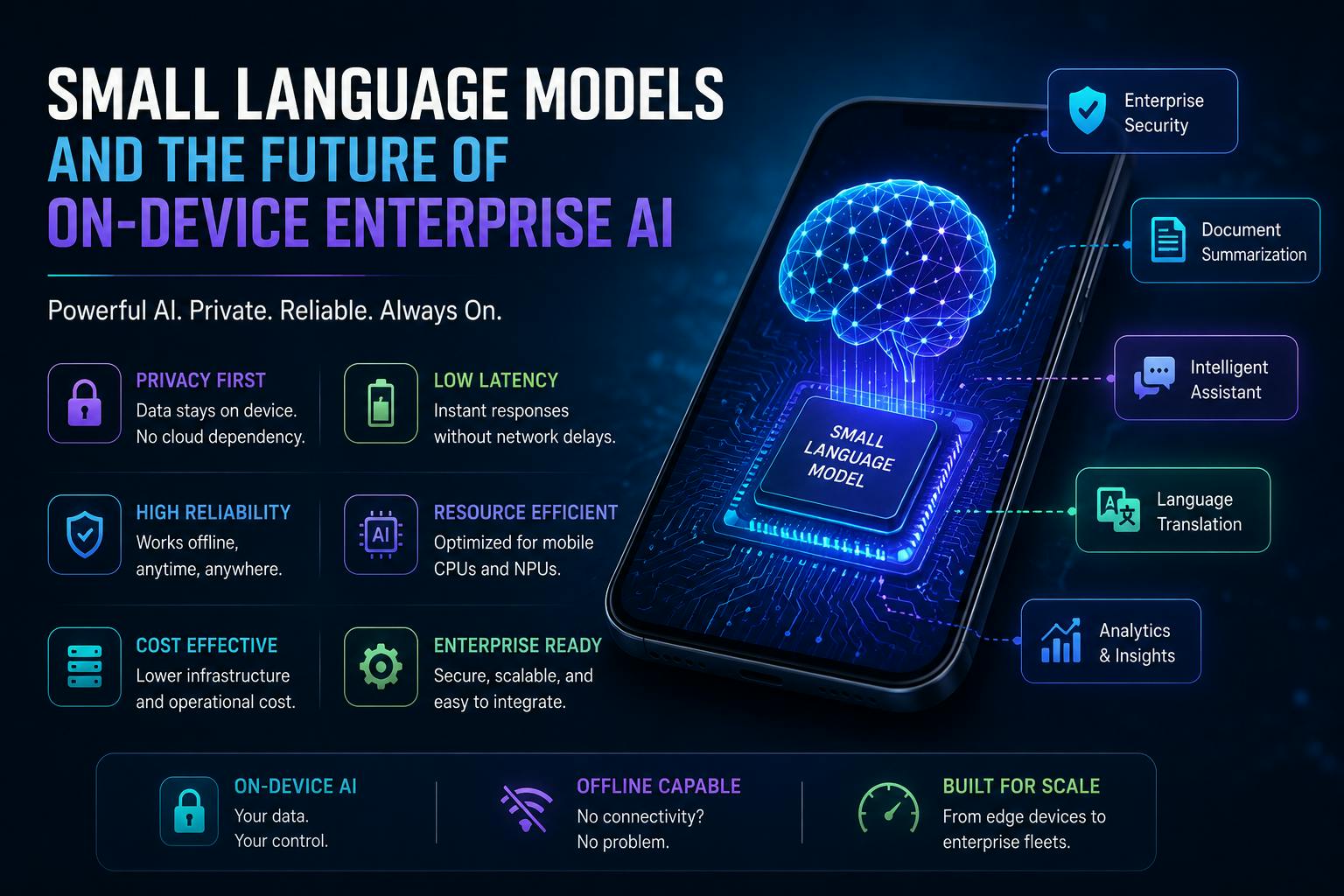
Enterprise AI is entering a local-first phase. Small language models, or SLMs, are no longer merely compressed substitutes for cloud models. They are becoming a distinct execution tier for privacy-sensitive prompts, predictable latency, reduced network dependence, and lower serving cost. Recent releases across Apple Foundation Models, Google Gemini Nano and Gemma, Microsoft Phi-3 and Phi Silica, Qualcomm AI Hub, and ONNX Runtime all point in the same direction as language intelligence is moving from remote endpoints into phones, laptops, and managed enterprise devices. Why the endpoint is becoming the default The business case for on-device inference is operational rather than ideological. Google positions Gemini Nano as a fit for use cases where privacy safeguards and low cost matter most, and notes that it runs through Android’s AICore system service, which uses device hardware and manages safety and model updates. ONNX Runtime frames on-device generative inference as a way to keep inference private and save costs, while Apple describes on-device processing as the cornerstone of Apple Intelligence and uses Private Cloud Compute only for requests that exceed local capacity. That pattern matches the shape of many enterprise prompts. A large share of internal AI traffic involves summarizing incident notes, rewriting support messages, extracting fields from forms, classifying short text, describing images captured by field teams, or transforming prose into constrained output. Google’s ML Kit GenAI APIs already expose prompt-based generation, summarization, proofreading, rewriting, and image description through Gemini Nano, while Microsoft exposes local text generation, summarization, and rewriting through Phi Silica and Windows AI APIs. The result is that common enterprise workflows no longer require a network round trip to produce useful language output. Why small models stopped feeling small The technical reason SLMs matter now is that the capability floor has risen sharply. Microsoft’s Phi-3-mini is a 3.8 billion parameter model trained on 3.3 trillion tokens, with Microsoft reporting 69 percent on MMLU while still describing it as small enough to deploy on a phone. Google’s Gemma 4 technical report extends the same trend with a multimodal family ranging from 2.3B to 31B parameters, while Google’s product material describes the E2B and E4B variants as edge-oriented models that prioritize multimodality, low latency, and hardware efficiency. Small no longer implies trivial. It increasingly implies appropriately scoped. That change alters model selection strategy. “Small” increasingly means appropriate for a device and a task, not incapable. Google’s Gemma 3 and Gemma 4 releases emphasize quantized variants, function calling, long-context support, and deployment across phones, laptops, and workstations. Qualcomm AI Hub turns that into a delivery pipeline by exposing optimization, quantization, profiling, and export into LiteRT, ONNX Runtime, and Qualcomm AI Runtime, while ONNX Runtime itself remains a cross-platform inference layer for mobile, desktop, browser, and edge scenarios. In enterprise terms, SLMs are becoming the Pareto-efficient tier for workflows that value bounded cost and bounded latency over maximum benchmark breadth. How the architecture is changing The dominant architecture is becoming on-device first and cloud second. Apple now formalizes that pattern with one Foundation Models framework that can target the on-device model or Private Cloud Compute through the same abstraction, and WWDC26 material shows Dynamic Profiles preserving transcript state while switching models for deeper reasoning. Android has moved in the same direction with hybrid inference in Firebase AI Logic, where PREFER_ON_DEVICE routes to Gemini Nano locally and falls back to cloud inference when needed. The emerging enterprise stack is therefore not “device versus cloud.” It is policy-based routing across both tiers, with locality as the default and cloud as escalation. The control points that matter most are not elaborate orchestration frameworks but lifecycle and budget controls. Apple now exposes context size and token counting, including cached and reasoning tokens; the current on-device system model is shown with an 8,192-token context size, while Private Cloud Compute is described with a 32K context window. Windows makes readiness checks part of the application lifecycle, and some Phi Silica configurations require explicit user consent because the model download can consume several gigabytes. Those details matter because enterprise AI on the endpoint is no longer just an inference problem. It is also a software distribution, storage, and UX problem. What production integration starts to look like The production appeal of SLM stacks is visible in how little code is required to create a local path. On Apple platforms, an application can bind a session directly to the on-device system model: let session = LanguageModelSession(model: SystemLanguageModel()) let response = try await session.respond( to: "Summarize this incident report in three compliance-safe sentences." ) That small surface area matters because the same LanguageModelSession abstraction can later switch models, preserve transcript-aware state, and attach local tools without rewriting the application layer. Apple’s current material also adds local OCR and Spotlight-backed search, enabling fully local retrieval-augmented flows against device-resident content. Android follows the same routing model. Hybrid inference in Firebase AI Logic can express an on-device-first policy in a few lines: val model = Firebase.ai(backend = GenerativeBackend.googleAI()) .generativeModel( modelName = "gemini-3.1-flash-lite", onDeviceConfig = OnDeviceConfig(mode = InferenceMode.PREFER_ON_DEVICE) ) val response = model.generateContent(prompt) When an application needs custom local prompting instead of fixed summarization or rewrite APIs, ML Kit’s Prompt API exposes multimodal request construction with image parts, text parts, and generation controls such as temperature and max output tokens. That turns the device into a governed inference target rather than a thin client for a remote LLM. Windows exposes the enterprise-hardening story even more clearly. Phi Silica requires readiness checks and supports content filters and LoRA adapters, so the local model can be specialized without rebuilding the entire application: if (LanguageModel.GetReadyState() == AIFeatureReadyState.NotReady) { await LanguageModel.EnsureReadyAsync(); } using LanguageModel languageModel = await LanguageModel.CreateAsync(); var result = await languageModel.GenerateResponseAsync(prompt, options); In practice, options can carry moderation settings or a low-rank adapter loaded from a safetensors file, which is exactly the kind of domain adaptation needed for policy language, service taxonomies, or product vocabularies. Local SLMs are therefore not just inference endpoints. They are becoming application-native components with platform APIs, content controls, and lightweight customization paths. What still constrains the model tier SLMs are not replacing cloud models. They are claiming the workloads that benefit most from locality. Apple still routes more demanding tasks to Private Cloud Compute. Google’s hybrid inference documentation notes that the current on-device path is specialized for single-turn generation from text or a single image input. Microsoft documents materially different latency and power characteristics between NPU and GPU execution. The technical future of enterprise AI is therefore not a pure edge story but a partitioned one in which task complexity, context length, energy budget, and policy sensitivity determine where inference runs. The deployment evidence already points to that outcome. Google reports that Kakao Mobility evaluated privacy, cost, accuracy, and response speed before choosing Gemini Nano through ML Kit’s Prompt API for production use, then reduced order completion time by 24 percent and increased conversion by 45 percent for new users in its address-entry workflow. That result does not imply that every enterprise workflow belongs on-device. It shows something more important that once model quality crosses a practical threshold, local inference stops being a novelty and starts becoming the default execution path for cost-sensitive, privacy-sensitive, and latency-sensitive business features. Small language models are not simply the future of on-device enterprise AI. They are the mechanism making that future operational now.
Enterprise AI Is Moving From the Cloud to the Endpoint
Full Article
Original Source
Read the full article at Hackernoon →KhanList aggregates and links to publicly available news content. We do not host full articles from third-party sources. Always verify important information with original sources.