
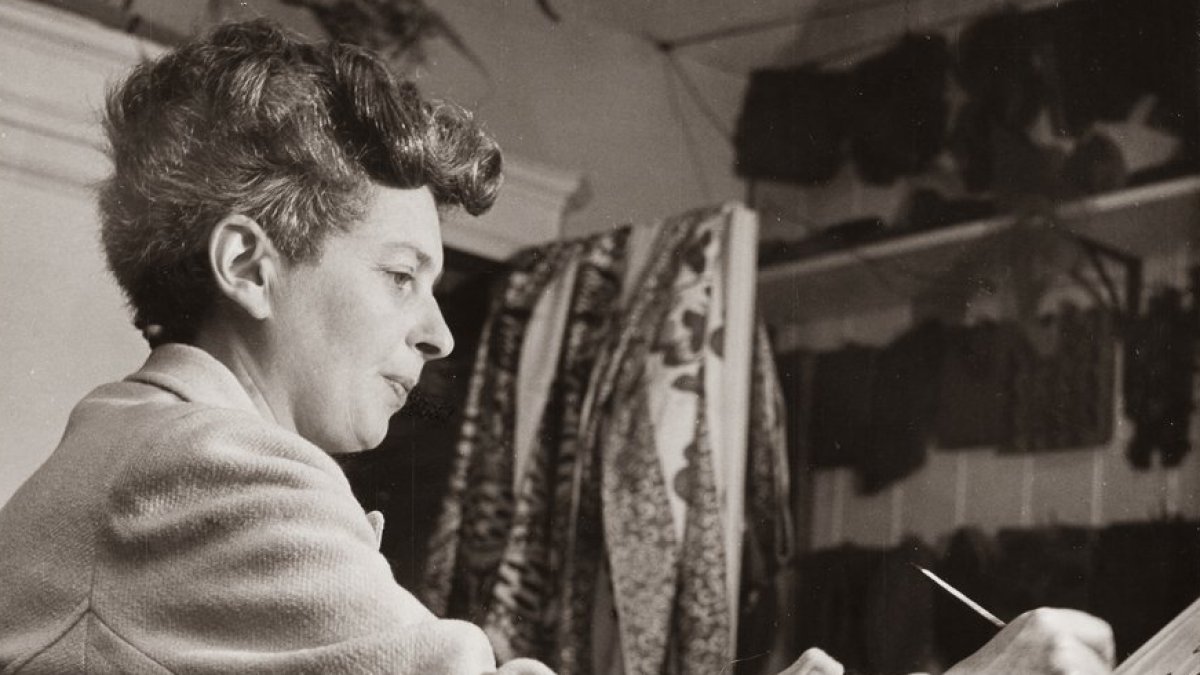
It will come as a surprise to absolutely no one that hiding the dirt well is a longstanding non-negotiable for designers of London Underground seat coverings. You might even wonder why our great capital has so stubbornly resisted the wipe clean seats increasingly favoured in other cities. The answer is at least in part to be found at Compton Verney, Warwickshire, currently host to an exhibition on Enid Marx, the artist-designer whose distinctive Underground seat fabrics from the 30s and 40s put London Transport on track as an unlikely beacon of British style. Marx was already a designer of some standing when in 1936, she came to the attention of Christian Barman, publicity officer for the London Passenger Transport Board (aka London Transport), and “the interior designer of the trains”, as Marx put it. Barman operated under the leadership of the inimitable Frank Pick, who oversaw the creation of London Transport in 1933, which transformed the capital’s disparate public transport services into a single entity. Pick was responsible for all aspects of its enduring identity: he commissioned the distinctive Johnston typeface still used today across the network, the celebrated posters of the 20s, the London Underground roundel, and Harry Beck’s famous Tube map, designed in 1933. “Moquette” – the hardwearing, carpet-like fabric that continues to be used on bus and Tube seats to this day – was already in use on public transport in the 20s. However, designs (such as the art deco Lozenge design from 1923) were created by the manufacturers to echo the dominant furnishing trends of the day. Enid Marx’s ‘Shield’ design was first used for Tube seats in 1938 (Photo: London Transport Museum) For Barman, like Pick, design was integral to the creation of a modern transport network serving one of world’s great capitals, and he set about commissioning a stable of notable artist-designers to produce bespoke seat coverings. Among them was Enid Marx, already known for her block-printed dress and upholstery fabrics that drew on British craft traditions as readily as on sources from across the British Empire. As a student at the Royal College of Art between 1922 and 1925, Marx belonged to an exceptional and era-defining cohort of artists, including Eric Ravilious, Edward Bawden, John Piper and Henry Moore. It was Ravilious who taught Marx wood engraving, the technique that would be the foundation of her distinctive fabric designs. Though no briefing document survives, Barman had to be exacting in his requirements and asked designers to avoid what Marx called “dazzle”, a strobing effect that could cause motion sickness. The prevalence of geometric patterns may in part be down to their more restful effect on the eye, and colours were carefully considered, with green a favourite because of its supposedly calming properties. Red was understood to be energising, the frequent combinations of the two offering a stabilising balance. Marx’s 1938 ‘Shield’ design moquette was used on seating by John Somerset Murray (Photo: London Transport Museum) Colour choice was also affected by the moquette itself, which because it has a pile, can make areas of colour look quite different. Lighting was also a consideration, and Marx recalled how in the 1930s, the prevailing wisdom was that “lighting on the underground trains should be pink so that the ladies looked their best”. In total, four of Marx’s designs were used on the Underground, the first of which was the freeflowing Shield design, installed on the Bakerloo and Northern lines between 1938 and 1948. Its contrasting but restricted colours give “Shield” a tight, graphic look, but it is actually one of her more organic designs, and follows on from her earlier fabric patterns, which incorporate repeated abstract motifs, often inspired by African and Middle Eastern textiles. In addition to the British Museum’s ethnographic collections, where she found examples of designs from Nigeria, Ghana, and the Middle East, Marx looked to the examples of day-to-day arts and crafts practised closer to home, which she collected with her partner, the historian Margaret Lambert. The bold, graphic design on Tube seat fabrics has continued through modern versions (Photo: David Potter/Construction /Avalon /Getty) Shield proved something of an exception, since the remaining three designs all conform to a grid pattern, from the muted but boldly graphic Belsize, used on the Metropolitan and District lines from 1940, to the square and diamond composition of Brent, introduced at about the same time. One of Marx’s most important innovations was to establish that bold, not muted, colours were most effective at disguising dirt, and designs including Shield were often manufactured in more than one colourway, including red and green. Accustomed as she was to small-scale, handmade manufacture, the transition to factory production wasn’t easy, and she found that some of her designs suffered in the process. Chevron, another grid design used on the Piccadilly and Central lines after the war, did not respond well to a colour change, which was found to produce the dreaded “dazzle” effect associated with motion sickness. Overall though, Barman valued Marx’s abstract patterns as naturally adaptable, so that “the same design may become a chair cover or, expensively mounted and framed, a single piece for the private collector”. The red and green woven seat of a Shaker chair from her collection is included in the exhibition to show how it might have inspired Marx’s moquette designs, which were almost exclusively abstract, since, she said, floral designs were inappropriately domestic for the Tube. Interestingly, fellow designer Marion Dorn felt differently, and her Colindale pattern from 1936 features a repeating leaf motif, in red and green. The original sketch for Enid Marx’s Shield design, installed on the Bakerloo and Northern lines between 1938 and 1948 Another more surprising Barman recruit was Paul Nash, better known as a landscape painter, surrealist and war artist responsible for some of the most enduring images of the First World War. He was also Marx’s tutor at the RCA, and a significant influence on her. Nash’s Alperton moquette, designed in 1936, is a distinctive and stylish grid pattern in brown, green and beige, that follows the orthodox wisdom that dirty colours disguise dirt. Marx’s preference for bright colours endured over the subsequent 90 years, while reflecting the broader trends of the time. The orange, brown and yellow chequerboard pattern that debuted on the District Line in around 1980 channels low-key psychedelia, the perfect backdrop to the brown polyester flares, burnt orange florals and pops of avocado green still lingering in the aftermath of the late 70s. Similarly, the primary colours of the Art Deco moquette introduced an up-to-date 90s flavour to a design rooted in the 30s. One of the most daring designs is Jack Thompson and Richard Eatough’s red and green Fossil moquette from 1954, which echoes the big pictorial prints that were in vogue at that time. Stripes and squares have proved the most enduring design elements and are the foundation of the Elizabeth Line moquette unveiled in 2022. Created by design firm Wallace Sewell, the purple colourway is a tribute to the late Queen, and among the pattern’s other references are a nod to the pinstripe suits traditionally associated with the City, and – in a rather optimistic flight of fancy – to the blurring effect of high speed. Despite the many practical considerations, many of which have barely changed over the past century, designers have always found ways to be innovative, while maintaining a sense of continuity with the past. In the 90s, London Underground introduced moquette specific to each line, creating individual identities that have been preserved to some extent on today’s Tube, though mainly through colour coding. Introduced in 2010, the Barman moquette is in use on trains across the network, its apparently abstract design composed of London landmarks including the London Eye, Big Ben, Tower Bridge and St Paul’s. Though no longer in service, Enid Marx’s influence lives on in the continued use of the moquette that she made an essential feature of London’s design landscape. And in a world where good design is increasingly sacrificed for cost savings, her outstanding work, and that of her fellow designers, offers a reminder of how public commissions can foster world-class creative work. For now, moquette is a London staple – if an innovative mind can find a way to keep it hygienic, it might stay that way. ‘The Pattern of Life: Enid Marx and Modern British Design’ is at Compton Verney until 3 January comptonverney.org.uk
Enid Marx, the woman who changed London’s Tube seats for ever
Full Article
Original Source
Read the full article at Inews →KhanList aggregates and links to publicly available news content. We do not host full articles from third-party sources. Always verify important information with original sources.