
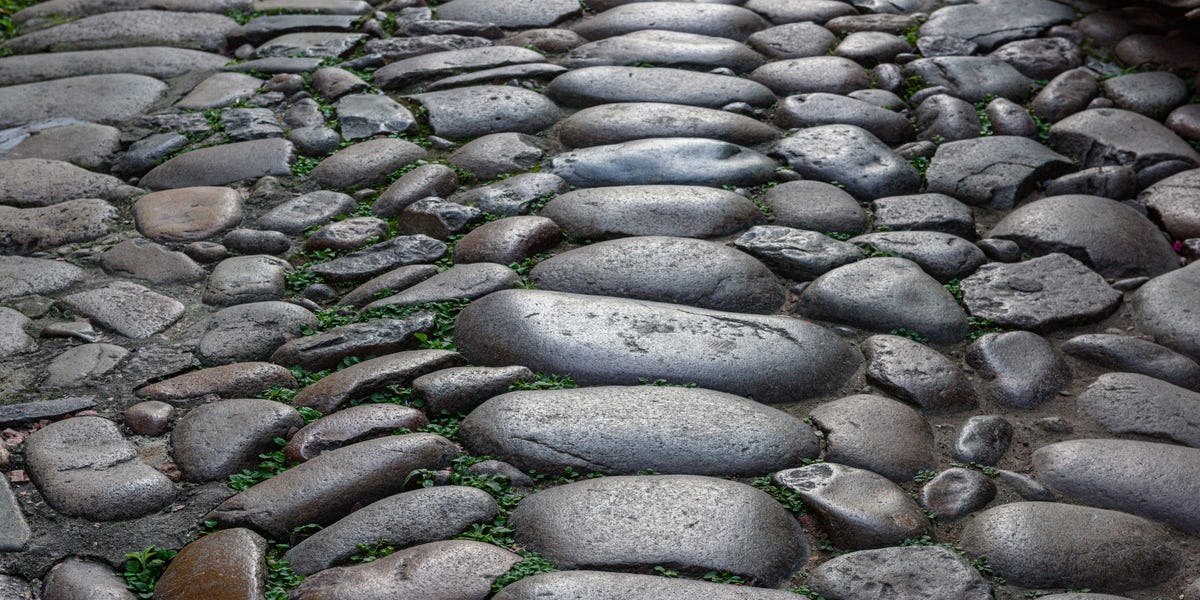
3 min readHere’s what you’ll learn when you read this story:Excavations ahead of construction on the new section of the A8 autobahn in southwest Germany have revealed a first-century C.E. Roman road.The Roman Alblimes Road connected plateau-topping forts and camps while offering a trade route.Archaeologists hope to uncover a full Roman road station as excavations in the region continue. Ahead of construction work on an autobahn in southwest Germany, crews discovered they weren’t the first engineers to consider the plateau near the town of Drackenstein suitable for a road. Excavations preceding work on a six-lane upgrade of the A8 autobahn between Mühlhausen im Täle and Hohenstadt revealed traces of one of the region’s most storied Roman roads from 2,000 years ago.Archaeologists uncovered a section of the ancient Alblimes Road on the Swabian Alb plateau, revealing a roughly 300-foot-long section of white Jurassic limestone.“The findings shed light on the origins, significance, and use of one of the oldest roads in Baden-Württemberg,” Dr. René Wollenweber, case officer for infrastructural corridor projects at the State Office for Monument Preservation, said in a translated statement from the Stuttgart Regional Administrative Authority. “The excavations demonstrate that the construction of modern transport routes—when accompanied by heritage preservation measures—is not only essential for the state’s infrastructure development but also enriches our knowledge regarding the evolution of the cultural landscape and Baden-Württenberg’s cultural heritage.”The road, which is about 16 feet in width, ran between the Roman forts at what are now Rottweil and Heidenheim an der Brenz, and was likely constructed during the reign of Roman Emperor Vespasian, between 69 and 79 C.E.The Swabian Alb forms a distinct, self-contained landscape stretching from the Rhine Falls at Schaffhausen to the Nördlinger Ries. The Roman Empire took advantage of the natural land bridge of over 120 miles by siting frontier forts and military camps on the plateau, linking them via the Alblimes Road. When the Roman province of Germania Superior was established in the first century C.E., the road facilitated trade and military activity. Experts believe the Alblimes Road may have also marked a boundary between the Roman Empire and the independent territory of Germania.Fieldwork in the 19th and 20th centuries exposed some of the area’s history, confirming the hypothesis of the Alb fortifications and a road linking them. The new discovery offers more evidence of what experts call a primary road in the regional network.Two specialist archaeological excavation companies, fodilus and ArchaeoBW, are working at the site, uncovering additional artifacts. So far, these have included a Roman coin bearing the image of an emperor (possibly Domitian), iron hobnails from Roman footwear, a Late Bronze Age burial urn, a bronze roll-headed pin, and traces of a Celtic settlement.“The people here in the Swabian Alb deserve to learn about their cultural history,” Wollenweber told SWR in a translated report.The teams have excavated roughly two-thirds of the area, and Wollenweber is hopeful that clues of a road station—where the Romans offered wagon repair and horse services—will fully materialize into an actual site before the end of the year.“The results show that the layout of modern major routes is by no means unrelated to historic lines of communication,” Wollenweber said. “In many cases, geography dictates the same natural corridors already exploited by Roman engineers.”Tim Newcomb is a journalist based in the Pacific Northwest. He covers stadiums, sneakers, gear, infrastructure, and more for a variety of publications, including Popular Mechanics. His favorite interviews have included sit-downs with Roger Federer in Switzerland, Kobe Bryant in Los Angeles, and Tinker Hatfield in Portland.
Engineers Widening an Autobahn Just Unearthed a Forgotten Roman Superhighway
Full Article
Original Source
Read the full article at Popularmechanics →KhanList aggregates and links to publicly available news content. We do not host full articles from third-party sources. Always verify important information with original sources.