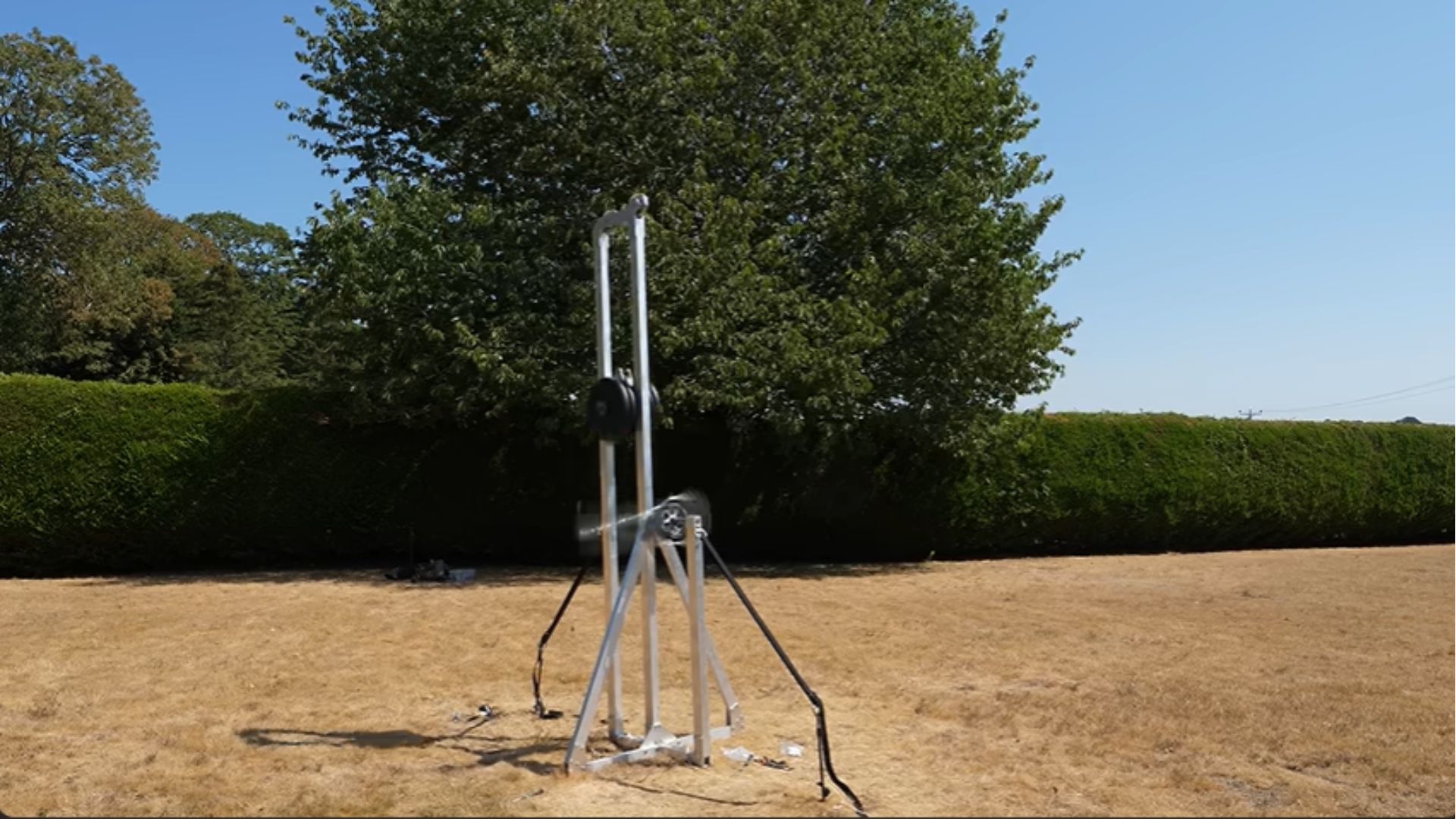
UK-based engineer Tom Stanton has successfully built a trebuchet that can send projectiles flying at supersonic speeds. Although, the projectile weighs a meagre four grams, Stanton would have been greatly sought during medieval times for his ability to design such a trebuchet, even though some of the tools he required to build it, did not exist at that time. Even though the world has no demand for trebuchets these days, Staton’s skills are on demand on YouTube at least. The UK-based aerospace engineer has slightly over 1.5 million subscribers for this YouTube channel and keeps them engaged with interesting builds like an air-powered plane, a bicycle powered by a Stirling engine or even a mechanical powered by a pendulum. Interesting Engineering has previously covered Stanton’s amazing builds, so a projectile travelling at supersonic speeds definitely deserves a piece, especially when powered by a siege weapon built for medieval times. Just in case, you aren’t sure, what a trebuchet does, here is a quick explainer. How does the trebuchet work? Trebuchets were designed to fling huge stones so that their momentum would bring down castle walls. A clever piece of engineering, the trebuchet uses a heavy counterweight that can be pulled and dropped down using manual force. As the weight drops down, a lever and sling transfer this onto a lighter projectile, which can be flung to a distance at considerable speed. The weight of the projectile and its travelling velocity would generate enough momentum to bring down big castle walls in a few shots. To cause more damage, heated shots were also used. But no matter the projectile, its speed remained more or less the same. This is because any object in freefall will accelerate at the maximum of 9.81 meters per second squared, due to the gravity on the Earth’s surface, which is a constant. So, the speed of the projectile also remains the same, even though the counterweight may be increased. So, when Stanton decided to breach the speed of sound with this device, he was surely taking up a major challenge. How Stanton’s trebuchet works To begin with Stanton designed his trebuchet the counterweight suspended from a 3:1 ratio pulley system, changing the relation between the counterweight used and the speed of the projectile. The arm of the trebuchet had to be rigid yet light and Stanton turned to carbon fibre for this. Stanton used the CNC mill, he had previously built at home to carve the piece and even redesigned them after stress tests exposed the weakness of his pieces. After much work, the redesigned trebuchet was ready for real-world testing and Stanton worked in 22-pound (10 kg) increments for the counterweight to test the system and get it up to supersonic speed. With the 22 pound (10 kg) counterweight, Stanton could hit the 394 miles per hour (mph) with his projectile. As he reached the 88 pound (40 kg) counterweight, the projectile speed reached 716 mph, just 51 short of the number, to match the speed of sound. Unfortunately, as Stanton attempted his experiment with a 110-pound (50 kg) counterweight, his trebuchet gave way, So, he had to return to the 88-pound counterweight and reduce the weight of the projectile to four grams. In the video, the projectile reached 776 mph (1,248 kph) or nine miles per hour faster than the speed of sound. The proof may be in the numbers but the loud crack and echo of the sonic boom did confirm that history was made that day. Recommended ArticlesGet the latest in engineering, tech, space & science - delivered daily to your inbox.Ameya is a science writer based in Hyderabad, India. A Molecular Biologist at heart, he traded the micropipette to write about science during the pandemic and does not want to go back. He likes to write about genetics, microbes, technology, and public policy.
Engineer harnesses gravity to launch a 4-gram projectile at supersonic speeds
Full Article
Original Source
Read the full article at Interestingengineering →KhanList aggregates and links to publicly available news content. We do not host full articles from third-party sources. Always verify important information with original sources.