
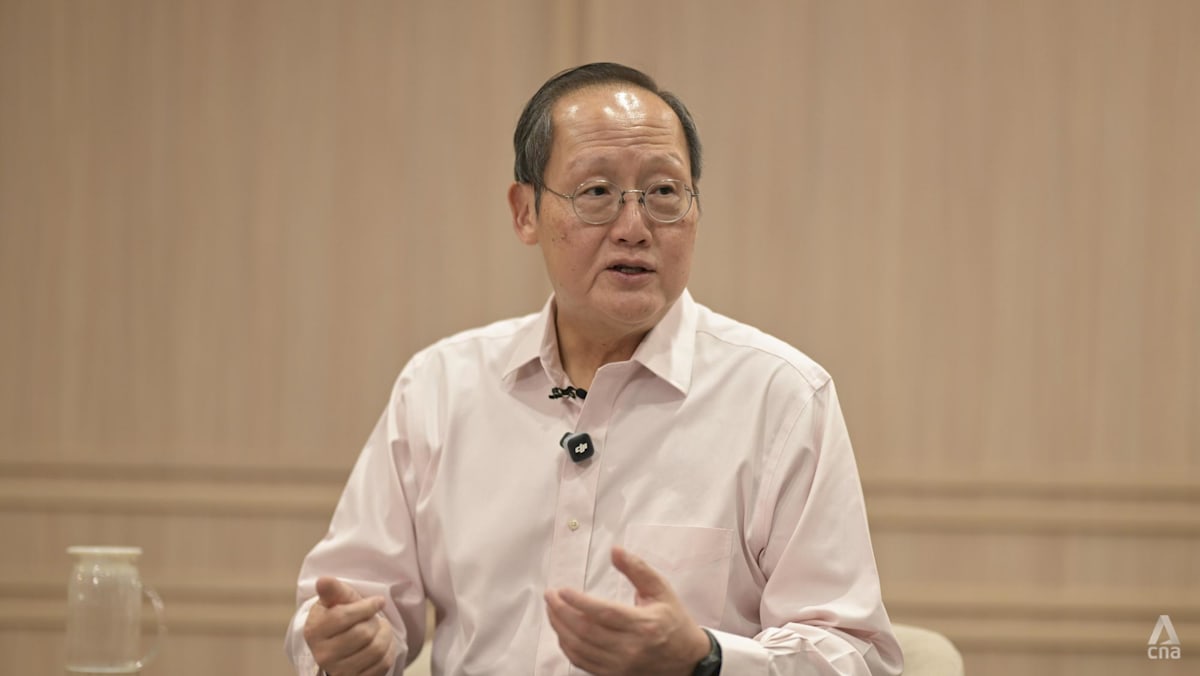
SINGAPORE: Working with neighbouring countries on energy resilience is "not a zero-sum game", even if countries have to prioritise their own domestic needs from time to time, said Minister for Energy, Trade and Industry (Energy and Industry) Tan See Leng.“Our philosophy has always been ‘prosper thy neighbours’,” he said, adding that Singapore works with neighbouring governments to allocate energy for their domestic consumption before export.Speaking to the media on Nov 13, ahead of Singapore assuming the Association of Southeast Asian Nations (ASEAN) chairmanship, Dr Tan said that such partnerships can bring economies of scale and increase project viability by attracting investment interest.He cited the ASEAN Power Grid – a plan to connect Southeast Asia’s electricity network – as an example. ASEAN leaders on Tuesday (Nov 17) signed an enhanced memorandum of understanding on the grid. The agreement, signed during the 49th ASEAN Summit in the Philippine capital of Manila, marked progress in making the decades-long plans a reality.In October, a report by the International Energy Agency warned that Southeast Asian countries are using more energy and becoming reliant on imported fuel, leaving the region vulnerable to supply disruptions and price shocks.Later that month, Indonesia announced reduced gas exports to Singapore to divert more supplies to domestic electricity needs.Dr Tan noted other geopolitical uncertainties, including AI-related developments, tariff wars, and an increasing need for neighbouring countries to keep up with growing domestic energy demand. For Singapore, a small and open country dependent on keeping supply lines open, the key concern should be how the country can continue to thrive and remain relevant, said Dr Tan.“Just as how it was 30, 40 years ago, when water itself was existential for us. Today, energy is existential for us,” he said.ASEAN’S ENERGY POTENTIALDr Tan said Southeast Asian countries have “huge natural resources” in terms of energy generation and alternative energy.For example, Indochina has landmass with wind and solar energy potential, while the Mekong River has “tremendous hydroelectric power”. The South China Sea has potential for more gas exploration, and part of the region, sitting on the Pacific Ring of Fire, has “abundant geothermal potential”, he said.Dr Tan also pointed to ASEAN’s growth potential, with 700 million people and relatively young countries, with Singapore being the only superaged society.As Singapore prepares to assume the ASEAN chairmanship, the key is unlocking the political willpower to push shared plans forward, as they require investments that “run into the decades”.“It's how do we articulate that vision, socialise the vision across all of the different governments and the peoples to get them to believe in this vision – because it's not just a vision, it's a real achievable goal,” he said.“And once investments come in, they crowd in. You are looking at at least hundreds of billions, if not at least a couple of trillions (in) potential investments opening up and coming into ASEAN,” he said.Regional energy leaders told CNA in May that the ASEAN Power Grid is increasingly being viewed as an economic and energy security necessity.But they also warned that Southeast Asia still faces major hurdles, including regulatory fragmentation, financing gaps and weak grid connectivity.Also on Tuesday, at the ASEAN Summit's closing ceremony, Singapore Prime Minister Lawrence Wong said the country will push for closer energy links across the region as it takes over the chairmanship.At a time when the world is becoming more divided, Singapore’s response is to keep building bridges and ensure that Southeast Asia remains a region where all countries can engage and cooperate, he added. DIVERSIFYING ENERGY SOURCESDr Tan said that for current and future generations, the goal is for Singapore to be energy self-sufficient, secure, reliable and affordable.Today, Singapore has diversified its gas supply by buying gas from countries including the US, Africa, Australia, the Middle East and Mozambique, Dr Tan noted. A liquefied natural gas facility was also developed in 2021 to stockpile gas and diesel – a supply that remains untouched, he added.Dr Tan noted the importance of diversifying Singapore's energy safety nets, so the country can continue to support itself even during times where its allies are unable to do so.“I think that has always been how we've been looking at this, to make sure that multiple layers provide a very strong interconnected, interwoven mesh … so that you don't have anything that slips through the cracks.”Singapore is working towards achieving net-zero emissions by 2050. While the country’s energy mix would likely still be underpinned by natural gas by then, it will no longer be as high as the current 95 per cent, said Dr Tan.He added that Singapore is ramping up domestic solarisation and will eventually be able to rely on a combination of green hydrogen and green ammonia as fuel sources.The government is also closely watching developments in the nuclear energy space, said Dr Tan, particularly with regard to its commercial viability.By then, there will also be a clearer picture of Singapore’s geothermal potential, he said.“But having said that, we are not betting on any one particular one,” he said.Asked whether Singapore would rely on carbon capture to meet its net zero goals, Dr Tan said that the technology, which traps and stores carbon dioxide, is still cost-prohibitive at its current scale."While I want to ensure energy security, diversification and decarbonisation, I've also got to ensure that it's affordable for all of you," he said. "We will decarbonise, but we will never decarbonise at all costs."Dr Tan said Singapore could meet about 40 to 50 per cent of generational power needs through renewable or clean energy, but pointed out that no country in the world can go “100 per cent green”, due to environmental and seasonal changes. While it remains difficult to move away from gas completely, Dr Tan described nuclear energy, which can substitute gas, as “so exciting”. He noted that one tiny pellet of uranium can produce as much energy as about one-fifth of an Olympic-sized swimming pool of gas.While these emerging sources appear to be "very, very safe" thus far, Dr Tan emphasised that the key to bringing down natural gas needs is harvesting alternative forms of energy at scale in a commercially viable way.Ultimately, Singapore's first and foremost focus must be on energy conservation due to its lack of natural resources and difficulty in accessing renewable energy, said Dr Tan. He urged Singaporeans to cultivate everyday energy-saving habits such as switching off lights and air-conditioning when not in use.“We must … ingrain into ourselves that we must save energy. And conservation is the key.”
Energy ties with neighbours 'not a zero-sum game' even when each puts its own needs first: Tan See Leng
Full Article
Original Source
Read the full article at Channelnewsasia →KhanList aggregates and links to publicly available news content. We do not host full articles from third-party sources. Always verify important information with original sources.