
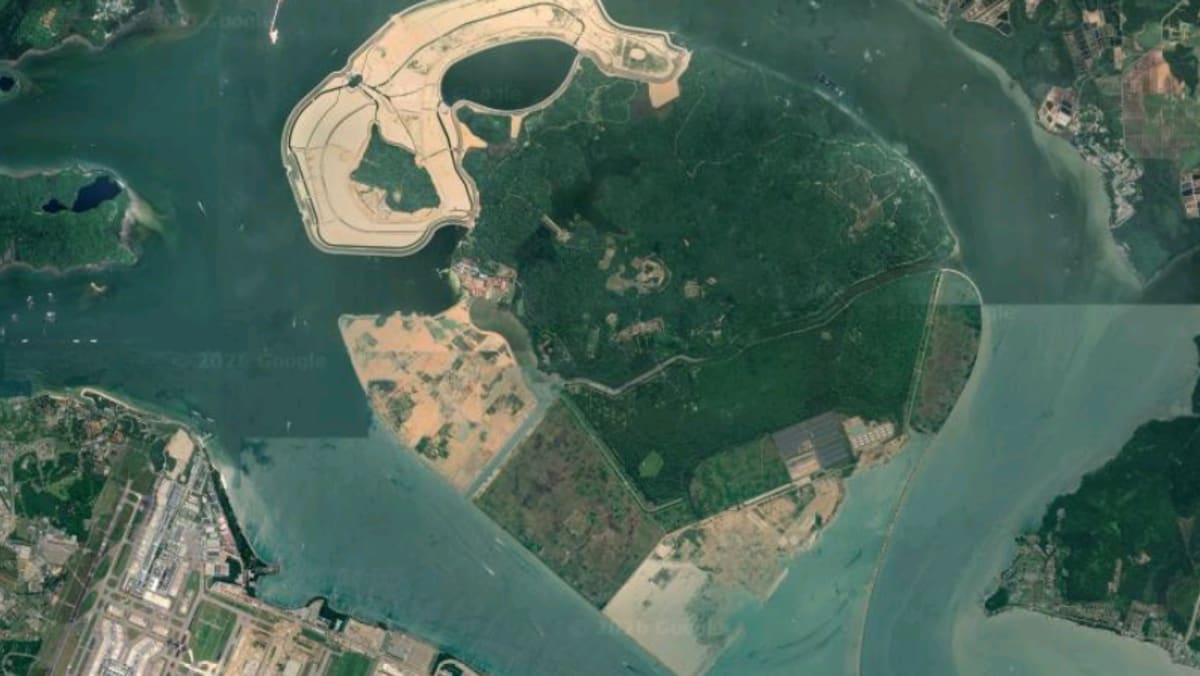
SINGAPORE: Pulau Tekong, long associated with military training, could one day take on another strategic role – housing energy infrastructure that helps power Singapore.But observers told CNA that making room for both activities would be only part of the challenge, with safety requirements and operational restrictions potentially imposing significant long-term costs.The island off Singapore's northeastern coast has housed the Singapore Armed Forces' (SAF) Basic Military Training Centre since 1999.In early October, the Energy Market Authority (EMA) announced that a 200ha site on reclaimed land at Pulau Tekong – equivalent to about 40 per cent of Sentosa Island's land area – is being studied for a possible energy infrastructure cluster. The cluster could house hydrogen-ready natural gas-fired power plants, a liquefied natural gas (LNG) terminal and other low-carbon energy technologies.EMA has called a tender for a consultant to conduct a feasibility study and propose a master plan. The consultant is expected to be appointed by mid-2027, with the study estimated to take about two years.Defence, energy and economics experts said developing energy facilities on Pulau Tekong, which was repurposed for military training nearly 40 years ago in 1987, could be feasible. But careful planning of safety buffers and operational arrangements would be needed to avoid costly disruptions to both military training and energy operations, they added.WHY PULAU TEKONG, AND WHY NOW?The feasibility study follows Prime Minister Lawrence Wong's announcement at the National Day Rally in August that roughly 500ha of land on Pulau Tekong – about the size of Toa Payoh town – would be available for future civilian uses after the SAF's needs are met.Mr Wong said no decision had been made on how the land would be used.Singapore will need more land for energy infrastructure as demand grows, EMA said in response to CNA's queries."However, the identification of suitable land for energy infrastructure has become increasingly challenging due to Singapore’s land scarcity and competing land needs to meet various national priorities," an EMA spokesperson said.An energy cluster on Pulau Tekong could help address these constraints and meet future energy demand in eastern Singapore, though EMA stressed that no decision has been made to proceed with the development at this stage."Subject to the findings of the study and assessments, plans for the proposed energy cluster on Pulau Tekong could be further developed, including its landtake and timeline, to support Singapore’s future energy needs,” it said. SAF recruits at Pulau Tekong. (Photo: Facebook/Basic Military Training Centre) Singapore's electricity demand is expected to grow substantially in the coming decades, driven by electrification, data centres and other energy-intensive activities, said Assistant Professor Tan-Soo Jie-Sheng of the National University of Singapore’s (NUS) Lee Kuan Yew School of Public Policy.Given the long lead times for major energy infrastructure, suitable sites would need to be identified well before additional capacity is urgently needed, added Dr Tan-Soo, who is also director of the school’s Institute for Environment and Sustainability.Beyond its available land, Pulau Tekong's offshore location could offer other advantages.Dr Kim Jeong Won, a senior research fellow at NUS' Energy Studies Institute, said the island's distance from densely populated mainland areas and direct access to the sea could facilitate safety management for facilities such as LNG terminals and hydrogen storage facilities.Seawater could also be used to cool thermal power generation facilities, she added.Some experts believe Pulau Tekong's existing military infrastructure could potentially be tapped to support the development of an energy cluster.The SAF's longstanding presence on the island provides a "natural security presence" for the proposed development, said Dr Ian Li Huiyuan, a research fellow at Nanyang Technological University's S Rajaratnam School of International Studies (RSIS).Meanwhile, an energy cluster on Pulau Tekong could also bring broader benefits to Singapore's energy system.Much of the country's energy infrastructure is concentrated in the west, and developing another cluster in the east could help diversify it."Developing another major energy cluster in the east could reduce the country’s exposure to disruptions affecting any single location," said Dr Tan-Soo.Pulau Tekong's location could also create opportunities to import electricity from neighbouring countries, although these would depend on commercial and technical assessments, he added. CAN POWER PLANTS AND LIVE-FIRING EXERCISES COEXIST?While Pulau Tekong may offer advantages as a location for energy infrastructure, accommodating such facilities alongside military ones would introduce safety and operational challenges.RSIS’ associate research fellow Thomas Lim said building energy facilities there could carry an "inherent risk", with live-firing and pyrotechnic exercises taking place on the island.There would naturally be concerns about potential accidents if safety management procedures are not adequately established, he added.Energy facilities would therefore need to be located outside military training safety zones, with their placement taking into account projectile trajectories to minimise interference between the two activities, Mr Lim said.RSIS’ Dr Li said the probability of an accident occurring was "extremely small" though he added the caveat that it is not completely zero."Live-firing areas are usually clearly demarcated and safety protocols put in place to prevent misfires," he added.Detailed technical and safety assessments would be needed to determine whether live-firing exercises could safely take place near LNG and hydrogen facilities, said experts.Opening up the island to civilian activities could also introduce security challenges.Dr Li said a dedicated civilian zone could increase the number of people accessing Pulau Tekong, making security oversight more difficult.Even if safety and security risks can be managed, another key question would be whether both activities could operate without imposing costly restrictions on each other.NUS’ Dr Tan-Soo distinguished between one-off development costs, such as additional protective infrastructure, and recurring costs arising from operational restrictions.This comes as military exercises could face restrictions when certain energy operations are taking place, potentially affecting training. At the same time, military activities could limit how flexibly and reliably energy facilities operate."Additional construction costs may be manageable if spread over the lifetime of an energy facility,” said Dr Tan-Soo. “However, recurring restrictions that affect electricity generation or military training could have more significant long-term economic implications.”Given that energy facilities often operate for several decades, “even relatively modest recurring restrictions could impose substantial economic costs” over their lifetime, he added.These constraints could also shape what kinds of energy facilities would be viable on the island.NUS' Dr Kim said the need for extensive safety buffers and protective measures could make some energy technologies economically unattractive, even if they are technically feasible. Any economic assessment should therefore weigh the costs and benefits for both military training and energy operations, rather than evaluate the proposed energy cluster in isolation, said Dr Tan-Soo.The government would also need to consider the opportunity cost of setting aside land for safety zones, particularly in land-scarce Singapore.In its reply, EMA told CNA its feasibility study would assess technical, regulatory and environmental considerations, including potential constraints and ways to mitigate them.It is in consultation with relevant agencies and ministries, including the Ministry of Defence, to incorporate their requirements and considerations. These include prioritising the safety of SAF personnel and minimising disruptions to training activities.WHAT WOULD CO-EXISTENCE REQUIRE? Experts said sharing Pulau Tekong would require careful decisions about how land is divided, how access is controlled and how activities are coordinated.Adequate safety buffers would be essential, but the distances required would depend on the types of energy facilities and hazardous materials involved.Mr Lim suggested adopting measures similar to those at military facilities on Singapore's mainland, such as perimeter fencing, colour-coded security zones, concertina wire and high gates to separate restricted and sensitive areas from those with wider access.But Dr Tan-Soo said LNG terminals, hydrogen facilities and natural gas-fired power plants have different safety requirements, making it "inappropriate to prescribe a uniform buffer distance".Instead, the required separation distances would need to be determined through site-specific risk assessments. A sign showing a protected area. (Photo: MINDEF) Beyond the physical footprint of energy facilities, access roads, utility corridors and security arrangements would collectively occupy substantial areas of land, Dr Tan-Soo added. Dr Kim added that space should also be reserved for future expansion and changing safety requirements.These safeguards could also complicate day-to-day operations."During construction, activities may need to be coordinated with military training schedules, potentially extending project timelines and increasing development costs," said Dr Kim."Once operational, military exercises could complicate fuel deliveries, maintenance access, and emergency response if roads, coastal waters, or other access routes are shared or subject to temporary restrictions."There could, however, be opportunities for shared infrastructure to benefit both sides, such as transport routes or utilities, while the energy cluster could potentially supply backup electricity to military facilities, Dr Tan-Soo suggested.Similar arrangements exist overseas, where energy infrastructure operates near military installations, but experts cautioned against drawing direct comparisons with Pulau Tekong.Dr Tan-Soo pointed to Cartagena in Spain and Kochi in India as examples of coastal areas where major LNG facilities operate alongside naval installations or in areas that serve as important naval centres.Dr Kim also cited military bases in the United States – including the Marine Corps Base Camp Pendleton and the Marine Corps Recruit Depot San Diego, both in California – where energy infrastructure has been developed through careful site selection, compatible land-use planning and mutually-beneficial operational arrangements. But these examples differ in scale and purpose from the major energy infrastructure cluster being contemplated on Pulau Tekong, experts noted. For instance, the project at Marine Corps Base Camp Pendleton spans about 7.8ha, compared with the 200ha being studied on Pulau Tekong, and focuses on battery energy storage rather than large-scale fuel storage or power generation, said Dr Kim."While these international examples demonstrate that civilian energy infrastructure and military activities can coexist within the same broader geographical area, they do not necessarily establish that large-scale LNG or hydrogen facilities can operate safely in close proximity to live-firing exercises," said Dr Tan-Soo.The key question, he added, would be whether the benefits of developing the energy cluster would outweigh the costs of accommodating it alongside military training. WHAT COULD TEKONG’S LONGER-TERM FUTURE LOOK LIKE? While 200ha is being studied for the proposed energy cluster, much of the roughly 500ha identified for future civilian uses could still be available for other purposes. In a written parliamentary reply in September, the Ministry of National Development said it was studying potential civilian uses for Pulau Tekong, which could include utilities and other industrial activities.Mr Lim suggested exploring developments that complement the SAF's existing activities, such as defence-related research. Retaining space for military use could also allow the SAF to conduct more complex and realistic training exercises in Singapore, he added.Dr Kim said the government's consideration of uses beyond energy infrastructure signalled that it was keeping its options open to meet future national needs.Dr Tan-Soo warned against permanently setting aside large areas for specific energy technologies, as more attractive alternatives could emerge over time."As such, the objective should not simply be to maximise the amount of energy infrastructure developed on Pulau Tekong," he said."It should be to ensure that the island’s development strengthens Singapore’s long-term energy security in a cost-effective manner, while preserving sufficient flexibility to accommodate changing technologies and future national priorities."
Energy cluster alongside military training on Pulau Tekong? Making room is only part of the challenge
Full Article
Original Source
Read the full article at Channelnewsasia →KhanList aggregates and links to publicly available news content. We do not host full articles from third-party sources. Always verify important information with original sources.