
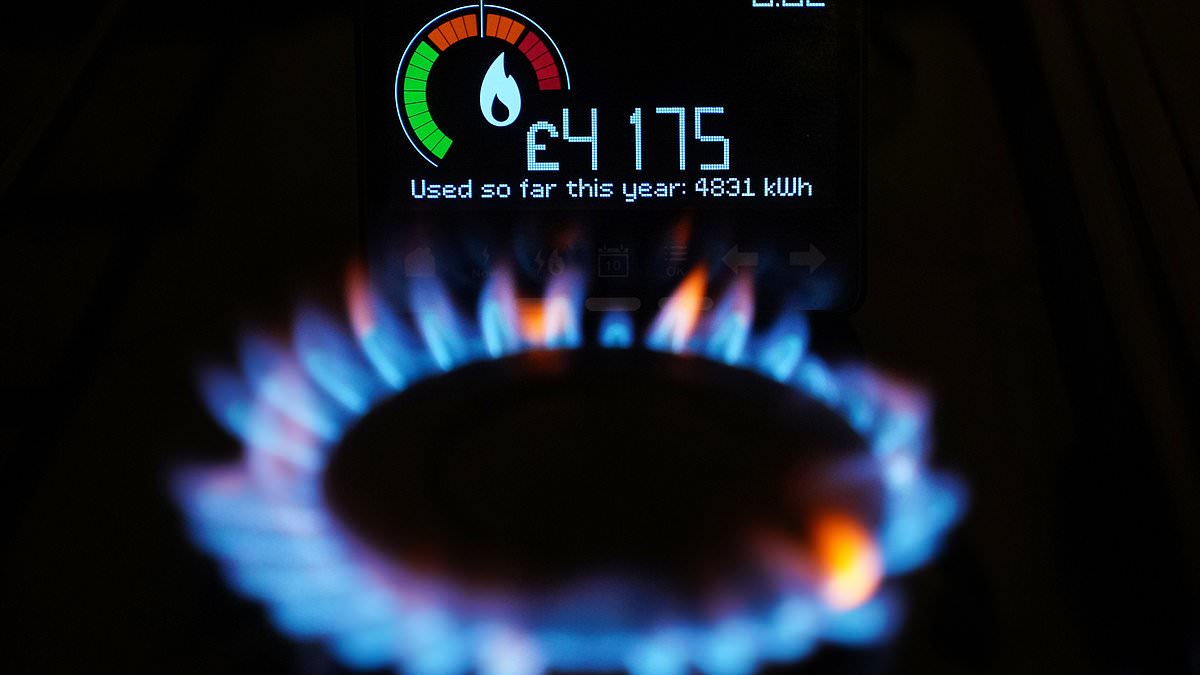
Households face heightened winter pressure from energy bills after regulator Ofgem revealed today that its price cap will increase by 4 per cent to a three-year high.Ofgem said the cap will rise by £60 per year – or £5 per month – to £1,723 for the average household using both electricity and gas if this level was sustained for a year.This increase reflected higher wholesale gas prices as a result of war in the Middle East, with volatile global markets remaining the dominant driver of price changes.The ongoing heatwaves across Europe have added further pressure by increasing gas demand for power generation to meet air conditioning and cooling demand.Richard Neudegg from Uswitch.com said: 'This is going to be another difficult winter. For price cap customers, gas costs will be almost 27 per cent higher than the same period last year, with the increase hitting just as the heating is due to go on.'The Middle East conflict continues to impact wholesale gas prices, and ongoing supply challenges are set to hammer household bills as winter demand looms.'Over half of households say they are already worried about paying for heating this winter. And now, those on standard tariffs may face a double blow on bills, with suppliers already pointing to another rise in January.'The government's electricity VAT cut, on top of the earlier removal of certain levies on bills, has meant this cap level isn't as high as it might have been. But these haven't been enough to hold off price cap hikes.' Ofgem said the energy price cap will rise by £60 per year – or £5 per month (stock photo)The Conservatives said Labour has failed to deliver on its promise to cut energy bills.Claire Coutinho, shadow energy secretary, said: 'Labour promised to cut energy bills by £300, but they have gone up by nearly £400 instead.'Our cheap power plan would cut energy bills for households and businesses by scrapping Government taxes and levies on bills, and it wouldn't cost the taxpayer a penny. We have to put cheap energy first.'Experts at Cornwall Insight had predicted last week that a typical household would face an annual bill of £1,729, up from £1,663, based on Ofgem's updated definition of a typical consumer, which came into effect from July to reflect falling household energy use.It said this would be the equivalent of £1,941 per year based on its previous calculations, up from £1,862 currently. Changes to energy price cap per unit and standing charge ELECTRICITYJuly to September 202626.11 pence per kWh57.19 pence daily standing chargeOctober to December 202626.32 pence per kWh54.83 pence daily standing chargeGASJuly to September 20267.33 pence per kWh29.04 pence daily standing chargeOctober to December 20267.97 pence per kWh29.68 pence daily standing charge Cornwall also warned October's rise will likely be followed by another hefty increase in January. Its analysts are forecasting a 9 per cent jump on January 1, which would take the cap up another £149 to £1,872.Craig Lowrey, principal consultant at Cornwall Insight, said: 'Households will see rising energy bills going into winter, with the risk that, unfortunately, January will bring even more hardship.'What is frustrating is these rises, as we have seen time and time again, have very little to do with what is happening in Britain.'He added: 'Where January bills land will depend on whether the situation in the Middle East calms down in the next couple of months.'However, even if we saw an end to the conflict, lower stocks going into winter as demand increases mean falling bills in January is unlikely.'Adam Scorer, chief executive of National Energy Action, added: 'Rising energy prices heading into winter will plunge people into despair and place millions at risk.'He added: 'The rise in gas prices is especially concerning with over seven in ten fuel poor households heating their homes with gas.'People will have to retread this dreadful and familiar path. They will be forced not to heat their foods, not to cook hot food, ration washing their clothes and going to bed at dusk.'The increased October cap will remain in place for three months for households in England, Scotland and Wales.It will come into force as people start to increase their energy usage further by using their heating more regularly, adding to bills.Neil Kenward, Ofgem's director general for markets, said: 'High international gas prices are continuing to drive energy costs in the UK.'We welcome the Government's intervention to remove VAT from electricity bills, without which customers would have faced even higher costs this winter. The removal of VAT from household electricity bills would knock about £45 off the annual Ofgem cap from October, Prime Minister Andy Burnham said after announcing the measure'Savings are available by choosing a fixed tariff, which are available at £100 or more below the October price cap, and many suppliers offer tariffs with cheaper electricity to smart meter customers for electricity consumed out of peak times.'It's also worth considering different payment methods, with prepayment customers paying the lowest price cap rates, and could save consumers an average of about £45 compared to direct debit.'Cornwall said the increase in October was less than otherwise expected because of the proposed removal of VAT from household electricity bills.This policy would knock about £45 off the annual Ofgem price cap from October, Prime Minister Andy Burnham said after announcing the measure.However, experts said the recent swing in global energy prices has more than offset the downward impact of the VAT policy. What is Ofgem's energy price cap and how does it work? The energy price cap sets a maximum price that suppliers can charge customers in England, Scotland and Wales for each unit of gas and electricity they use.It also sets a maximum daily standing charge – the cost of having your home connected to the grid.The headline price cap figure provided by Ofgem indicates what a household using gas and electricity and paying by direct debit can expect to pay if their energy consumption is typical.It is important to note that it does not limit a home's total bills because people still pay for the amount of energy they use – so if that is above the average they will pay more, and if it is below they will pay less.Energy is regulated separately in Northern Ireland.The price cap taking effect from October 1 will rise by 4 per cent, effective for the three-month period to December 31. Energy Secretary Miatta Fahnbulleh said: 'Families will be understandably concerned about the cost of energy bills this winter, which is being driven up by the Iran war.'Energy is an everyday essential and it needs to be affordable for everyone, which is why we have cut VAT on electricity bills from October, to give families some breathing space.'This has limited the rise in the price cap and follows the £150 in costs we removed from bills earlier this year, and we will keep looking at what more we can do to protect families from unaffordable bills.'Speaking to Sky News, Ms Fahnbulleh said the Government is looking at 'fundamental reforms' to drive down energy bills for good number and her one priority is affordability.She said: 'If you look at energy bills, if you look at how much of a family's finances it is taking up, it is far too expensive.'So, whether that is short-term support that we're providing to provide a bit of breathing space, which is what the Government has done and will continue looking at that, or more fundamental reforms that we need to make to the energy market to drive down bills for good, we are absolutely determined to do that.'She also argued renewable energy investment is 'absolutely critical' to breaking the link between high gas costs and bills.Ms Fahbulleh also said she was 'frustrated' global events had increased bills in the UK but would not be drawn on criticising US President Donald Trump for starting the war in Iran.But the Liberal Democrats said the latest energy price rise is 'continuity Starmerism'.Pippa Heylings, the party's energy spokeswoman, said: 'This latest rise in the price cap has wiped out the small savings from Andy Burnham's cut of VAT on electricity bills, proving that continuity Starmerism will keep families stuck in a financial mire.'The Prime Minister must wake up to the scale of the challenge and accept that bold change is needed to bring bills down.'Ms Heylings called for the Government to back the Lib Dems' essential energy guarantee, which would take profits from energy networks and use them to bring down costs on the essential energy used by households. Claire Coutinho, the Conservatives' shadow energy secretary, said Labour has failed to deliver on its promise to cut energy billsNed Hammond, trade association Energy UK's deputy director for customers, said: 'This latest increase is in line with the predictions and any such rise is always more worrying over the winter months when customers naturally use more energy.'Coming off the back of a significant hike over summer, this further intensifies the challenges faced by customers struggling to afford their bills.'As well as measures to improve targeted support, the Government needs to assess how to bring bills down over the longer term.'The impact the conflict in the Middle East has had on gas prices underlines why we need to move to using more of our own sources of clean energy.'But it's equally true that we need to look at a fairer way of funding the policy and system costs that are also driving bills higher.'Citizens Advice chief executive Dame Clare Moriarty said: 'Today's price cap rise pushes energy prices to a three-year high. It's another sign of the relentless erosion of living standards across the country: energy bills are simply too high, prices leapfrog incomes and debt levels continue to grow.'The Government has already taken positive action to cut levies and VAT on electricity, but the impact of the conflict in the Middle East means people still face rising costs. We need further bold action to protect those most at risk of being trapped in cold, dark homes this winter.'The Government must commit to funding a reformed energy support scheme for those who need it most, like single-parent families and disabled people.'Simon Francis, co-ordinator of the End Fuel Poverty Coalition, said: 'As with previous rises, it is the price of gas driving this latest increase. Every unit of gas used will be significantly more expensive than last winter and more than 150 per cent higher than at the end of 2020.'Price rises fall hardest on the households who can least afford them, with millions forced to pay more for the same energy or ration the energy they use even further.'Cutting VAT on electricity and last year's extension of the warm home discount was a start, but ministers need to go further and faster in helping people.'That means further expansion of support programmes, funding a proper energy debt relief scheme and a serious push to improve energy efficiency of the homes that need it the most.'Meanwhile Energy UK has warned that customers could owe around £7billion in unpaid energy bills by the end of the year.The latest data shows that more than three million customers are now in debt or arrears and the average amount owed is about £1,800, according to the group.Energy UK's chief executive Dhara Vyas said more targeted support is still needed to help households facing further costs.She said: 'Too many households continue to feel the strain of high energy bills.'Instead of relying on stop-gap, ad hoc or emergency measures, we need a better, targeted and more permanent way to give people confidence that they'll get help when they most need it.'The current arrangements fail to provide the help needed and work out more costly. Household energy prices are set to increase further for British households.'
Energy bills to hit three-year high with £60 annual increase as Ofgem announces 4% rise from October
Full Article
Original Source
Read the full article at Dailymail →KhanList aggregates and links to publicly available news content. We do not host full articles from third-party sources. Always verify important information with original sources.