
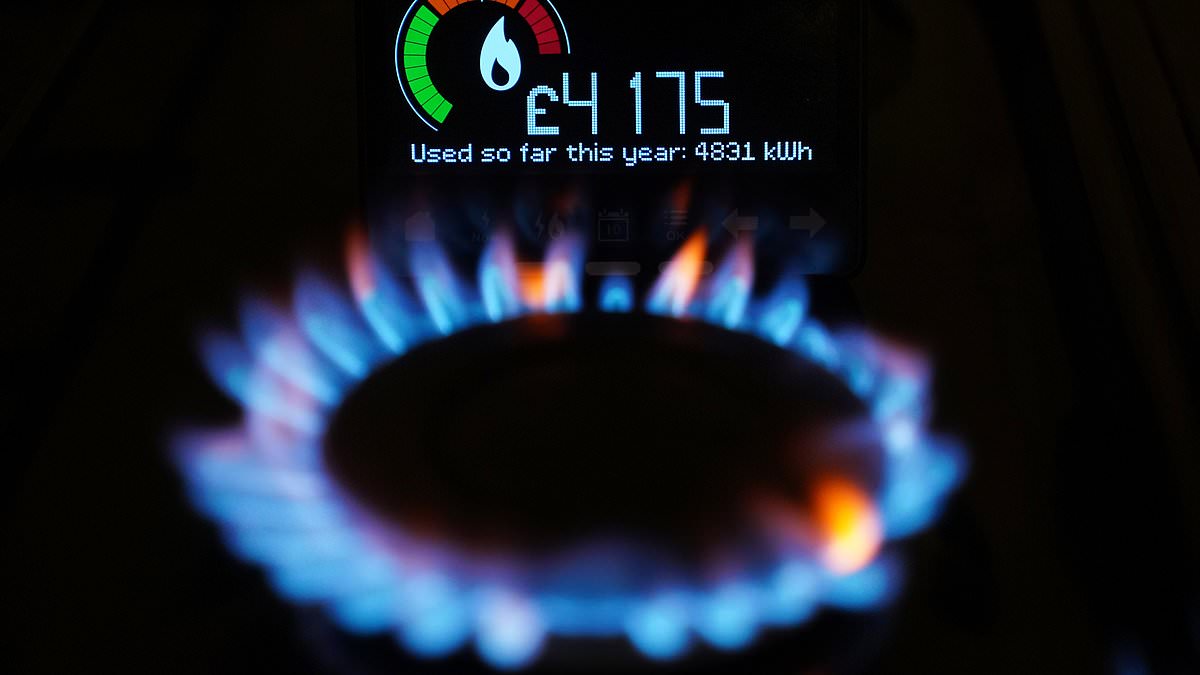
Household energy costs are set to soar by more than a quarter to the highest level in four years in January as experts warned a typical bill could jump by more than £400 due to the Iran war.Experts at Cornwall Insight have predicted Ofgem's energy price cap will rise by 26 per cent to £2,166 a year on January 1, up £443 on the level between October and December, to hit the highest since 2023.It said the Government's £100 household energy payment announced in the Budget for homes in council tax bands A to D in England is not included in the forecast because it is a one-off payment made outside the price cap.Ofgem will announce the quarterly price cap level for January to March on November 25.Wholesale energy prices have reduced in recent weeks on hopes of a resolution to the Middle East conflict, but not soon enough to prevent the January bill shock.Cornwall Insight said there could be a further small rise in April, but added the forecast is expected to change before it is announced in February, given the volatility in wholesale markets.Dr Craig Lowrey, retail markets principal at Cornwall Insight, said: 'After already climbing in October, energy bills look set to rise again in the new year, and the timing could hardly be worse, with colder weather in January pushing up energy use and households already dealing with the cost-of-living crisis.'Once again, the cause lies thousands of miles away, yet another reminder of how events beyond our control have a very real impact on our energy bills. Household energy costs are set to soar by more than a quarter in January (file photo)'While the £100 Household Energy Payment and the removal of VAT from electricity bills will be welcomed, ultimately this support can only chip away at the edges of a bill that continues to be pushed up by events in the Middle East.'What we can control is how exposed we are to these shocks in the future. With bills this high, it makes sense that the Budget put affordability first as the Government looks again at whether energy policies are delivering value for money.'But we have to be careful this doesn't put investors off building low-carbon power in Great Britain, because ultimately the less our bills are tied to the gas price, the less the next market spike will hurt households.'Simon Francis, coordinator of the End Fuel Poverty Coalition, said: 'It now looks like households will pay more for every unit of gas this winter than at any point in history.'He added: 'Since January 2021, prices and wages have each risen by around a third, but the typical energy bill has more than doubled.'Bills are racing away from what people can afford, even though Ofgem now assumes the typical home uses much less gas than it did then, partly because people are cutting back just to get by.'This is the clearest sign yet that the only lasting way to protect people in the long-term is to get our homes off gas for good.'Sam Richards, chief executive officer of pro-growth campaign group Britain Remade, said: 'Families face another rise in energy bills in the middle of winter, taking them to their highest level since the energy crisis in 2023. Cornwall Insight's Default Tariff Cap forecast (dual fuel, direct debit customer) QUARTERLY January - March 2027 TDCV forecast Standing charge (£/per day) Per Unit Cost (p/kWh) Electricity (2,500 kWh) £1,017.09 0.56 32.54 Gas (9,500 kWh) £1,148.80 0.31 10.90 TOTAL£2,165.89 Source: Cornwall Insight Price Cap Predictor 'Britain is paying the price for relying too heavily on volatile international gas markets.'From Russia's full-scale invasion of Ukraine to the war with Iran, every international crisis shows how exposed we are. The answer is to build far more domestic clean power, from renewables to new nuclear, and to implement the Fingleton Review in full.'The Government should also reconsider local pricing. It would cut bills across the country, especially for people who live near clean energy generation.'Britain has the resources to produce cheap, secure energy domestically. What's missing is a planning system that allows us to build fast.'Sabrina Hoque, energy expert at Uswitch.com, said: 'It's looking increasingly likely that we'll be ringing in the new year with the biggest price increase since the height of the energy crisis.'This final prediction puts rates 37 per cent higher than the same period last year, and further rises are expected in April.'This blow to bills lands during the most energy-intensive months, with households consuming about 44 per cent of their annual gas between January and March.'More than half of those on standard variable tariffs are already worried about whether they can afford to heat their home this winter.'If you're on a standard variable tariff, or your fix is about to end, you'll be hit by this increase, but for most customers there is an escape route.'The cheapest fixed deal on the market is £1,759 a year for a typical home. That's £407 below the forecast January cap.'Locking in a lower rate now will avoid January's bill shock. It only takes a couple of minutes to run a comparison and find a better deal before the hike lands.'
Energy bills set to soar by £443 this winter with prices expected to hit highest level since 2023 due to chaos in the Middle East
Full Article
Original Source
Read the full article at Dailymail →KhanList aggregates and links to publicly available news content. We do not host full articles from third-party sources. Always verify important information with original sources.