
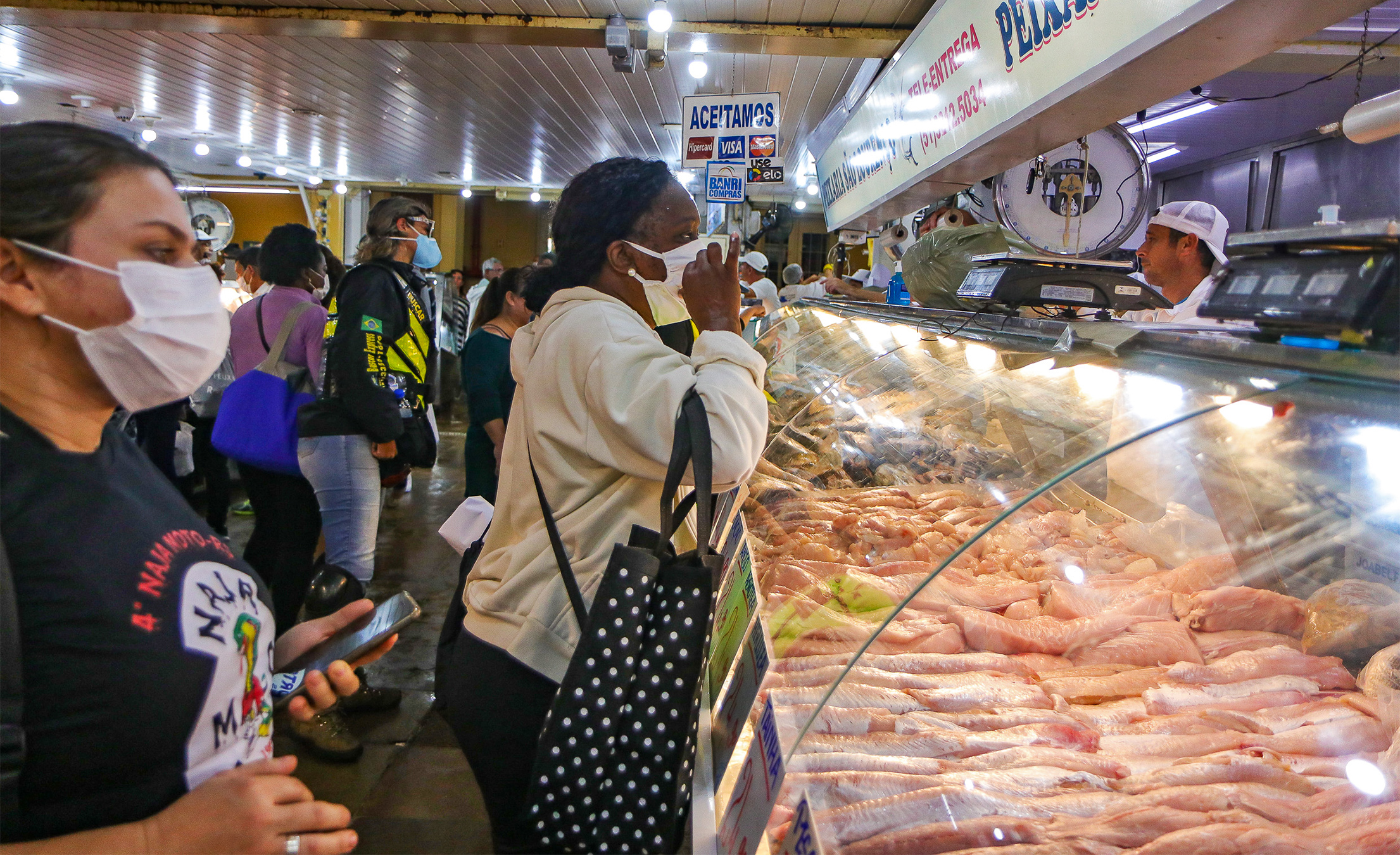
In April 2026, the Brazilian government prohibited the import of meat from endangered shark species, making it illegal to sell any species of the genus Squatina, the angelsharks.Despite the new regulation, angelsharks continue to be sold freely in the South of Brazil and local governments have placed new orders for the product.Three public agencies said they would suspend the purchase plans after being contacted by Mongabay.In addition to a lack of enforcement, experts point out that compliance with the new rules is hampered by the sale of meat from various shark species under the generic name “cação.” PORTO ALEGRE, Brazil — “Good choice!” said the clerk at one of the fish stalls in the Porto Alegre Public Market when Mongabay asked about the peixe anjo, which means “angel fish” in Portuguese, in mid-September. “We sell a lot of these. It’s really good, and it doesn’t have any bones.” The same product was for sale by at least four other fishmongers in the traditional market of the capital of Rio Grande do Sul state, in the South of Brazil. Prices were attractive, ranging from 30 to 37 reais per kilo ($5.70 to $7). The problem is that the “angel” isn’t just any fish — it’s a shark. More specifically, an angelshark, and in Brazil, that means three of the world’s most endangered shark species: Squatina guggenheim, the angular angelshark; S. occulta, the hidden angelshark; and S. argentina, the Argentine angelshark. And fishing of these species is prohibited in Brazil. For many years, the Brazilian government authorized the import of angelsharks from neighboring countries. According to data from the Federal Revenue Service obtained by Mongabay through the Freedom of Information Act, 48 metric tons of S. guggenheim meat and 194.6 metric tons of S. argentina entered Brazil between January 2021 and Sept. 10, 2026, totaling 242.6 metric tons. Most of the shipments came from Argentina, entering the country through the customs ports of São Borja and Uruguaiana municipalities in Rio Grande do Sul, and Dionísio Cerqueira in Santa Catarina state. Once in Brazil, the imported product was mixed with large quantities of angelshark that had been illegally caught inside the country, according to Luiz Eduardo Bonilha, an environmental analyst from the federal environmental agency, IBAMA. “Angelsharks illegally captured in Brazil were laundered with import invoices,” said Bonilha, who works as an enforcement officer in Porto Alegre. On March 27, 2026, IBAMA published a regulation banning the import of all sharks on the Official National List of Endangered Species, which effectively closed any loophole for the sale of angelshark. The new rule took effect on April 3. “Today, any kilogram [of angelshark], regardless of origin, is illegal,” Bonilha told Mongabay in an interview. Angelshark for sale at the Porto Alegre Public Market. Image by Fernanda Wenzel/Mongabay. At the Porto Alegre Public Market, however, vendors said they were unaware of the new rule. Two vendors told Mongabay they import the frozen product from Argentina and remained confident that it was legal. “Since our [angelshark] is banned here, we have to buy it from abroad to be able to sell it,” one of the vendors said. When informed about the import ban, he expressed skepticism about the new rule: “Given the amount [of angelshark] that comes in every week here in the South [of Brazil], I don’t think so …” Two other merchants said the fish came from the Rio Grande do Sul coast itself, in the municipalities of Tramandaí and Rio Grande. “We’re going to step up enforcement among retailers,” Bonilha said when he learned angelshark was being freely sold at the public market. “This constitutes criminal conduct.” In an email to Mongabay, Rio Grande do Sul’s environmental secretary did not clarify whether any enforcement actions had been taken to ensure compliance with the new rules in the state. (Read the full response here.) IBAMA published the new regulation months after Mongabay published a series of reports on shark meat purchases by government agencies in different regions of the country. In Rio Grande do Sul, that investigation identified orders for 211 metric tons of angelshark by municipal governments and the state government between 2015 and 2025 — a quantity equivalent to 10 full shipping containers. Under the pretext that it is an inexpensive, boneless fish, the shark ended up in school lunches for public school students and on the menus of hospitals, health clinics and shelters. In a statement sent to Mongabay, Lais Belsito, a technical advisor at the Brazilian Association of Fish Industries (Abipesca), noted that the new rules are consistent with the conservation policy for endangered species in Brazil. But she emphasized the need to “periodically assess the conservation status of these species and, when necessary, reassess their classification.” According to Belsito, it is not yet possible to gauge the impact of the new regulations on angelshark imports. (Read the full response here.) State and cities appear to ignore new rules According to Igor de Brito Silva, IBAMA’s biodiversity enforcement coordinator, public purchases of angelshark were automatically prohibited as the new rules came into force in early April. “New contracts become illegal because all species in the Squatina genus found in Brazil are threatened,” he told Mongabay. Nevertheless, Mongabay uncovered four recent calls for bids in Rio Grande do Sul for the purchase of angelshark. One of them, published on Aug. 10 by the state secretariat of health, calls for bids to supply 960 kilograms (2,116 pounds) of angelshark to the São Pedro Psychiatric Hospital in Porto Alegre. The bidding process has already been completed. Mongabay’s previous investigation, in 2025, identified 11 angelshark calls for bids by the Rio Grande do Sul state government, totaling 16 metric tons of the fish. At the time, the state government told Mongabay in a statement it would instruct all its agencies to remove the species from their procurement notices. When asked by Mongabay about the new call for bids, the Rio Grande do Sul government stated via email that “the necessary measures are being taken to revise the process, removing the item and replacing it with another permitted fish species.” According to the statement, “guidelines for the agencies responsible for fish purchases will be reinforced.” (Read the full response here.) Meat from endangered sharks ended up in school lunches for public school students in Rio Grande do Sul. Image courtesy of Angelo Miguel/MEC. The quantities listed in the solicitations do not necessarily correspond to the volume of fish purchased. The bids were conducted through the price registration system, which was created to facilitate recurring purchases, such as food. Government agencies publish a list of the products they will need throughout the year, and the companies offering the lowest price win the contracts. The notice specifies a maximum supply volume for each product, but this does not mean that orders must reach this limit. Three municipalities in Rio Grande do Sul also placed recent orders for angelshark, Mongabay found. Gravataí, which Mongabay’s 2025 investigation listed as the second-largest purchaser of the product in the state, with 59.5 metric tons, opened a new bidding process for the supply of angelshark on July 27, 2026. The call for bids sought the purchase of up to 250 kilograms (550 pounds) of the product, but no supplier won the contract. The city government did not respond to Mongabay’s inquiries by the time of publication. The city government of Gramado, which Mongabay’s 2025 investigation found had budgeted for the purchase of 250 kilograms of angelshark, issued a new call for bids on July 1 for the supply of 2,156 kilograms (4,753 pounds) of the product. In a WhatsApp message, the city government told Mongabay that the purchase of angelshark in 2025 had been canceled. “This year’s bidding process was prepared by another municipal department and again included this species; however, the process is ongoing and is expected to be revised,” the city government stated. (Read the full response here.) The Colinas administration also issued a call for bids on July 27 for the purchase of 250 kilograms of angelshark for school meals for students in the municipal school system. In an email to Mongabay, city officials stated that no purchase of the product has been made to date, and that in light of the environmental regulation, “the purchase of the aforementioned item will not take place.” (Read the full response here.) In addition to harming marine ecosystems, the consumption of shark meat can also pose health risks due to the high concentrations of heavy metals, such as mercury, arsenic and lead. Sharks are at the top of the food chain, so their bodies accumulate contaminants from their prey, their prey’s prey, and so on. So much so that the U.S. Food and Drug Administration (FDA) advises that children and pregnant women avoid eating shark meat. In Brazil, however, the Ministry of Health recommends shark meat as one of the boneless fish options to be offered to children up to 2 years of age. In August, the marine conservation NGO Sea Shepherd Brasil filed a lawsuit against the Ministry of Health, requesting it remove this recommendation from the dietary guidelines. “Including this type of meat in school lunches or public institutional meals is an act of frequently and unnecessarily exposing vulnerable populations to carcinogenic and neurotoxic risks,” the NGO states in the lawsuit. Packaging hinders enforcement The ban on importing endangered shark species was a long-standing demand of Sea Shepherd Brasil. In addition to creating opportunities for the sale of illegally caught animals, the organization argues that it makes no sense to protect angelsharks along the Brazilian coast while simultaneously encouraging the capture of animals from the same populations off the coasts of neighboring countries. “In Brazil, 39% of shark species are already at risk of extinction,” Nathalie Gil, president and executive director of Sea Shepherd Brasil, told Mongabay in an interview. “It’s a market that is absurdly permissive.” According to Gil, IBAMA’s new regulations represent a step forward in regulating this market, but they do not solve the problem. Shark meat continues to be sold in packages under the generic name “cação,” without identification of the species. As a result, endangered shark species can easily be sold “disguised” as blue shark (Prionace glauca), for example, which is generally legal to fish and trade in Brazil. “The issue of imports has been resolved, but the domestic market is still left to chance,” she said. “It’s a bottleneck, and I hope we continue to seek a solution to this, whether through judicial or administrative channels,” said Silva from IBAMA. In his view, the generic description of products undermines enforcement and misleads consumers. “There is no justification for this. It’s merely an opportunistic convenience that encourages fraud,” he said. Shark meat from various species is sold in Brazil under the generic name “cação.” Image by Philip Jacobson/Mongabay. The illegal sale of angelshark in Porto Alegre shows that it is also necessary to monitor commercial establishments’ compliance with the new regulations, but there is a shortage of enforcement agents. “We have a very inadequate infrastructure to handle all environmental enforcement in the state,” said Bonilha, from IBAMA in Porto Alegre. He added that there are only 10 enforcement agents to cover the entire state of Rio Grande do Sul. “It’s very difficult for us to put everything on hold to carry out a targeted operation focused on a single species,” he said. Enforcement efforts also need to extend to the borders. In an email to Mongabay, the Federal Revenue Service stated that the initial control of angelshark imports is carried out by IBAMA, which can deny an import license. Shipments are also subject to physical inspection by the Ministry of Agriculture. Most difficult, however, is ensuring that the product does not enter Brazil using false import documentation listing it as another type of fish. “The biggest challenge is identifying a shipment with a false declaration of contents and combating smuggling and contraband, which occurs when legal or illegal goods are brought into the country without passing through customs controls,” stated the Federal Revenue Service. (Read the full response here.) Banner image: Angelshark, commonly called peixe anjo in Brazil, (“angel fish” in Portuguese), continues to be sold at stalls in the Porto Alegre Public Market. Image courtesy of Alex Rocha/PMPA. This story was first published here on our Portuguese site on Oct. 2, 2026. Revealed: Brazilian state buys endangered angelsharks for school lunches That ‘fish’ on the menu? In Brazil’s schools and prisons, it’s often shark Credits Topics
Endangered angelshark is still traded in Brazil despite import ban
Full Article
Original Source
Read the full article at News →KhanList aggregates and links to publicly available news content. We do not host full articles from third-party sources. Always verify important information with original sources.