
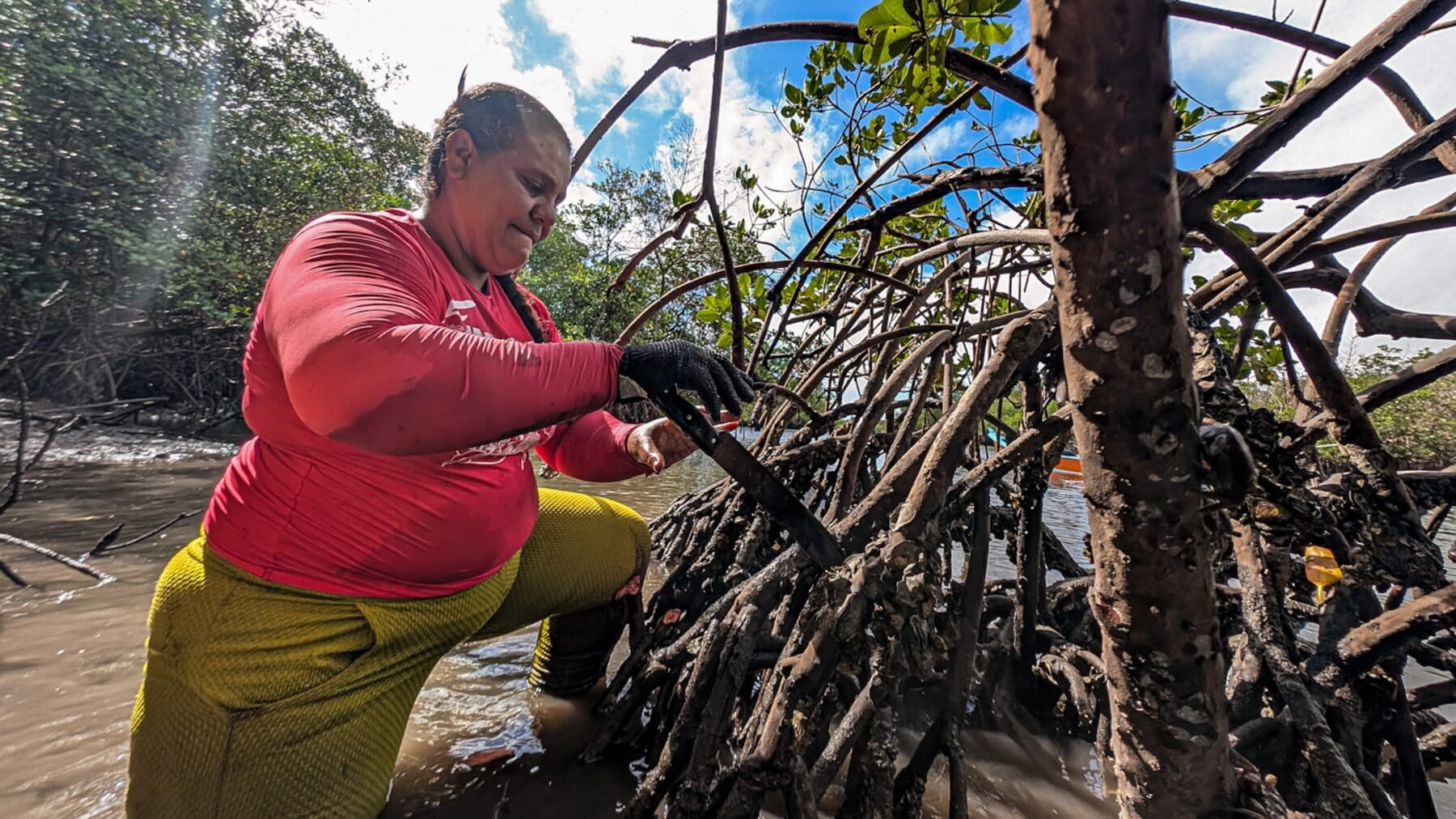
Women shellfish gatherers along the coast of Brazil’s Sergipe state are losing access to mangroves and watching mollusk and crustacean populations dwindle as urban projects and real estate development advance over the areas where they live and work.The Movement of Women Shellfish Gatherers of Sergipe grew out of an environmental education program funded by state-run oil company Petrobras to fulfill an environmental licensing requirement. Today, its leaders are demanding their rights, professional recognition and greater autonomy from the program.The decline of shellfish gathering also hits these women’s bodies and their culture. They say they spend long hours in the mud only to harvest less, while traditional practices such as singing to capture mangrove crabs known as aratu are no longer being passed down in some families. Adriana Hora dos Santos stands waist-deep in the water. Her dark hair is tied in a single braid; her arms and torso covered by a pink Lycra shirt. The thick mangrove mud reaches her thighs. Using a machete just over 40-centimeters (16-inches) long, she pries dozens of oysters from the twisted roots with a steady cadence: Not too fast, not too slow. Across the Vaza-Barris river, the buildings of Sergipe’s state capital Aracaju seem otherworldly. Here, one hears the lapping of the water, the strike of the blade and Santos’s voice: “I am, I am a shellfish gatherer / Queen of the mangrove, I am a warrior! / I am, I am a shellfish gatherer / A fighting woman, a striver / It’s the wind that gives it to me / It’s the river, it’s the mangrove, it’s the sea / My chest aches, enclosed river / My chest aches with no fish caught / Come, woman, fight, emancipate yourself / We are Sergipe’s shellfish gatherers!” This is the anthem of the Movement of Women Shellfish Gatherers of Sergipe (MMS), a grassroots collective that has resisted continuous environmental degradation and cultural erasure for decades. Acting as guardians of the mangrove, they do environmental protection work while facing pressures that put their own survival at risk. To hear one of these women is to hear many: Their verbs almost always come in the plural. “We are always in a flock,” Santos says. And it was as a flock that they introduced Mongabay to the mangrove. The mangrove as a refuge The workday follows the tides and ends only after the buckets are full. On this day, the trip is by boat, but it can be done on foot or by bicycle. It means hours of travel and long waits in the mud. Once inside the mangrove, where land and water blur into a single ecosystem, the women move as amphibians. Before going into the water, they warn that being well prepared is essential: Long pants, a sun shirt, a hat, thick socks pulled up to the shins, and protective footwear they make themselves from scraps of denim. “It’s a thicker fabric that protects our feet from being cut on pieces of shellfish, especially oysters,” they say. A bucket, a machete, a pole and sometimes a cone-shaped net known as jereré complete the gear. These supplies make work easier but do not reduce their physical strain. “People think R$ 40 is too much for massunim, but they don’t understand what we go through. It’s an entire process, lasting hours and hours,” Santos says, referring to the clam known in southeastern Brazil as vôngole. It begins with gathering, and then the process continues through cleaning, preserving and preparing the shellfish for market or the table. In general, they boil or roast it over a wood fire to save on cooking gas. One of the few remaining stretches of mangrove forest near Sergipe’s capital that are still preserved and accessible, amid rapid urban development. Image by André Cherri / V.U.E.L.A. Working isolated in the mangroves or on croas — sandbars that emerge in riverbeds or along beaches during low tide or the dry season — the gatherers face not only natural hazards like heat, humidity, tangled roots and insects, but also other kinds of violence, including that perpetrated by men. Therefore, traveling in groups is more than a tradition; it is a strategy for survival, mutual care and protection. Violence pervades the lives of almost all these women as well as those of the multiple generations before them, and that violence often begins right at home. Many describe the mangrove swamps as a refuge. Santos’s mother, for instance, left her alcohol-abusing husband and became the family’s breadwinner. She raised 10 children by gathering shellfish and cooking for others. “Back then, there was abundance. We’d find everything [in the mangroves] and come back happy, because everyone returned with their containers and buckets full,” she recounts. There would be a pot full of aratu, another of land crabs and another of blue crabs, plus massunim and sururu clams. Her grandmother, sisters, aunts and uncles all lived near the Vaza-Barris river. “People lived off farming and the tides. This whole area used to be cropland surrounded by water; it hadn’t been filled in like it is now,” she says. They grew potatoes, cassava, coconuts and yams. What they harvested, they ate. Any surplus was taken by boat to the central market in Aracaju, along with the shellfish. Areia Branca is an area south of Aracaju that was once a traditional settlement of fishers and farmers. Until 2021, it was part of the so-called Aracaju Expansion Zone — a generic designation the city government abolished when it elevated Areia Branca and five other neighboring areas (such as Mosqueiro and Robalo) to the status of official districts. Now connected to the city center by Melício Machado Avenue, the region is undergoing major paving, drainage and urban development projects led by the municipal administration. It is home to Ribanceira, one of the capital’s last clean, well-preserved river beaches. The other large river flowing through the capital, the Sergipe, has suffered from ongoing pollution since the second half of the 20th century. “I think this idea of a better life in the city is pure fake news. It’s just TV stuff. We’re much better off here,” says Santos, who is proud to have recently opened her own business — a small eatery near the Ribanceira beach — especially since she can no longer make a living solely out of shellfish gathering. While in the past some of the riverside population used to leave their villages for the city in search of better living conditions given the lack of local job opportunities, today’s scenario is different. “I feel like we’re being forced out by development projects. And the river itself hardly yields anything anymore [in terms of fish and shellfish],” she says. “It’s just that the river is no longer ours.” Adriana Santos continues to work in the mangroves along the river. Behind her, condominium developments and real estate speculation are encroaching on what was once entirely mangrove forest. Image by André Cherri / V.U.E.L.A. Processing massunim clams begins with washing off excess sand and debris on the riverbank before heading home. This work has historically gone unrecognized. Image by André Cherri / V.U.E.L.A. How it all began: The PEAC and the movement’s origins The history of MMS is linked to the Environmental Education Program with Coastal Communities (PEAC), a legal requirement imposed by Brazil’s environmental agency IBAMA on Petrobras as a condition for the company to retain its environmental licenses for oil and gas exploration in the Sergipe-Alagoas Basin. In practice, it is as a compensatory measure: In order to continue offshore exploration, Petrobras is required to fund environmental education initiatives aimed at the traditional communities living in the area affected by these activities. Today, the program is implemented by the Sergipe Federal University (UFS) under an agreement with the Sergipe Research and Extension Support Foundation (Fapese). It covers 95 traditional communities spread across 10 municipalities along the state coast, as well as Conde and Jandaíra in Bahia — a map defined not by state borders but by the path oil would take in the event of a spill. Working with fishers, shellfish gatherers, mangaba fruit pickers, and other riverine communities, PEAC’s stated goal is to address, through pedagogical and grassroots approaches, the socioeconomic impacts caused directly and indirectly by offshore oil and gas exploration. It was under this framework, and following a vulnerability assessment conducted in 2013-2014, that the project focused on women shellfish gatherers was born and eventually gave rise to the MMS. The analysis revealed that the oil and gas industry’s impact affected women in a unique way: When shellfish became scarce, the situation worsened for them, in a context also linked to increased violence. From this emerged the Project for Sociopolitical Organization and Strengthening of Women Shellfish Gatherers on the Sergipe Coast. “This project didn’t create the movement itself; it was an initiative involving popular education and critical environmental education with women in the area covered by PEAC,” explains UFS professor Sandra Oliveira, who is the project’s current coordinator. “Upon understanding the reasons behind their impoverishment, the loss of shellfish, increasing violence, and loss of territory, the women concluded that the best way to confront the situation was through a social movement. They organized on their own initiative after gaining access to this knowledge and developing political awareness.” This creates a structural contradiction: A social movement is born from a mitigation policy that is itself a condition for a license to continue exploring these women’s territories. “The big challenge over the years has been how the movement emancipates itself from this place, including financially, as it still depends, to a large extent, on funding from Petrobras,” Oliveira says. According to her, the movement’s leaders already understand this contradiction. At first, they considered Petrobras a benefactor; today, they see the company as responsible for the changes experienced in the communities. Adriana moves across a sandbank known locally as a croa while lying flat; one of the amphibious movements required in shellfish gathering. Prolonged exposure to the mud contributes to health problems among shellfish gatherers, particularly gynecological conditions. Image by André Cherri / V.U.E.L.A. Women are proud shellfish gatherers According to Oliveira, the movement’s main achievement in recent years has been giving visibility to shellfish farming and women’s role in defending their territories, not only in Sergipe, but also in other political and urban spaces. She explains that, unlike fishers’ organizations, which are already established in the public sphere, women shellfish gatherers were historically not recognized as artisanal fishers, “since most of them are men.” However, the work involved in processing seafood, such as removing mollusks and crustaceans from their shells and cleaning shrimp, has always been done by women. “But this wasn’t even considered officially part of artisanal fishing,” said Oliveira. Women’s role in the mangroves and shellfish gathering was considered as mere domestic help or as complementary to their fisher husbands’ income. This historical asymmetry was felt directly in these workers’ pockets and rights. For decades, the old rules of fishers’ community associations did not even allow women to be members. “Under a strong patriarchal structure, women shellfish gatherers defined the fight for equal rights in fishing and the recognition of their own identity as shellfish gatherers, which used to be invisible,” says Gislei Lazzarotto, author of Itinerâncias – Marisqueiras e educação ambiental: qual é o seu território? (Itinerancies – Women shellfish gatherers and environmental education), a book resulting from her Ph.D. thesis in psychology at UFS, which included an internship at PEAC. For two years, she spent time with shellfish gatherers from different areas of Sergipe. “What I saw is that these women’s daily lives turn into a constant defense strategy,” Lazzarotto says. “They suffer gendered violence both in family settings and in public participation arenas.” According to her research, the legislative scenario began to change with the Fisheries Act (Law 11.959) in 2009, when the Brazilian State included the pre- and post-capture stages as integral and legitimate parts of the artisanal fishing supply chain. Shellfish gatherers Jilvanilda Santos and Marilene Passos da Vitória return from the mangroves after hours of gathering, balancing cans on their heads. Today, a full day’s work yields increasingly less shellfish than it did a decade ago. Image by André Cherri / V.U.E.L.A. Sururu mussels. Image by André Cherri / V.U.E.L.A. Despite some progress on paper, the real guarantee of protective social benefits such as closed-season insurance (paid to fishers during the fishing ban for species reproduction) is still complex. There are still bureaucratic obstacles and questions about the recognition of women’s work in selfish gathering. Recently, in coordination with the Movement of Artisanal Fishers, women shellfish gatherers began to demand their recognition as an occupational category, despite previous views suggesting that it would be more advantageous to call themselves just “women artisanal fishers” in order to access already consolidated rights. “If the fishers’ movement already existed, why not have the women shellfish gatherers’ movement?” asks MMS coordinator Graziela dos Passos. “They are shellfish gatherers, guardians of the mangrove. And they are also fishers, with no contradiction,” Lazzarotto says. More than seeking their labor rights, shellfish gatherers turned the very name of their activity into a symbol of pride and political strength. “The movement is a school; it’s a way for us to learn to stand on our own two feet,” says Jilvanilda Santos, who has been a member of the MMS for around 12 years. She says the collective has changed her life. “One thing was realizing and understanding the violence I used to experience with my ex-husband,” she says. “Now I know my rights as a woman and as a shellfish gatherer.” Passos reports that the movement gave her the opportunity to strengthen herself and fight for her community. “Before that, I didn’t know what to do, how to resist, who to resort to, you know?,” she says. “Now we know that there is IBAMA, that there is the Sergipe State Environmental Administration (ADEMA), for example. Some agencies that were established to help us.” Two generations of shellfish gatherers from the same family: Marilene Passos da Vitória and her daughter Graziela dos Passos, a leader of the Sergipe Shellfish Gatherers’ Movement, in front of their home. Image by André Cherri / V.U.E.L.A. Jilvanilda Santos gathering shellfish in the mangroves. Image by André Cherri / V.U.E.L.A. Without women shellfish gatherers, ‘no crab on the plates’ Oliveira explains that the identity of Sergipe’s women shellfish gatherers is linked both to ecosystem characteristics and local food culture. In the state, shellfish diversity and abundance stem from the geography of its rivers and mangrove forests. However, by engaging with other shellfish gatherers from the Jequiá Lagoon in neighboring Alagoas, where mangroves are also teeming with aratu crabs (Aratus pisonii), for instance, the movement observed that those women do not gather them, as their main product is the blue crab (Callinectes sapidus). It makes sense, then, that the Da cata ao prato (Gather-to-Plate) Fair has become one of the movement’s most important events. “It was a huge hit, a major achievement for us,” Adriana Hora dos Santos says. With two editions already held in partnership with PEAC, the fair offers several activities designed to bring the public closer to the world of women shellfish gatherers. Over the course of two days, entire families enjoy traditional products and dishes, while meeting the very people who prepared them. “It’s a way for society to understand this supply chain and place greater value on the work of women shellfish gatherers,” Oliveira says. “No mangroves, no shellfish gatherers. No shellfish gatherers, no crab on the plates of the people of Sergipe.” Today, the project’s management within PEAC is shared with MMS leaders. The movement brings together representatives from around 20 communities, from the north of the state through the central region, including Aracaju, Barra dos Coqueiros, São Cristóvão and Itaporanga d’Ajuda, and down to the south, where most leaders live, since that is where PEAC started its activities. As the movement’s visibility has grown, its leaders have been invited to participate in all kinds of initiatives, from federal government events to town councilors’ activities — though not always with clear intentions. Yet, there is also genuine political advocacy: Elected officials have stepped forward to champion the MMS cause and advance it further. Among their most steadfast allies is Linda Brasil, Sergipe’s first transgender state deputy and one of the state’s top vote-getters. She attends the movement’s annual gathering — the Sergipe Women Shellfish Gatherers Meeting (EMARIS), where representatives from agencies such as IBAMA, ADEMA, the Federal Heritage Department (SPU), and the National Social Security Institute (INSS) are also invited, allowing the shellfish gatherers to press for what is rightfully theirs. Along with aratu crabs, sururu mussels, oysters, massunim clams and other crabs, swimming crabs are part of the diversity that makes Sergipe’s mangroves one of the cradles of the region’s shellfish-gathering culture. Image by André Cherri / V.U.E.L.A. Two recently approved laws emerged from these meetings. One of them established Jan. 9th as the State Day of Women Shellfish Gatherers. The other, more ambitious law created a state policy to support shellfish gathering, featuring development and occupational health initiatives. “We thought we’d have a real fight on our hands to get it passed,” Oliveira says, “but it went through quickly. Now the battle is over the budget.” For the MMS coordinator, these achievements are the direct result of the shellfish gatherers’ political advocacy work. “Moving between villages, sharing demands and strategies to confront violence, and participating in training sessions created the conditions for their voices to be heard,” Lazzarotto adds. However, the time dedicated to external advocacy drew the leaders away from their own communities. During their last joint evaluation, they acknowledged: “Now it’s time for us to go back.” They aim to strengthen their grassroots organization and share what they learned with the women who stayed behind. Meanwhile, those who remained continue to face ever-growing threats. Body-as-territory: ‘The mangrove is my life’ Day after day, shellfish gatherers’ bodies bear the physical toll of spending more and more time immersed in the mud. According to those women, the volume of shellfish gathered has plummeted over the last decade: What once took two or three hours to gather now requires a full day’s work and yields less in the end. “You work harder for a smaller catch; shellfish prices rise, and life gets worse. The water is warmer and contaminated. This drives shellfish away and makes them scarce,” Graziela dos Passos says. Spending this extra time in the water, submerged and wet for hours on end, also takes a significant toll on their health. The issues most frequently reported — yet also the most overlooked — include gynecological and vascular problems as well as injuries caused by carrying heavy loads. Through her research, Lazzarotto mapped precisely how the women’ bodies and the territories they inhabit are inseparable, explaining the link between environmental degradation and their physical and political experiences: “For them, the territory is an extension of themselves,” she concludes. In the wake of environmental degradation, the knowledge that inhabits the territory is also being lost, such as the practice of “charming” aratu crabs, in which they lure crustaceans out of their burrows by whistling, tapping on cans and singing. Graziela dos Passos’s mother Marilene Passos da Vitória demonstrates the process: At 68, she climbs onto a gaiteira, the twisted mangrove branches they use as perches to stay above the mud. Then she sits down, taps the ground and sings. “If you don’t sing, they won’t come.” She attaches bait, specifically an aratu, to the end of a nylon line tied to a small wooden stick, and waits. “The mangrove is my life. I was raised in the mangrove. I learned to catch aratu from my mother, who learned it from hers.” This knowledge, passed down orally from one generation to the other, now faces a less obvious threat posed by certain Pentecostal and neo-Pentecostal churches. There are reports of these churches banning the songs used to lure the aratu, as the songs are associated with Afro-Indigenous religions. Among Adventists, the restriction is dietary: They preach abstinence from shellfish, which the Bible deems “unclean.” “I can’t eat crab or massunim clams anymore … only fish,” Marilene says. “But I can catch them for others who don’t know the Word yet.” Graziela Passos walks through drainage construction works that have cut off the traditional route to the mangroves of Mosqueiro. “They filled our mangroves with rocks,” she says. Image by André Cherri / V.U.E.L.A. Lack of access to the mangrove and the end of the river The “enclosed river” mentioned in the MMS anthem refers to access to the mangrove, which is gradually being cut off. In the old village of Mosqueiro, which was part of the “Expansion Zone” and will soon become just another district of Aracaju, Graziela dos Passos points to a construction project that has been channeling fresh water over the mangrove for two years. As the heavy machinery moved through, she watched the creatures — aratu and guaiamum crabs (Cardisoma guanhumi) — scrambling out of the sand, suffocating; they climbed up wooden stakes to save themselves. “Right there, by that coconut tree, was the path to our little landing,” she says, recalling how, until recently, everyone used to walk there to fish and gather shellfish. “This fresh water is already causing all this. The sururu [mussels] are dying, and the oysters are dropping off dead.” This project is part of one of the largest urban infrastructure works ever undertaken in Aracaju, under the Aracaju City of the Future program funded by the New Development Bank (NDB). According to data from the city government, the project includes a macro- and micro-drainage system featuring a 7.6-kilometer (7.72-mile) main canal and 18 secondary canals, alongside paving and sewage. The total investment is approximately 180.6 million Brazilian reais ($35.4 million) and covers the Areia Branca area. According to the City, the goal is to resolve the region’s chronic flooding problems. Graziela dos Passos challenges this view: She believes the seasonal lagoons already serve as a natural drainage system. However, the land has been sold off and filled in to make way for new subdivisions and gated communities. To her, the construction project is just another gateway for the real estate speculation that has impacted the region for years. “People kept taking our little mangrove patches for their piers and their fancy speedboats, and this is what it’s turned into,” she laments. All of this, she notes, was authorized by IBAMA. Graziela Passos walks through drainage construction works that have cut off the traditional route to the mangroves of Mosqueiro. “They filled our mangroves with rocks,” she says. Image by André Cherri / V.U.E.L.A. To reach the mangroves now, one must cross a flooded stretch, which is part of the construction project itself. The City promised a walkway over the concrete canal, but nothing has been done so far. “And once all this turns into a sewer, how are we supposed to get across?” she asks. State and municipal agencies say that the construction work will result in sewage treatment. The shellfish gatherers remain skeptical. They recall the city’s other major river, the Sergipe, where promises of sewage treatment never materialized. “That’s exactly what’s going to happen to our Vaza-Barris here,” Graziela dos Passos concludes. According to the São Francisco and Parnaíba Valleys Development Company (Codevasf), the Vaza-Barris river spans 450 kilometers (280 miles). It originates in Bahia’s backlands and flows through 30 municipalities before emptying into the Atlantic Ocean in the state of Sergipe, south of Aracaju. Although the state capital itself does not appear in Codevasf’s official records, communities within the municipality, such as Mosqueiro and Areia Branca, have always relied on the river’s waters. The Sunset Waterfront development in the Mosqueiro community is another example of a project that has altered life along the banks of the Vaza-Barris; while it brought improvements for the local population, it also impacted the environment for fishers and riverside communities. The site is now crowded with recreational motorboats and unauthorized structures. “If I show up with my humble little boat, I can’t dock. The Navy itself will chase me away,” Jilvanilda Santos says. These projects are not isolated incidents. According to the women shellfish gatherers, they are linked to haphazard urban expansion and real estate speculation, considered as primary causes for the loss of territory and restricted access to mangrove areas. Traditional boat race on the Sergipe River, which runs through central Aracaju and has suffered ongoing pollution since the second half of the 20th century. Image by André Cherri / V.U.E.L.A. ‘It’s a clash of two worlds’ There is an ongoing discussion within PEAC regarding the extent of the oil and gas industry’s responsibility in this scenario of threats. The project team and the shellfish gatherers’ movement are often asked why they raise issues like real estate speculation, which are seemingly unrelated to oil. “These threats are connected to a development model centered on a petro-dependent economy: More roads, more infrastructure, and a greater flow of people and capital,” Oliveira states. According to the professor and project coordinator, the contrast is clear: For the oil and gas industry, the territory is an economic resource. For women shellfish gatherers, the mangrove is a way of life and a source of food, livelihood and income. “They manage it in a completely different way,” she says. “They don’t want the mangrove to disappear; they want to care for it. It’s a clash of two worlds.” Once, when a shellfish gatherer asked her why the governor — who owned a house by the river — wanted to destroy it, Oliveira replied that for that gentleman, the river is scenery, it’s something to gaze at or to ride a jet ski on. The woman seemed confused and asked again: “But what does he eat?” Despite its flaws, environmental licensing policy is a barrier against this exploitation logic. “It makes people aware of why they are losing their territories and why shellfish are becoming scarcer,” Oliveira says. “It was designed to prevent communities from being steamrolled.” PEAC continues to operate against this prevailing current, running a program that is costly, in her view, yet negligible compared to the scale of its funders’ resources. A single day of profit from oil in the Campos Basin, she estimates, would fund the entire program for 40 years. Faced with an increasingly unfavorable scenario, the women shellfish gatherers’ movement is discussing local alternatives for protection. In the south of the state, a proposal has been stalled for years: Turning the region into an extractive reserve, that is, a type of conservation unit that would allow the shellfish gatherers to continue their way of life under a different legal framework. The model could be replicated in other parts of the state. Oliveira also believes that cooperative models offer a way to make shellfish gatherers’ work economically viable, reducing their dependence on industry funding. “The idea of reparation should come with something permanent,” she says. Ultimately, what sustains these women is their own network of friendships, care and shared labor. “The movement has managed, to some extent, to tell a story and call out this environmental racism,” Lazzarotto says. “There is a very real risk that these communities could disappear without ever having their stories told.” For women shellfish gatherers, then, documenting these memories is a victory in itself. This gave rise to the book Guardiãs do Mangue, memória marisqueira (Women Guardians of the Mangrove: Shellfish Gatherers’ Memories), a collaborative work published in 2025 by the MMS and coordinated by UFS professor Lívia Cardoso. It includes texts, poems and visual records of the daily realities of shellfish gathering. “Today, daughters are learning and writing this story alongside their mothers, with a sense of pride that didn’t exist before,” Lazzarotto sayss. Yet, there are no guarantees. They remain hopeful, but the question lingers: Will their grandchildren ever be able to make a living from the river, the mangrove and shellfish gathering, just as their grandmothers did? Traditional boat race on the Sergipe River, which runs through central Aracaju and has suffered ongoing pollution since the second half of the 20th century. Image by André Cherri / V.U.E.L.A. Image banner: Adriana Hora dos Santos harvests oysters from a mangrove forest near Areia Branca, a former traditional village that is now a neighborhood of Aracaju. Image by André Cherri / V.U.E.L.A. This story was first published here in Portuguese on Sept. 8, 2026. Colombia’s women clam collectors protect Pacific mangroves and mollusks Brazil’s ‘Mothers of the Mangroves’ protect an ecological and cultural heritage ‘It has been worth it’: The local women saving Yucatán’s mangroves Credits Topics
‘Enclosed river:’ Women shellfish gatherers fight for access to mangroves in Brazil
Full Article
Original Source
Read the full article at News →KhanList aggregates and links to publicly available news content. We do not host full articles from third-party sources. Always verify important information with original sources.