
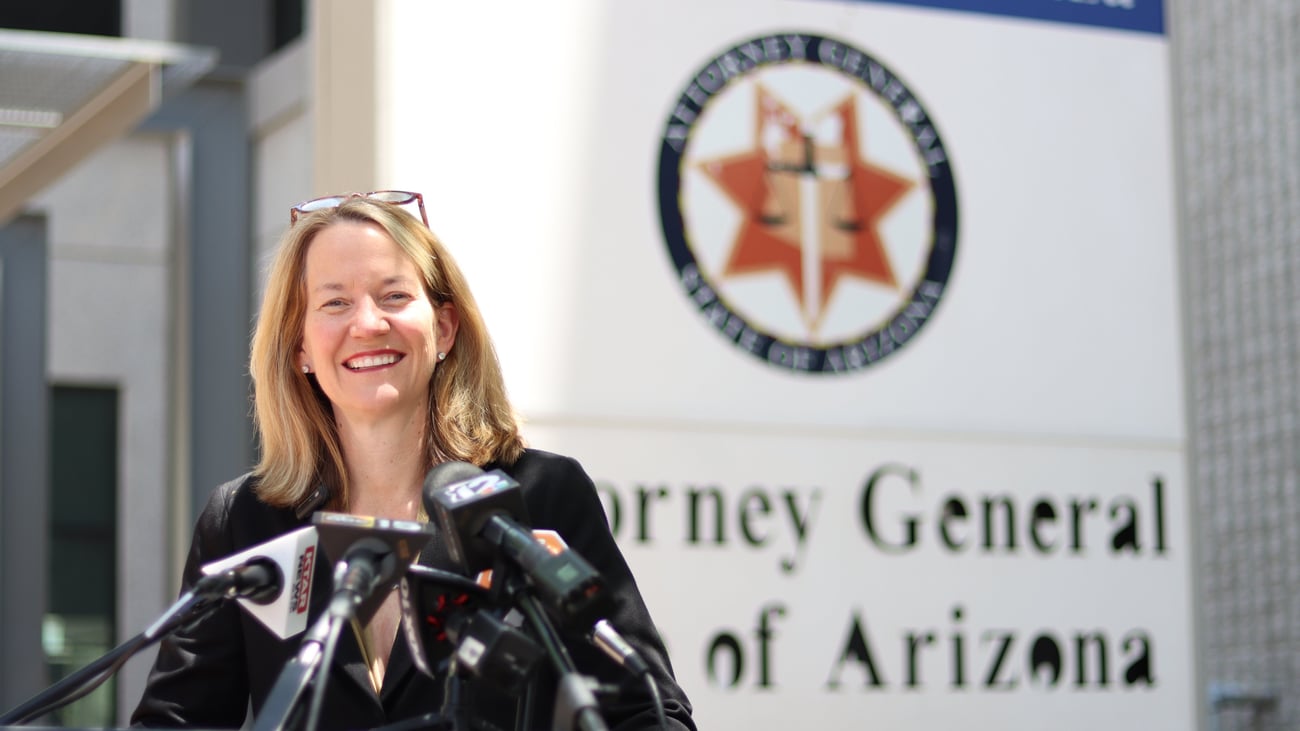
The law was upheld by a Ninth Circuit panel last year, which found that the plaintiffs had no standing to challenge a provision requiring cancellation of some voter registrations.(CN) — An en banc panel of the Ninth Circuit Court of Appeals unanimously upheld an Arizona voter registration law Friday, concluding that a voter outreach organization does not have standing to challenge a law requiring cancellation of some voter registrations.“Because the organizations have not clearly shown that the cancellation provision affects or interferes with their voter-registration and voter-education efforts, they have not established an injury-in-fact,” U.S. Circuit Judge Anthony D. Johnstone wrote for the panel.The panel of 11 judges also held that the plaintiff organizations had standing to challenge the law’s felony provision but were unlikely to succeed on the merits of their claim.“Although the stand-alone phrase ‘mechanism for voting’ arguably encompasses voter registration and education, the full text and statutory context of the Felony Provision show that it likely does not criminalize those activities,” Johnstone wrote.Passed in 2022, Senate Bill 1260 requires county recorders to cancel the registration of voters registered in another county and makes it a felony for election officials to register voters already registered in another state.Nonprofits Alliance for Retired Americans and Voto Latino say the law could lead to improper cancellations and prosecutions because voters may register in a new county or state before their old registration is removed. They argue the law would chill voter engagement and hinder their voter registration efforts.The nonprofits sued the governor, attorney general and Arizona’s 15 county recorders in August 2022.In November, a three-judge appellate panel reversed a preliminary injunction that had blocked the law since the day after it took effect. The panel found the plaintiffs lacked standing to challenge the cancellation provision because they had not shown an actual injury, and that they were unlikely to succeed on the felony provision.The plaintiffs successfully sought en banc review, arguing the law would lead to more improper voter registration cancellations and force them to spend more resources re-registering voters.However, Johnstone wrote that spending more time and resources educating voters about the law and helping them cancel old registrations is not a concrete injury, citing the Supreme Court’s ruling in FDA v. Alliance for Hippocratic Medicine. There, the justices unanimously ruled anti-abortion groups lacked standing to challenge the Federal Drug Administration’s approval of abortion pills, writing that the groups’ impaired ability to provide services “does not work to demonstrate standing.”“Without any showing of actual or imminent injury to the organizations’ voter-registration activities, they are left only with the loss of time and resources they have spent manufacturing one,” Johnstone said. But under Hippocratic Medicine, this is not a concrete injury.”The plaintiffs also challenged a provision requiring prosecution of anyone who “provide a mechanism for voting to another person who is registered in another state.” They argued the phrase could apply to their voter registration efforts.Johnstone agreed, writing the provision “arguably covers the organizations’ voter registration and mobilization efforts” and poses a credible threat of enforcement.The judge acknowledged Arizona Attorney General Kris Mayes has disavowed enforcing the felony provision against election officials who double-register voters. However, he said the disavowal is nonbinding and does not legally prevent county prosecutors from enforcing the law.Still, Johnstone ruled that the plaintiffs’ organizations are unlikely to succeed on the merits of their claim when considering the provision’s full context.“The organizations’ reading of the felony provision’s criminal ban on knowingly providing a ‘mechanism for voting” to include a ‘process’ for voting like voter registration is arguable,” he said. “In context, however, the better reading of ‘mechanism for voting’ is an ‘instrument’ or ‘technique’ for voting, like a ballot. So it likely does not include voter registration and mobilization.”U.S. Circuit Judge Daniel Bress, a Donald Trump appointee, concurred, joined by U.S. Circuit Judges Consuelo Callahan, a George Bush appointee, as well as Mark Bennett, Ryan Nelson and Lawrence VanDyke, all Donald Trump appointees.Bress argued the majority did not go far enough in its opinion, writing that the court should have modeled for the lower courts how to conduct the organizational standing analysis post-Hippocratic Medicine.“Today’s decision instead replaces our misguided organizational standing precedents with yet another misguided form of analysis that fails to respect Supreme Court precedent and leaves our law of organizational standing as nebulous as we found it. Where Hippocratic Medicinesought to rein in organizational standing, the majority opinion yet again loosens the slack,” he said.VanDyke additionally wrote a separate concurrence.The panel was rounded out by Chief U.S. Circuit Judge Mary Murguia, a Barack Obama appointee, along with Jennifer Sung, Holly Thomas and Roopali Desai, all Joe Biden appointees.Senior U.S. Circuit Judge Sandra Ikuta, a George W. Bush appointee, was originally assigned to the en banc panel, but died after the case was argued and submitted. She was replaced by U.S. Circuit Judge Salvador Mendoza, Jr., a Joe Biden appointee.Representatives for the parties did not immediately respond to a request for comment.Subscribe to our free newslettersOur weekly newsletter Closing Arguments offers the latest about ongoing trials, major litigation and rulings in courthouses around the U.S. and the world, while the monthly Under the Lights dishes the legal dirt from Hollywood, sports, Big Tech and the arts.Additional Reads
En banc Ninth Circuit reverses lower court bar on Arizona voter registration law
Full Article
Original Source
Read the full article at Courthousenews →KhanList aggregates and links to publicly available news content. We do not host full articles from third-party sources. Always verify important information with original sources.