
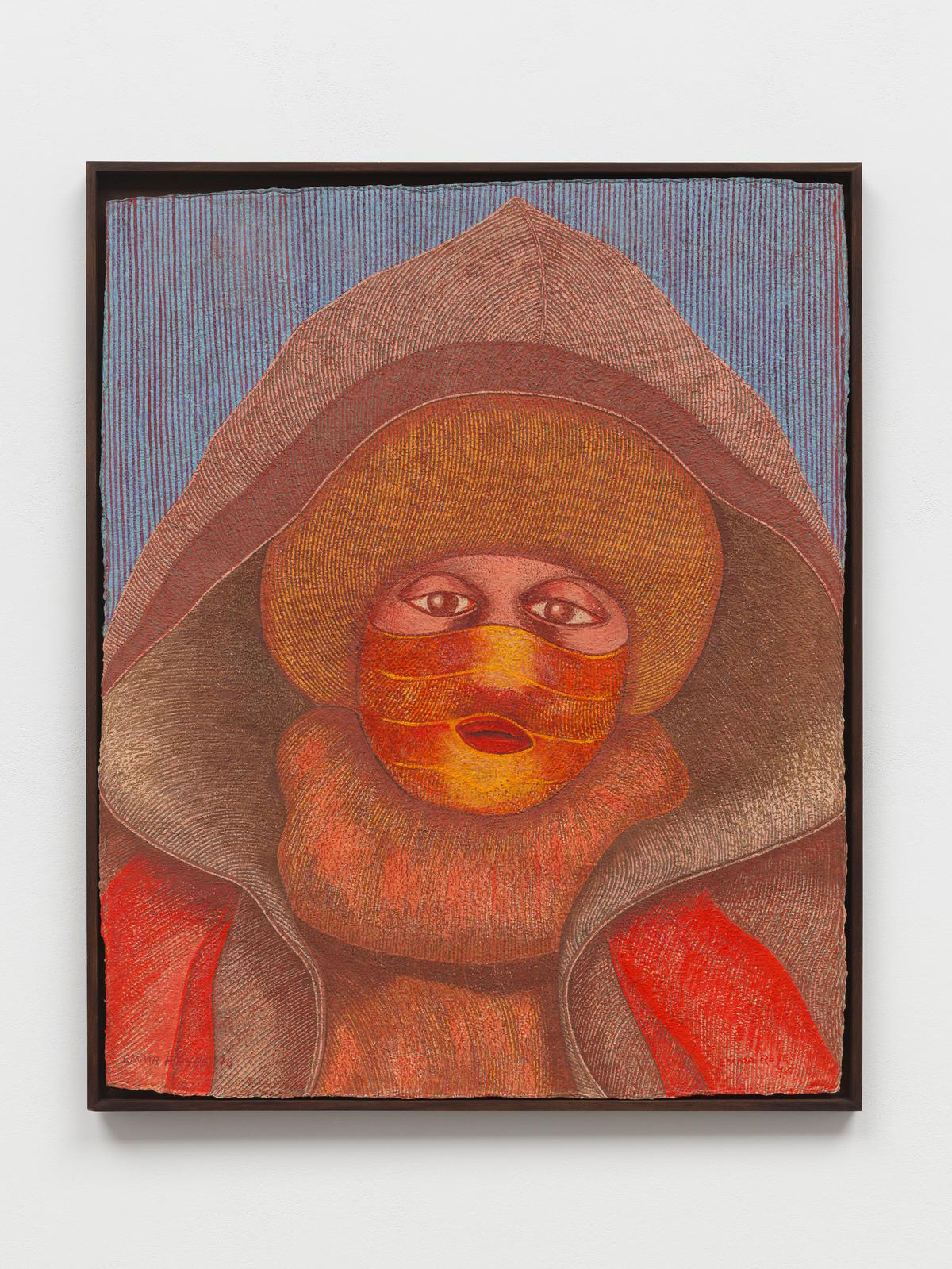
Few in Britain are likely to know the name Emma Reyes. In her native Colombia, however, she is celebrated as much for an extraordinary life — dramatised in a 15-part television series — as for her paintings and storytelling, which earned her the name “mama grande” among Latin American artists and writers living in France, where she settled during the early 1960s.Her first solo UK exhibition, at White Cube Mason’s Yard, offers a belated introduction. Rather than attempting a full survey, it drops into the final years of Reyes’s career, when she was pursuing an increasingly radical approach to portraiture. In the resulting series, entitled “The Masks”, which she started in 1990 and continued almost until her death in 2003, faces are stripped down and reassembled into vivid, vibrating forms that hover somewhere between human, animal and plant — less representations of individuals than shifting states of being. Emma Reyes.In one of the final paintings she created, Untitled (1998), curving forms in verdant green, yellow and muddy red interlock and overlap to create what looks like a map of a brain or some other organic system — the human form all but dissolved. Faces are more discernible in earlier examples. In one particularly psychedelic painting from around 1990 (nearly all of Reyes’s works were untitled), eyes, a nose, even teeth are rendered in greens and blue striations over orange and yellow brushstrokes. Here we are reminded of the decorative motifs found on Mayan and Aztec ornaments, as well as the giant Olmec heads carved from basalt that Reyes encountered on her travels through Mexico.Art in the shadow of tragedyTwo paintings from “The Masks” on show depict figures with children or babies — a possible reference to Reyes’s own child, who was reported by journalist Diego Garzón to have been killed in front of her in Paraguay, just months after she gave birth in the early 1940s. Sadly, when an artist’s biography is so tragic it can overshadow the work, and this is certainly the case with Reyes. The Paraguay story is just one of many harrowing traumas she endured. Born in Bogotá in 1919, Reyes lived in abject poverty, spending her days as a young girl playing at the rubbish dump with other children or locked in the windowless room she lived in with her mother, sister and half-brother. Abandoned and taken to a convent when she was just five or six, Reyes spent the next decade or so working long days in its kitchens and laundries, where she was relentlessly bullied. There were opportunities, too. It was at the convent that Reyes learned to sew, and she became skilled at embroidering sheets, tablecloths and sleeping gowns. Her subsequent paintings bear a resemblance to stitchwork: at White Cube, two black ink portraits from the 1970s, painstakingly crafted on rag paper, have the appearance of textiles. When she was 19, Reyes escaped from the convent and spent the next few years travelling through South America. In Mexico, she met Diego Rivera and Frida Kahlo, assisting the former with a mural at the University Olympic Stadium in Ciudad Universitaria. In 1947, Reyes secured a scholarship to study painting under the Cubist artist and theorist André Lhote in Paris. While in Europe, she rubbed shoulders with influential artists and intellectuals such as Alberto Moravia, Jean-Paul Sartre and Enrico Prampolini.Fit for a museum retrospectiveIt was not until she was in her thirties that Reyes first put paint to canvas, having had no encounter with painting before fleeing the convent. Her early works often drew on the hardships of those formative years, depicting scenes of rural life and Colombia’s peasants and indigenous communities. The White Cube exhibition is deliberately narrow in its remit, and leaves much of her earlier work outside the frame. Yet its handful of earlier paintings are some of the exhibition’s most compelling. An example from her “Imaginary Portraits” series from the 1970s is particularly striking, its hooded subject rendered in earthy tones. It feels at once intimate and strange. So, too, does a beautifully executed, if stylised, painting of a flower — a chrysanthemum, perhaps — from 1989. Both possess a formal assurance that, at times, threatens to outshine the looser, more demonstrative canvases of her final series.That is not necessarily a criticism of White Cube’s focused presentation. Galleries this size are not built for retrospectives, and this is better understood as a tightly framed introduction. But it left me wanting considerably more. If anything, it makes the case for a proper museum survey — whether in Colombia, France, or here in the UK, where female Latin American artists are having a moment.
Emma Reyes at White Cube Mason’s Yard: A glimpse of this extraordinary artist isn’t enough
Full Article
Original Source
Read the full article at Standard →KhanList aggregates and links to publicly available news content. We do not host full articles from third-party sources. Always verify important information with original sources.