
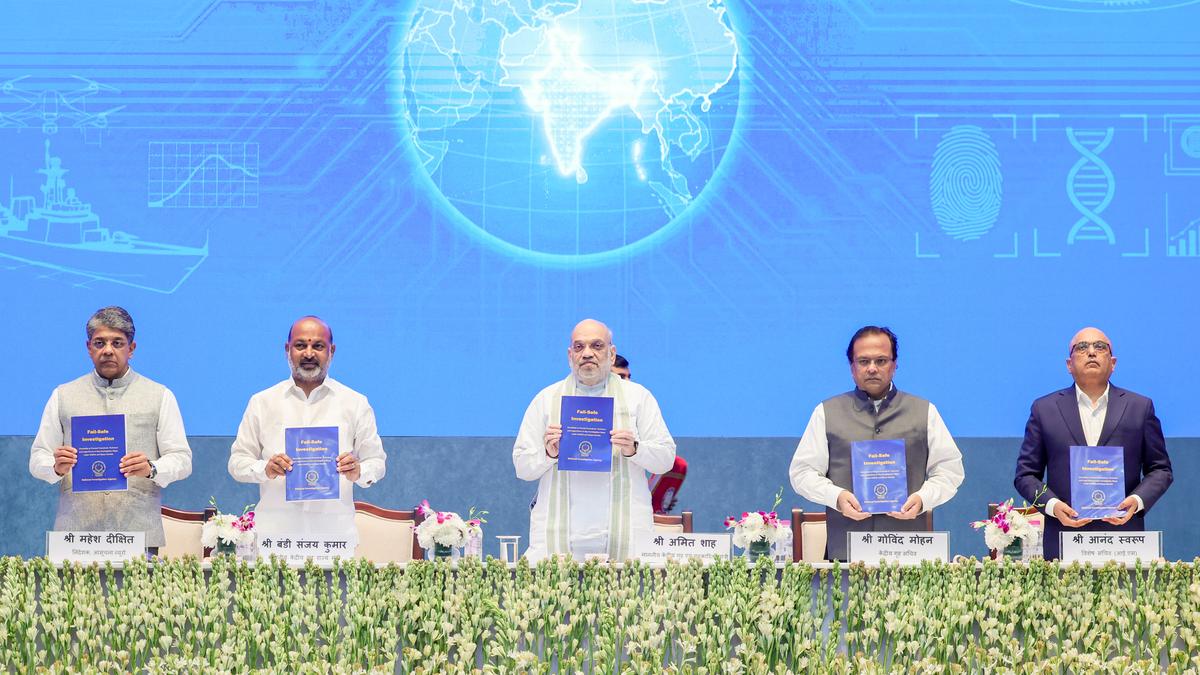
The Multi-Agency Centre (MAC), a centralised intelligence-sharing platform, now tracks cybersecurity, narcotics, organised crime networks, and emerging radicalisation hotspots, Union Home Minister Amit Shah said on Thursday (November 19, 2026).The MAC, which also acts as a common counter-terrorism grid and functions under the Intelligence Bureau (IB), was conceptualised in 2001, in the aftermath of the Kargil war, but became fully operational in 2009.In 2025, the MAC network was revamped to connect all police districts in the country through a secure network. Mr. Shah said that the functioning of the MAC has been reorganised.He said that the anti-terrorism squads (ATS) of every State needed to strengthen their cyber-expert units as technology is increasingly being used in such crimes.He made the remarks while addressing the inaugural session of the two-day counter-terrorism conference organised by the National Investigation Agency (NIA) in New Delhi. On the occasion, he released the publication, Fail-Safe Investigation, brought out by the NIA. He also laid the foundation stone for the NIA’s office complex in Chandigarh and inaugurated the NIA’s residential complex at Maidangarhi in Delhi. In addition, the Union Home Minister e-launched the NIA’s ‘Pushti’ portal and conferred decorations on seven officers and personnel of the agency.Union Home Secretary Govind Mohan, Intelligence Bureau Director Mahesh Dixit, Special Secretary (Internal Security) in the Ministry of Home Affairs, Anand Swarup, and NIA Director General Rakesh Aggarwal were present at the event.Confronting terrorismMr. Shah said that India has been confronting terrorism for a long time, and noted that while the police forces of different States had made various kinds of efforts, a lack of coordinated action was clearly visible. Over time, during the tenures of successive governments, gradual efforts were made to overcome these shortcomings, he said.“Today, we can say with satisfaction that in this vast country — from Kashmir to Kanyakumari and from Dwarka to Kamakhya — we are putting in place a system under which a uniform strategy to combat terrorism will operate right down to the level of every police station,” the Home Minister said.He said that with the killing of Lashkar-e-Taiba (LeT) terrorist Latif Bhat, Kashmir has become free from the presence of India-born terrorists, adding that this situation has come about after 35 years. He also said that more than 40 modules of the Shahzad Bhatti network, which has been declared a terrorist organisation under the Unlawful Activities (Prevention) Act (UAPA), have been neutralised across the country.Mr. Shah said that the hallmark of a successful agency is apprehending terrorists and putting them behind bars before they can carry out their plans. He said the police in every State should analyse this model and implement it in their respective areas.Unified action planThe Minister said that in September 2019, a unified action plan was prepared to counter radicalisation, which was finalised in December 2019 after discussions with various Ministries.A National Memory Bank was established, and efforts were made to create a centralised database. He said that during this period, not only were the legal powers of the NIA enhanced, but its national character was expanded. Mr. Shah said NIA officers have been trained to gain international exposure, and 70 new NIA Special Courts have been established across the country. He also highlighted the implementation of a new comprehensive approach to border security, the complete removal of illegal religious structures along borders, and improved coordination among various agencies to strengthen economic security.He said that the provisions of the UAPA have been strengthened and that the flow of information needs to be made smoother and more robust at the institutional level.“On the operational front, agencies must enhance their capabilities while also undertaking modernisation. We must target the entire chain of terror financing, which requires better coordination with financial investigation agencies,” he said, adding that the entire terrorist network must be investigated and its capabilities dismantled.Mr. Shah said that by investigating the entire network, many incidents can be prevented before they occur. He emphasised the need to develop a mechanism through which police station-level intelligence is transmitted to the Director-General of Police, enabling the extraction of actionable intelligence. Establishing a Quadrangular Regional Security Grid in border States should be a key priority, the Minister added.
Emerging radicalisation hotspots now under purview of Multi-Agency Centre: Amit Shah
Full Article
Original Source
Read the full article at Thehindu →KhanList aggregates and links to publicly available news content. We do not host full articles from third-party sources. Always verify important information with original sources.