
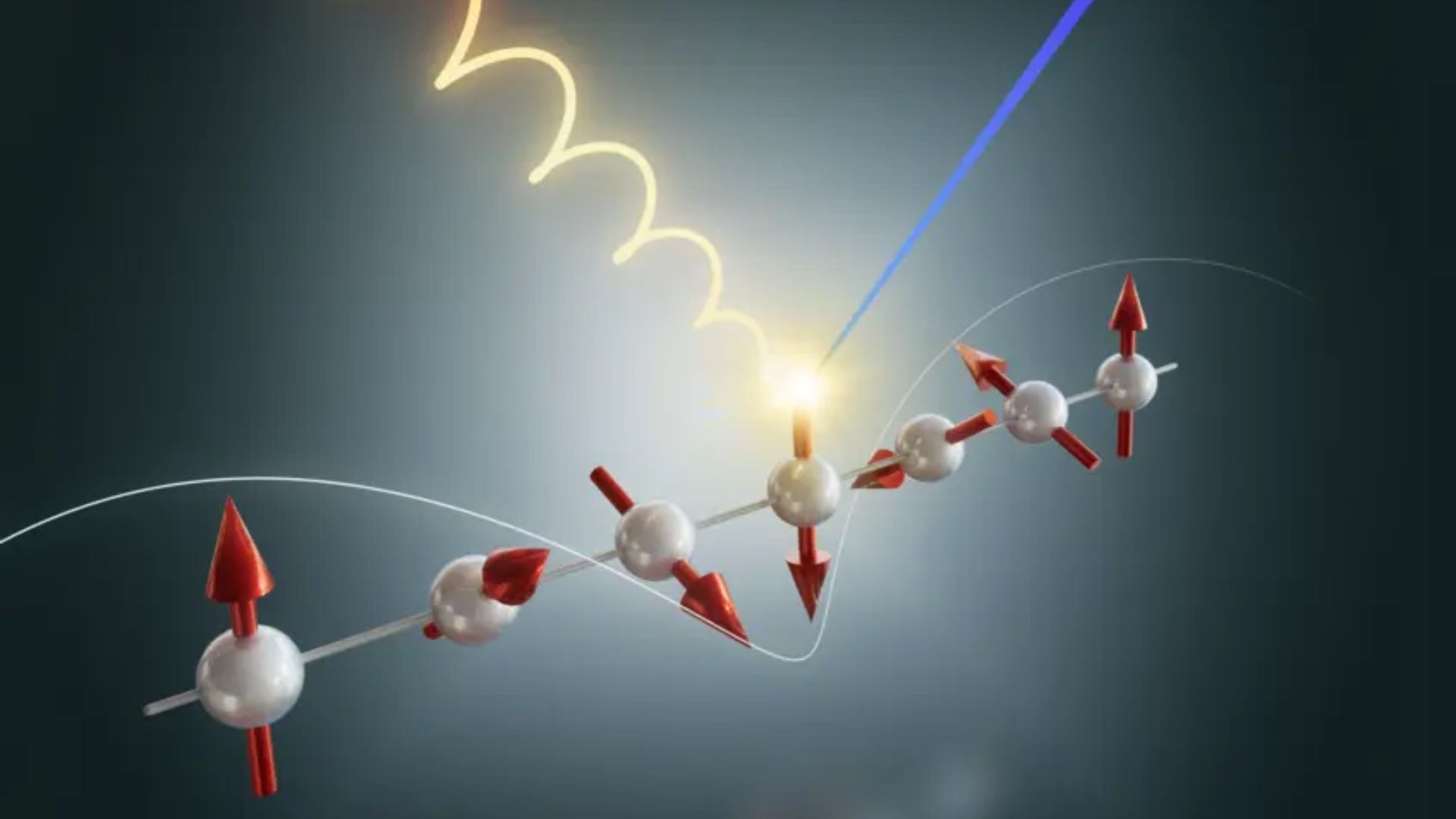
An international collaboration of researchers from 19 institutions across the world has found experimental evidence for p-wave magnetism in a chemically simple metallic compound, europium silicide (EuSi). This could help researchers further explore how chirality and magnetic symmetry influence electronic properties and could open new areas of technology from spintronics to superconductivity. In a conventional ferromagnet, the electron spins align in the the same direction, which produces magnetization. P-wave magnetism is different since atomic spins arrange into a spiral or helical pattern, resulting in no magnetization. However, if the electron spins are split by the direction of motion, then it generates a p-wave magnetic pattern. In the p-wave state, electrons moving in opposite directions have opposite spin polarizations. This relationship between electron momentum and spin is called an odd-parity spin texture. The challenge of p-wave magnetism has been to find suitable materials with these properties. Previous attempts to understand this phenomenon included candidates with very low magnetic ordering temperatures or complicated symmetry. Why is EuSi special? EuSi can be grown as single crystals of high quality made from stoichiometric metal. This makes it ideal for systematic experiments. “What makes EuSi particularly exciting is that an unconventional electronic spin structure emerges from the magnetic order of a chemically simple metal,” said Claudia Felser, director at MPI CPfS. Erjian Cheng, a researcher at the MPI CPfS in Dresden, Germany, grew high-quality crystals of EuSi around three years ago. Preliminary research on these crystals showed a strong influence of the magnetic order on their electronic band structure. “That observation led us to investigate whether this simple compound could host a much more unusual magnetic state,” explained Cheng in a press release. The researchers wondered if EuSi hosted an unconventional magnetic state and probed this further using neutron-scattering and spin-resolved spectroscopy. How did scientists spot it? The team found that at temperatures between 33 and 62 Kelvin (-240 degrees Celsius and -211 degrees Celsius), magnetic moments of Europium atoms formed an ordered spiral. While these spins are substantial, they cancel each other, resulting in no net magnetization. In their p-wave state, the electrons moving in opposite directions had opposite spin polarizations. Spin-resolved photoemission spectroscopy showed a characteristic sign change in electron spin polarization in regions where the p-wave spin texture vanishes, thereby indicating a p-wave magnetic state. Even though the crystal structure of EuSi is centrosymmetric or symmetric around a central point, the spiral arrangement of magnetic spins can give it a magnetic state of opposite handedness. “This demonstrates how the discovery of new materials can reveal entirely new electronic phenomena. EuSi now gives us an experimental platform to investigate how magnetic symmetry and chirality can be used to control electronic properties,” added Felser in the press release. Theory suggests that p-wave magnets made from metals show strong current-induced responses, unconventional superconducting states and spin-polarized electronic transport without an external magnetic field. Even though scientists have not yet attempted to demonstrate these effects in EuSi, the availability of the material makes it possible to verify the theory through laboratory experiments. It also shows that the properties of quantum materials is not defined by the chemical composition or structure but also by their symmetry and magnetic order. The research findings were published in the journal Nature. Get the latest in engineering, tech, space & science - delivered daily to your inbox.Ameya is a science writer based in Hyderabad, India. A Molecular Biologist at heart, he traded the micropipette to write about science during the pandemic and does not want to go back. He likes to write about genetics, microbes, technology, and public policy.
Elusive p-wave magnetic state observed in simple metal, could advance quantum tech
Full Article
Original Source
Read the full article at Interestingengineering →KhanList aggregates and links to publicly available news content. We do not host full articles from third-party sources. Always verify important information with original sources.