
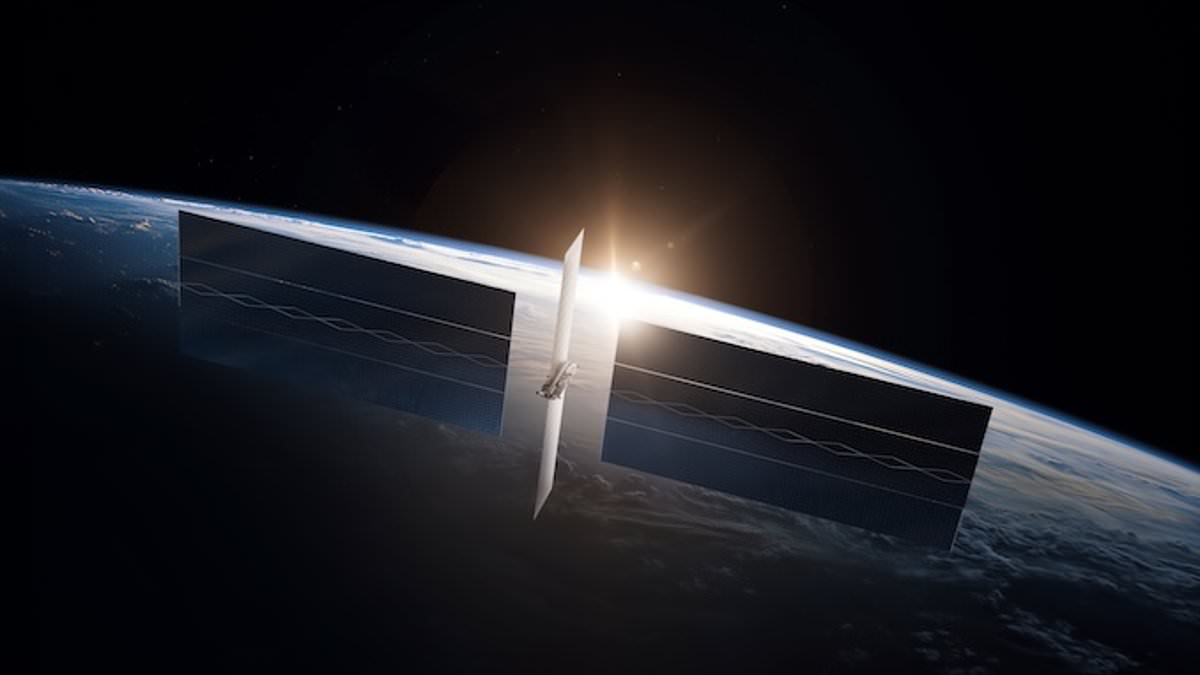
The Trump administration has authorised SpaceX to launch up to one million satellites as part of its plan to build data centres in space.The US Federal Communications Commission (FCC) said SpaceX's Starmind constellation would 'process massive amounts of data to be used back here on Earth'.'America is leading the world into the era of super intelligence,' FCC Chairman Brendan Carr said in a statement, using Trump's moniker for artificial intelligence.He added that data centers would be 'essential to sustaining America's leadership in SI'.However, scientists have warned that data centres in space could be 'catastrophic' for the planet. 'Allowing a million orbiting data centers with no environmental review isn't just irresponsible — it's reckless,' Tim Whitehouse, executive director of Public Employees for Environmental Responsibility, previously warned.'The potential for these projects to degrade the atmosphere with pollution and debris and harm wildlife needs to be carefully considered before licensing these projects.' The Trump administration has authorised SpaceX to launch up to one million satellites as part of its plan to build data centers in space The US Federal Communications Commission (FCC) said SpaceX's Starmind constellation would 'process massive amounts of data to be used back here on Earth'Projects for orbiting data centres have multiplied over the past year.Alongside SpaceX and its Starmind constellation, Google is pursuing its own initiative under the codename 'Suncatcher', while Jeff Bezos's Blue Origin has submitted an application to the FCC for its 'Project Sunrise'.Several startups are also in the race, including Starcloud, which successfully operated an advanced processor known as a GPU aboard a satellite in late 2025. Google also reached that milestone in October.SpaceX has the advantage of having its own rockets that have already completed hundreds of missions.In August, Musk promised a first SpaceX satellite launch into orbit in the fourth quarter of 2027 and a ramp-up in 2028.The company has struck a deal with Nvidia, which will supply its latest-generation Vera Rubin processors, specially designed to operate in space.Most space-based data centre projects have a similar architecture: a constellation of satellites in low Earth orbit, positioned close together to ensure reliable connections between them.Starmind's satellites will communicate with those already in orbit as part of SpaceX's Starlink satellite internet network, which will then relay the data to Earth.Other competing networks plan to receive data directly from Earth and send it back using lasers.But experts have warned of technical obstacles, as well as environmental concerns. Proponents claim there are several advantages to space data centres – including free, limitless power from the sun, and cheap operating costs (stock image) Unresolved technical challenges include processors' ability to withstand the high levels of radiation in space.Observers also point to the difficulty of withstanding extreme temperatures or avoiding damage from space debris and micrometeorites.The American Astronomical Society (AAS) said it was 'disheartened and dismayed' by the FCC's decision.'The proposed constellation would significantly undermine decades of federal investment in astronomical facilities and the ability of astronomers and the public to enjoy and study the night sky,' the AAS said in a statement.It noted that the constellation 'involves larger (and therefore brighter) and more numerous objects', meaning the satellites would 'be visible as extremely bright objects for longer periods in the night sky'.'Drastically expanding satellites in space has a direct impact on people's everyday lives as well as the future of our planet,' Jan Hasselman, a senior attorney at the nonprofit group Earthjustice, said in a statement.There are, however, numerous advantages to locating a data centre in space over building one on Earth.Among those, a satellite in what is known as a sun-synchronous orbit can capture solar energy continuously and with eight times the efficiency of its ground-based equivalent.WHAT IS SPACE JUNK? MORE THAN 170 MILLION PIECES OF DEAD SATELLITES, SPENT ROCKETS AND FLAKES OF PAINT POSE 'THREAT' TO SPACE INDUSTRYThere are an estimated 170 million pieces of so-called 'space junk' - left behind after missions that can be as big as spent rocket stages or as small as paint flakes - in orbit alongside some US$700 billion (£555bn) of space infrastructure.But only 27,000 are tracked, and with the fragments able to travel at speeds above 16,777 mph (27,000kmh), even tiny pieces could seriously damage or destroy satellites.However, traditional gripping methods don't work in space, as suction cups do not function in a vacuum and temperatures are too cold for substances like tape and glue.Grippers based around magnets are useless because most of the debris in orbit around Earth is not magnetic.Around 500,000 pieces of human-made debris (artist's impression) currently orbit our planet, made up of disused satellites, bits of spacecraft and spent rocketsMost proposed solutions, including debris harpoons, either require or cause forceful interaction with the debris, which could push those objects in unintended, unpredictable directions.Scientists point to two events that have badly worsened the problem of space junk.The first was in February 2009, when an Iridium telecoms satellite and Kosmos-2251, a Russian military satellite, accidentally collided.The second was in January 2007, when China tested an anti-satellite weapon on an old Fengyun weather satellite.Experts also pointed to two sites that have become worryingly cluttered.One is low Earth orbit which is used by satnav satellites, the ISS, China's manned missions and the Hubble telescope, among others.The other is in geostationary orbit, and is used by communications, weather and surveillance satellites that must maintain a fixed position relative to Earth.
Elon Musk is building a data centre in SPACE: Trump approves SpaceX to launch one million satellites - but experts warn they could be 'catastrophic' for the planet
Full Article
Original Source
Read the full article at Dailymail →KhanList aggregates and links to publicly available news content. We do not host full articles from third-party sources. Always verify important information with original sources.