
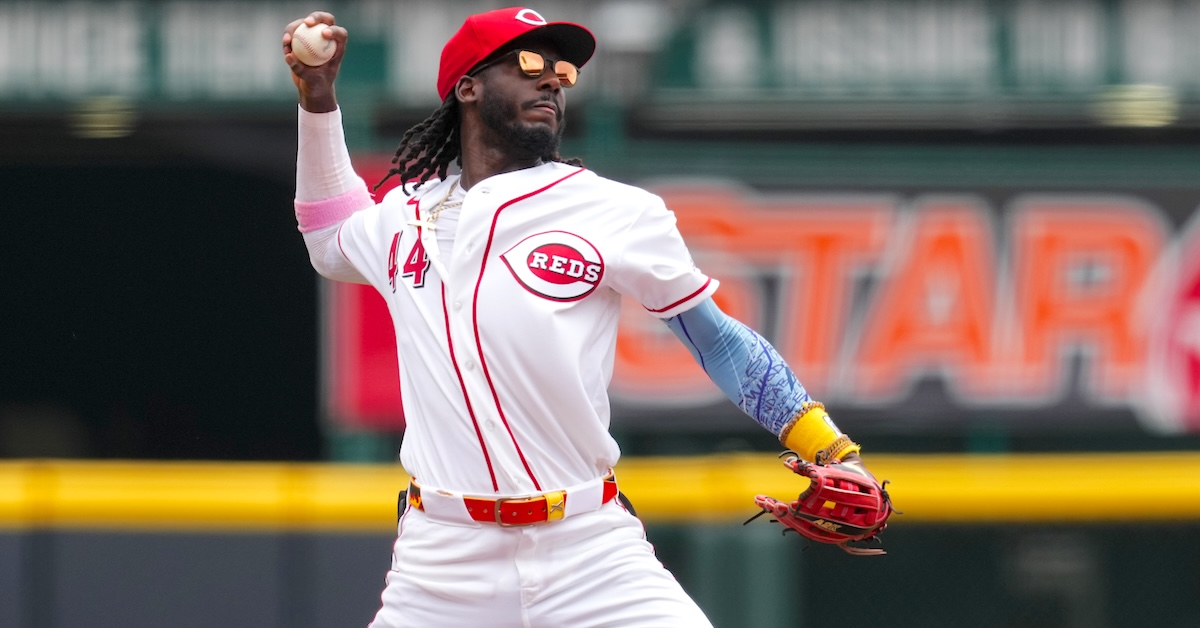
Aaron Doster-Imagn Images Right around this time last year, I wrote an article about Elly De La Cruz’s arm. It’s a fantastic arm, long and powerful, and right off the bat this article is getting weirder than I intended. Sorry. This long, powerful arm has its drawbacks. Since De La Cruz debuted in 2023, it has been the source of 39 throwing errors, tied for the second most in baseball. I was writing about all those errors last year because I had a theory that maybe De La Cruz’s arm wasn’t as bad as the numbers made him look. Learning from other conspiracy theories, I figured that starting with a YouTube video might help my cause gain traction: “You see what I’m getting at, right?” I wrote. These throws don’t look that bad. De La Cruz throws the ball so hard that first basemen don’t have enough time to react. They’re getting handcuffed over and over again. None of these throws is perfect, but they’re not all that far off target either. Six of the seven hit leather. Were they thrown by a shortstop with a lesser arm, at something a bit further below the speed of light, the first baseman might have picked them cleanly. Instead, they went uncaught. De La Cruz is getting dinged for errors on balls that aren’t all that far off target, and maybe that’s a little bit unfair. In order to test my theory, I watched every single error De La Cruz made, not just the throwing errors. And there were a lot to choose from. He may be tied for second in baseball in throwing errors since his debut, but his 47 fielding errors put him in first place by a wide margin and make him the overall error king of the mid-2020s. However, as we all know, errors are not the best way to measure defensive prowess. According to Statcast, De La Cruz grades out as the 13th-best shortstop in baseball since his debut. He’s long and quick. In part, the reason he makes so many errors is that he gets to balls other shortstops aren’t fast enough to reach, which gives him more opportunities to boot them, and he attempts throws that other shortstops don’t have the arm strength to bother with, which gives him more opportunities to throw the ball into the stands. That’s a great way to get dinged by the official scorers, and even the trained video techs who do the grading for DRS, which hates De La Cruz with the white-hot intensity of a supernova. The impassive Statcast cameras think De La Cruz is great, though, and DRP thinks he’s below average, but not all that far from it. “In order to take full advantage of De La Cruz’s gifts,” I wrote, “the Reds just need to make sure they get a great defender at first base, one who majored in scoops. Such a first baseman could easily make De La Cruz’s rocket arm even more of an asset.” After writing all that, though, I acknowledged that my theory was probably wrong, because when I watched all those errors, I found that he also made lots of high throws that looked truly uncatchable. But I also made one other important caveat: So that was my thinking. An average shortstop throws a certain percentage of balls in the dirt, and an average first baseman scoops them a certain percentage of the time. I can’t say for certain whether De La Cruz throws more balls in the dirt or gets fewer scoops than the average shortstop. In order to do so, I’d have to watch thousands of throws and take meticulous notes, and while readers of this site know that is absolutely the kind of thing that I would normally do, it’s not how I wanted to spend Thanksgiving. Well, this Thanksgiving, I don’t have to watch thousands of throws. The soulless Statcast cameras don’t celebrate Thanksgiving because they have no concept of gratitude. They’ve already watched all the throws for me. Baseball Savant’s new first base receiving leaderboard has helpfully separated the throws into buckets. It’s calculated their average expected out rate. It’s even provided fun wireframe graphics that answer the question we’ve all been asking ourselves: Is it possible to make a throw so bad that your first baseman metamorphoses into a tiny bug? This data goes back to 2021, and in that time, no fielder has been hurt by his first basemen as much as De La Cruz. The receiving woes of Cincinnati’s first basemen have cost him 12 outs, and no other player has lost more than 10. In fact, only four other players have lost more than six outs. De La Cruz is a wild outlier here, and that’s before you remember that he only debuted in 2023, so the other infielders have had a lot more time to get doinked by their respective first basemen. If you look only at the past four years, De La Cruz’s -12 mark is not just the worst in baseball, it’s twice as bad as all but one other infielder! It’s more than twice as bad as every other shortstop. I will say that again. Since 2023, Elly De La Cruz’s first basemen have lost -12 OAA while fielding his throws. The next worst shortstop is Trea Turner at -5 OAA. De La Cruz is getting jobbed! He’s getting robbed! His hose is getting hosed! Please allow my to share my favorite line reading from Brooklyn Nine-Nine: Over the past four years, 37 shortstops have made at least 200 tracked throws to first base. Among them, De La Cruz’s 80% on-target rate ranks 13th. He’s been on target more than the average shortstop! That said, his 93% expected out rate ranks 29th. To me, that says that although he’s on target more often than most shortstops, when he misses he misses really badly. But these numbers aren’t really about either of those situations. Statcast is calculating average expected out rate for a reason. It’s analyzing each throw, looking at how likely each ball is to be caught. Wild throws with no chance of getting caught and perfect throws with a near-perfect chance of getting caught aren’t necessarily the ones moving the needle, because they’re playing out as expected. It’s about all the throws in between, and for four years now, De La Cruz’s throws are getting caught less than expected. Over the past four years, Statcast says that 22 different first basemen have received at least one throw for the Reds. Just two of them have a receiving OAA above zero, while seven are below zero. You might also notice that a lot of these first basemen are shorties. Over the past four years, the 5-foot-9 Spencer Steer has received twice as many balls as any other first baseman for the Reds. The 6-foot-2 Joey Votto ranks fifth in terms of balls received, and he’s the only player in the top six who’s above 6-foot-1 (and he also conveniently retired before they remeasured everybody’s height for the ABS challenge system). The 6-foot-1 Sal Stewart may have taken Rookie of the Year honors, but he also graded out pretty badly at receiving. Remember all those errors on high throws in the video? The ones that made me think maybe my theory was all wrong last year? Over the past four years, 37 players have made at least 200 tracked throws at shortstop. Among them, De La Cruz’s 5.7% high-throw rate ranks 15th. He throws high a bit more than the average shortstop, but not by much. All the same, he’s lost 2.3 OAA on high throws, second worst among shortstops. Remember all those low throws I showed you at the beginning, the ones that started this theory in the first place? It turns out that on low throws, Cincinnati’s first basemen have -4.8 OAA when De La Cruz is throwing. That’s the worst mark for any infielder by a wide margin. Among shortstops, Anthony Volpe’s is second worst at -2.4. That is to say, that there’s only one other shortstop for whom first basemen have been even half as bad at fielding low throws. And here I’ll remind you that Statcast differentiates between low throws and scoops. So these aren’t the really difficult scoops. They’re throws that don’t quite touch the ground or bounce close enough to the bag to be easily scoopable. They get caught 86% of the time. De La Cruz’s catch rate on low throws is 69%, second lowest among his shortstop peers. To be clear, I still think some of this is De La Cruz’s fault. The explainers Mike Petriello and Tom Tango wrote don’t indicate that the velocity of the throw is included in the calculations. As we know, one of the problems is that De La Cruz throws the ball so hard that first basemen are often handcuffed by the limited reaction time. If you remove shortstop and look only at throws from second basemen and third basemen, then Cincinnati’s first basemen grade out perfectly average over the past four years. There’s some variation, of course. They grade out as above average at second base, thanks to the fact that Matt McLain has one of the most accurate arms in the game, but they’re well below average at third base. I’m not saying that De La Cruz’s arm deserves to be considered accurate. Even if we gave him credit for those -12 receiving OAA by knocking 12 throwing errors off his total, he’d still have the seventh most in baseball over the past four years. But I stand by the assessment I made last year even more resolutely. More than any player in baseball, De La Cruz could benefit from having a first baseman who’s a great receiver. He can make throws that other shortstops don’t even attempt, and a good first baseman would make sure he’s rewarded for that. Instead, Cincinnati’s first basemen are making his arm look worse than it is.
Elly De La Cruz Is Less Unscoopable Than Previously Thought
Full Article
Original Source
Read the full article at Blogs →KhanList aggregates and links to publicly available news content. We do not host full articles from third-party sources. Always verify important information with original sources.