
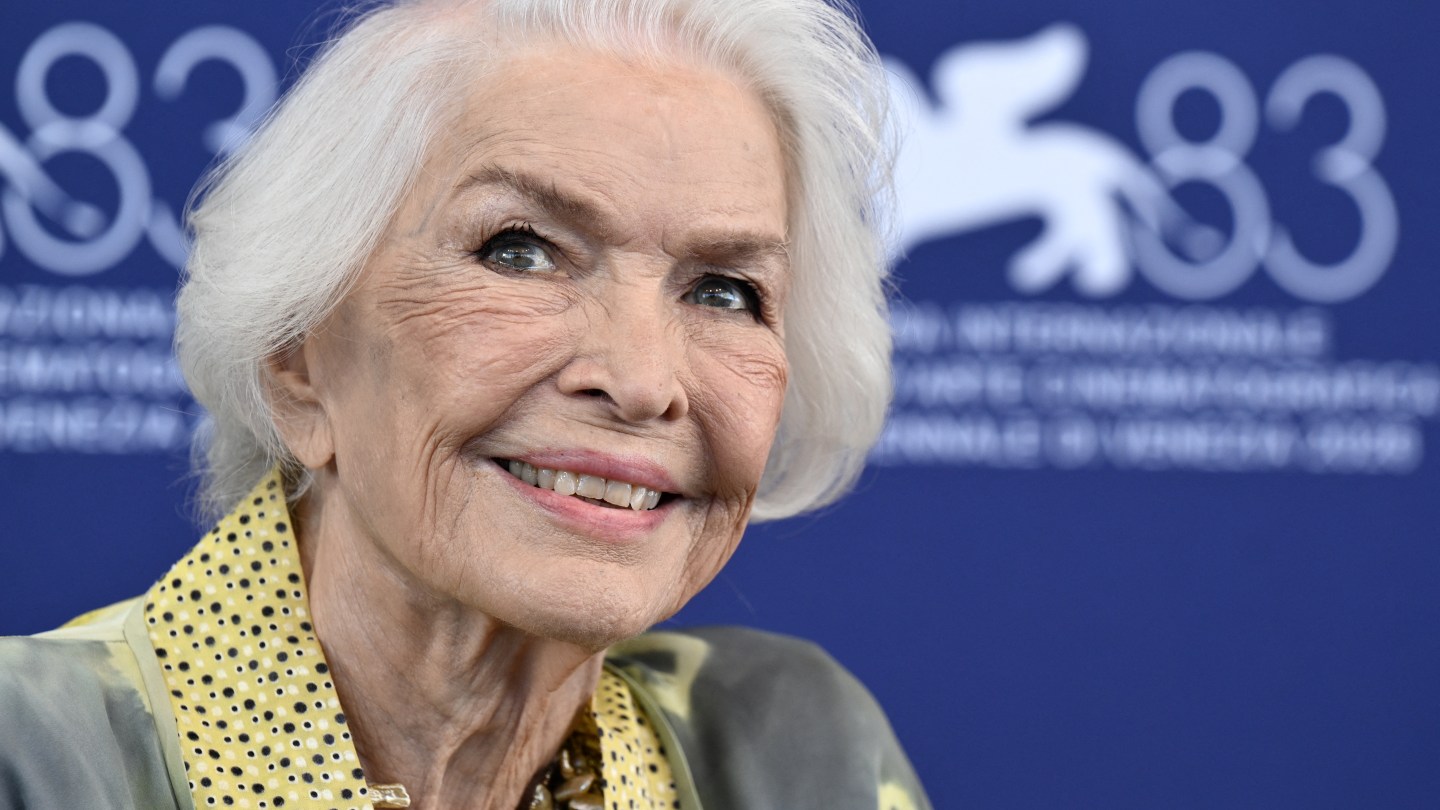
Ellen Burstyn never met Marilyn Monroe. Not properly, anyway. By the time she walked through the doors of the Actors Studio in New York, Monroe was already dead. But the two women did see each other once, across a nightclub table, and Burstyn has been carrying the moment around for the better part of six decades. “I was enchanted just looking at her. She was such a magical creature,” Burstyn recalled, speaking to reporters at the Venice Film Festival, where she is presenting two films this year and will receive an honorary Golden Lion for lifetime achievement at a ceremony this evening. “And then she looked at me and nodded at me. I was very early in my career, and I thought: I’ve just been recognized by Marilyn Monroe. I carried that in my heart.” Burstyn plays a version of Monroe, an imagined projection as if the legendary actress had lived into her 90s, in Flesh Impact, a new short film from director Maggie Gyllenhaal (The Bride!). Dakota Johnson plays the younger Monroe in flashbacks. She also appears in Kornél Mundruczó’s drama Place to Be, which screens out of competition in Venice, as an elderly woman who strikes up an unlikely friendship with a middle-aged divorced man (played by Taika Waititi). “He’s the most talented, funny, nice, charming, adorable human being I’ve ever worked with,” said Burstyn. “The movie is about our relationship, and of course he’s a young man compared to me, and I’m much older, so it’s not a sexual relationship, but it is a love relationship [and] that’s what I think people are going to respond to.” Asked how the role of women in Hollywood has changed since she started out, the actress didn’t hesitate: “Oh my goodness. Enormously.” “When I first started working, which was 150 years ago,” the 93-year-old added, drawing a laugh, “there were no women on the set. There were no women in the crew. Nobody. It was all men. If a woman was on the set, then she was an actress.” The change, she said, came slowly and incrementally, one job at a time: first a script supervisor, then a camera assistant, then more. “Slowly that changed, until finally it’s gotten to the point where women are handling heavy equipment without even thinking about it, and they’re integrated into the crew.” The roles themselves took longer, and Burstyn had a hand in forcing that particular door open. The origin story of Alice Doesn’t Live Here Anymore, the 1974 road movie that won her the Academy Award for best actress, begins on the set of The Exorcist. John Calley, then running Warner Bros., called her agent and said the studio wanted to make another film with her. The scripts started arriving. “Every one of them was this old-fashioned idea of what women represent,” she said. “I didn’t recognize any of the characters as anything like the women I knew, or myself. Their husbands would go out and save the world, and when they came home, the women would hand them a cup of tea. It was that kind of supportive role.” So she made a counteroffer. “I said, ‘Well, I’d like to make a film about women as I know women to be.'” For a director, she picked “an unknown director” with a single feature to his name: Martin Scorsese. His working method, she said, shaped the film as much as the screenplay did. At the end of each shooting day, the company would rehearse the following day’s scene — and improvise through it. “That script grew into a film that I think is credited with helping to change the consciousness of women worldwide.” The Exorcist, by contrast, she described as both transformative and brutal. William Friedkin was “an extremely talented director,” she said, “but he was also one of those directors who would do anything to get a shot” — including, in her case, a back injury she says she should never have sustained. “It was a life-changing experience, but it was painful physically.” Asked about the through-line in her memoir — the way her discovery of herself as an actress ran parallel to her discovery of herself as a woman — Burstyn credited her decades studying with Lee Strasberg at the Actors’ Studio. “When you study with a master, it changes your life,” she said. “It changes who you are to yourself, because it brings you into areas not only of your art but of your own being and your own understanding. And it changes what you do forever.” The work never stopped, either. Even after winning the Oscar [for Alice Doesn’t Live Here Anymore], and after Strasberg had put her in front of a classroom to teach, she was still turning up as a student. “I was still working for him,” she said, “bringing in scenes, bringing in difficult things.” The octogenarian mainly avoided politics during the talk, with only a side mention that “my country right now is providing a lot of material to be explored artistically and politically.” Asked if she had any advice for younger actresses coming up, Burstyn recounted her own encounter, early in her career, with a screen legend of her youth. “I met Bette Davis. She said, ‘the only thing that’s important is your work. Anybody tries to get in the way of you and your work. They’re your enemy’,” Burstyn recalled. “So that was my advice from the older generation.”
Ellen Burstyn on Being “Recognized” by Marilyn Monroe, Changing Roles for Women With ‘Alice Doesn’t Live Here Anymore’
Full Article
Original Source
Read the full article at Hollywoodreporter →KhanList aggregates and links to publicly available news content. We do not host full articles from third-party sources. Always verify important information with original sources.