
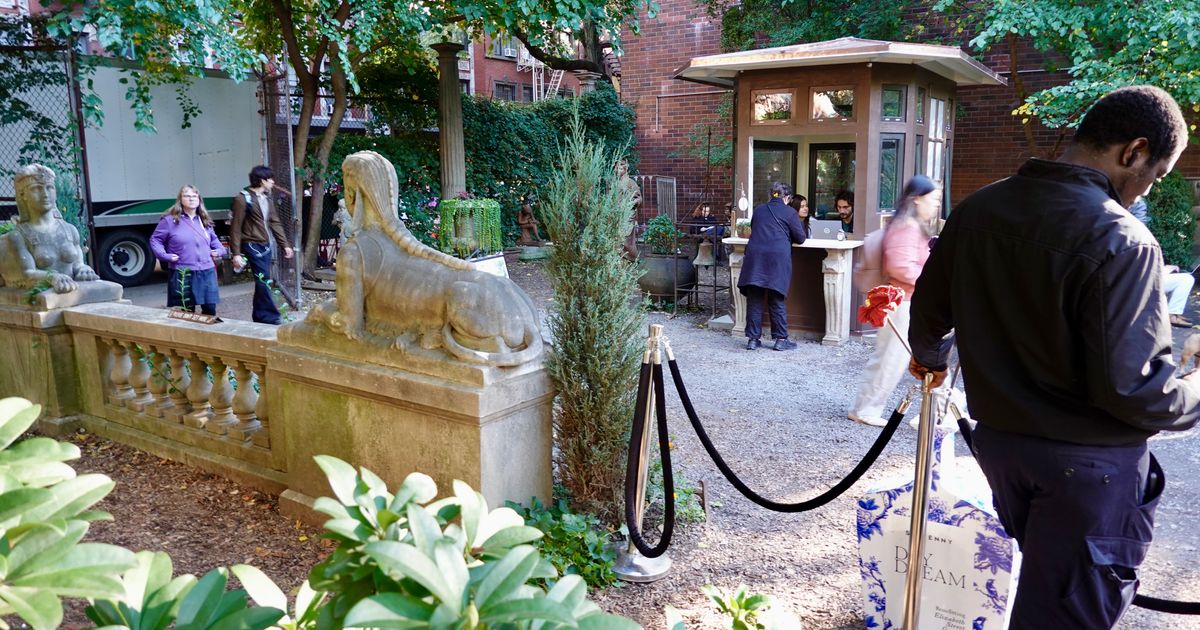
Elizabeth Street Garden Is a City Park Now. But It’s Not Acting Like One. By , an Emmy Award–winning Curbed writer who has reported on New York City for four years A velvet rope cordons off the public from a marketing event at Elizabeth Street Garden. Photo: Adriane Quinlan On a crisp fall afternoon at the Elizabeth Street Garden, five security guards in black stood along a velvet rope that cordoned off a section of the park, just off the main gate. Inside, a fashionably dressed crowd — including the model Aly Kima, HGTV host Maddie Scalzi, and the fashion writer Jalil Johnson — were sipping mocktails and plumping the cushions of sectional sofas squeezed between the plantings and statuary. This was a marketing event for Sixpenny, whose influencer-approved sofas have become somewhat ubiquitous on social media; the afternoon installation was aimed at drumming up press for a new line of slipcovers. CEO Robert Natale cut through the crowd in Gucci loafers and a white double-breasted jacket. He had rented the space because he used to take his lunch breaks here and thought it “perfectly on brand,” he told me. ”There’s a beautiful element of serenity when you walk into a garden like this … that feeling of relief when you sit down on a really comfy sofa.” Sixpenny CEO Robert Natale crouches down to speak with guests. Photo: Adriane Quinlan Natale didn’t say how much he paid to rent the place — “it’s, like, a lot” is all he would admit. He had given the funds to a nonprofit that now runs the park after volunteers spent more than a decade fighting to save it from being taken over by a planned affordable-housing project. Its status as a public park was cemented late last year, when then-Mayor Eric Adams made a last-minute play to save the garden, designating it as parkland. A formal agreement signed by the Parks Department and the nonprofit Elizabeth Street Garden, Inc., in December granted it a ten-year license to maintain and operate the space. The terms are fairly simple, requiring the group to be accessible and transparent; the nonprofit agreed to keep hours “consistent with public parks in the City,” to submit plans for any events to the city for review and approval ahead of time, and to share monthly reports on the money it earned and spent. With no special loopholes for sofa-related marketing events, it seemed the Sixpenny one would have required a permit. But the city hadn’t been notified of it and couldn’t share how much money Sixpenny paid. It didn’t get an operations report from the group in October, which means it also couldn’t share how much an earlier Carnival-themed fundraiser had generated the week before the couches arrived. A couch advertising one of the new slipcover colors from Sixpenny. Photo: Matthew Kappas A guard next to the garden’s main entrance. Photo: Adriane Quinlan Neither City Hall nor the Parks Department responded to a request asking if Elizabeth Street Garden, Inc., had ever filed the required reports or requested permission to hold an event. And neither did board members of the nonprofit, including chair Renee Green and executive director Joseph Reiver. The group’s lawyer, Norman Siegel, also had no response by press time. The organization clearly knew the terms it had signed; in an affidavit that Reiver shared under oath with the Supreme Court this year, he wrote that he “entered into a license agreement with the Parks department” and “has been operating the Garden as a City park since the license was granted.” There’s also the matter of the unkept promise to extend park hours — in winter, it’s open only between 10 a.m. and 4 p.m., the hours of a Champagne brunch or a freelancer who can work from anywhere. In comparison, the playground around the corner is open from 7 a.m. to 6 p.m., and the closest city park, Sara D. Roosevelt, has even more extended hours. The reality of how the park is operating is maddening to at least one group that advocated for building affordable housing on the site. “New York gave up 123 affordable homes for low-income seniors on this site in exchange for a promise that the garden would operate as a public park,” wrote Open New York director Annemarie Gray in a statement. “Less than a year into that agreement, the group running it has reportedly failed to file its required financial reports and closed off part of the space during public hours so a luxury furniture brand could stage a photo shoot for influencers. Seniors on fixed incomes lost homes here so that one of the wealthiest neighborhoods in Manhattan could keep a garden run by and for the wealthy people who live around it.” Still, the garden has been in limbo for so long that it’s not entirely surprising that it’s ignoring a city agreement. For most of the year, it waited on the Mamdani administration to choose between proceeding with the housing plan or settling with developers. The nonprofit may also have a pressing need to raise money; it’s on the hook to maintain and operate the garden but doesn’t receive public money to do that. And there may be even bigger bills in the background. A panel of judges last year upheld a decision that found the garden was still on the hook for the rent it stopped paying the city in 2018, which amounted to a total of around $95,000 in 2023 and has been accruing 9 percent annual interest since then. When the Adams administration announced the deal last year, Deputy Mayor Randy Mastro told the press the back rent was under discussion. It’s unclear if the current licensee is obliged to pay; the 2025 judgment was against Elizabeth Street, Inc., an entity founded in 1990 by the owner of the gallery next door, Allan Reiver, who died in 2021, and not against Elizabeth Street Garden, Inc., the entity that signed the city agreement. Regardless, public filings show the charity has been hemorrhaging cash — losing $52,955 in 2024 and $115,528 in 2025. It would be in the red if not for its $1 million in assets described as “architectural elements that are works of art and have historic value”: in other words, the benches and statues its donors want to protect, not sell off. During the pop-up, a young woman came into the park with a pizza box and looked miffed to see the velvet ropes. Jade told me she’d wanted to go sit on the couches, but they were only for guests invited to the marketing event, so she eventually found a spot near the back of the park where a man named Louis overheard our conversation. He’s a commercial video director who lives nearby and was journaling with a Mont Blanc pen. He said he didn’t mind the pop-up and wouldn’t mind two or three a month if it kept the park going. And he wouldn’t even mind, he said, if the park was entirely private, like a club. “If they charged an entry fee, I’d pay,” he said. A $4,299 daybed in a new color offering, “Fountain Head,” advertised in the public park. Photo: Matthew Kappas Elizabeth Street Garden Is Not Acting Like a City Park Your product is saved! You’ll receive emails when your saved products go on sale. Manage preferences.
Elizabeth Street Garden Is a City Park Now. But It’s Not Acting Like One.
Full Article
Original Source
Read the full article at Curbed →KhanList aggregates and links to publicly available news content. We do not host full articles from third-party sources. Always verify important information with original sources.