
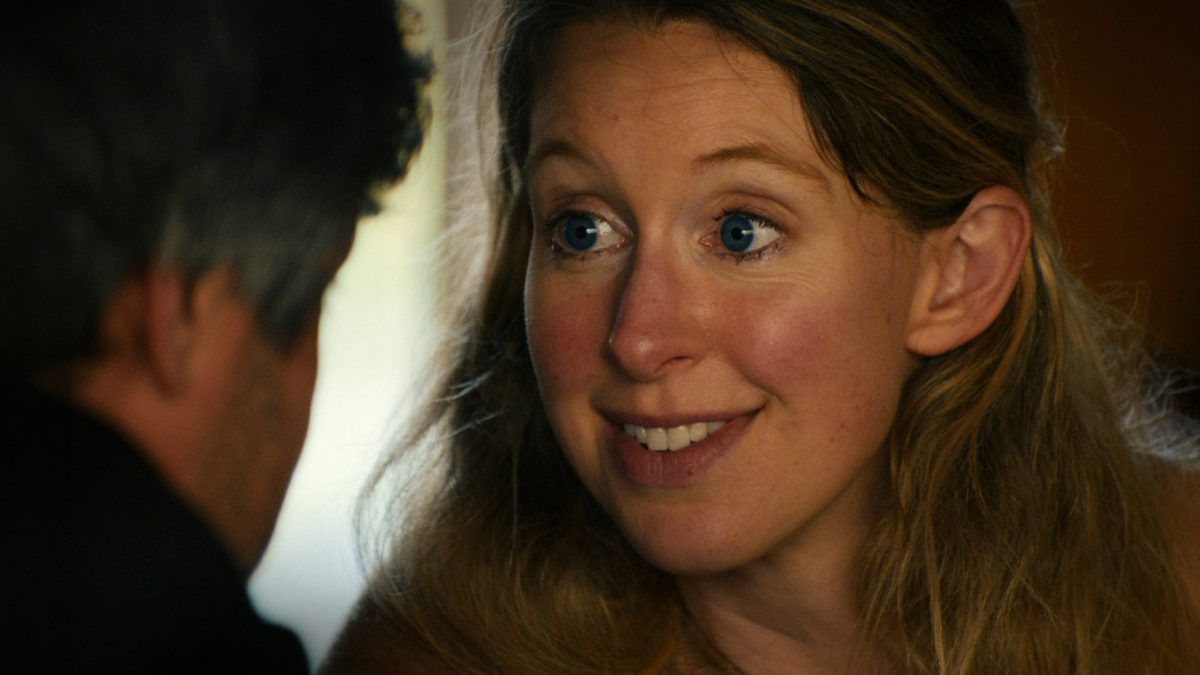
This September, delegates at Colorado’s Telluride Film Festival were invited to a secret screening. As 650 intrigued cinephiles piled into the Werner Herzog Theatre, constructed inside an ice rink every year, every single one had their phone confiscated. They had no idea what they were about to watch. Nearly three hours later, they were stunned, and possibly none the wiser. On the same day, New York’s coolest independent film distributor, A24, released a trailer on YouTube. It featured Elizabeth Holmes – the disgraced and incarcerated tech founder who defrauded investors in her blood-testing start-up Theranos, because the device that made the company worth $9bn didn’t work – directing her long, unblinking gaze into the eyes of the frustrated magician and comedian Nathan Fielder, who stared back at her with a headset around his neck. “Why would I deceive you?” she asked blankly, head wobbling slightly, eyebrows skywards, accompanied by a sinister, Hitchcockian score, the sounds of the Pacific lapping at the beach outside and the occasional gurgle of the baby she was rocking with her foot. “There’s no reason for me to do that.” Those 77 seconds sent the internet and film industry into a frenzy. You Can See Everything is a documentary no one saw coming, unlike any made before, and has become the unlikely film of the year. Its acclaim is universal, screenings have been selling out weeks ahead of release, and it might be the first documentary nominated for the Best Picture Oscar – I can’t think of any hype that matches it.Its very concept is bizarre: Holmes, who has said little publicly since her exposure in 2015, her indictment in 2018 and her conviction in 2022, and her husband Billy Evans – we’ll get to him later – invite a film crew into their home to document the month before she goes to a Texas prison for 123 months. The film the couple solicited is a bid to “control the narrative”, long wrested by journalists, critics and even screenwriters, per the Amanda Seyfried-fronted Apple TV series The Dropout. They have “nothing to hide”, just wanting to tell their “human” story, to rebrand Holmes as a gentle wife and mother after nearly a decade subject to derision and caricature as a Silicon Valley wunderkind, with her Steve Jobs polo necks, straw-brittle hair and affected deep voice, and subsequently as the most extreme of the female “scammers”. To do this, they enlisted not a traditional journalist but Fielder, the creator of the reality-ish series Nathan for You and The Rehearsal, known for his deadpan, awkwardness and drastic immersion in his work, as he blurred the lines between fact and fiction. He, along with his co-director Lance Oppenheim and their crew, move in with the family; he lurks in corners as they talk and eat dinner, he listens in on them in their bedroom, he follows her husband to the gym and into the shower. It is, frankly, totally mad – much of its entertainment lies simply in observing how three weirdos interact with each other – as well as engrossing and beautifully shot and funny and scary. The longer it goes on, the more you find yourself examining the extent to which anyone can ever be believed, whether the meaning of truth itself can really differ from person to person. Co-directors Nathan Fielder, right, and Lance Oppenheim (Photo: JC Olivera/Getty) For Fielder, who agreed to the project with A24 on the condition that he could abandon it if he didn’t record anything useful, participation is not surprising. This is a unique opportunity to indulge curiosity, and he becomes obsessed, for years, with working out whether Holmes is “fully sincere” or “the most manipulative person who ever lived”. (Followers of Fielder’s work have wondered the same about him.) Both become harder to ascertain the closer he invariably grows to Holmes, and his own ethics about film-making are challenged. But for Holmes, the intention is even more perplexing. She insists she is innocent, that she has never lied, still claims that the device she once called “the most important thing humanity has ever built” works. (From what logic I can just about deduce, in her mind it will work at some unspecified point in the future, when chemistry and technology have made significant advances allowing it to work – a bit like how a time machine will work when someone will finally get around to that business of getting quantum mechanics to, well, allow time travel.) And she is, quite incredibly, seeking funding for a second biotech venture. Is she – and you ask yourself this many times – insane? What good could any of this exposure and shameless grifting possibly do for her reputation? Which is where things get even messier. Because somehow, unbelievably, I think I came away with a better impression of Holmes than the one I walked in with. This is a film of two halves. The first takes us right up to Holmes’s surrender in Texas, Fielder leaving the couple alone to have sex for the last time in a decade (no conjugal visits in federal prison) and Holmes’s voice breaking as she reminds her partner there is breast milk in the fridge. We see her moping around, feeding her newborn baby, swimming in the sea, running on the beach in a manner hitherto unattempted by anyone with legs, and despite her convincing act as a bright, strange girl (she is 42) who has been led astray and misunderstood, we are able to remind ourselves that someone accomplished enough to become the world’s youngest self-made female billionaire is more than capable of hoodwinking us that she is good and honest, as fascinating as it is to watch her try. But that gets a lot harder when she and her voice are removed. Once Holmes, in jeans and her favourite beige sweater, walks into Federal Prison Camp Bryan, it is up to Fielder to continue his study of truth and trust without her. Into the breach to help him do this in the second half – which I will keep vague to avoid spoiling – is Evans. His controlling manner was signposted early in the more domestic half of the film, by the number of times he spoke on Holmes’s behalf, his irritation at the crew and even at Holmes’s visiting parents and most of all by a telling scene in which he confiscates a bowl of eggs from Holmes because she cannot whisk them properly. Now, he becomes the villain. If Holmes was the archetypal Silicon Valley swindler who profited off the hopes of the sick and desperate, Evans, who creates an AI model of Holmes during her imprisonment (and thinks its body is better than hers), who posts idiotic tweets from her account without her permission, who idolises Charlie Kirk and carries a gun at all times, is the nadir of the radicalised tech bro. His coercion upstages his wife as the subject of her own movie – and comes very close to making her its victim. The question for Fielder, who has grown increasingly and uncomfortably protective of Holmes and torn about his responsibility as a film-maker, is: is she in on it? Is this all part of her act? ‘You Can See Everything’ is in cinemas now
Elizabeth Holmes is not the villain of You Can See Everything. That’s a problem
Full Article
Original Source
Read the full article at Inews →KhanList aggregates and links to publicly available news content. We do not host full articles from third-party sources. Always verify important information with original sources.